Hi, message us with any questions.
We're happy to help!





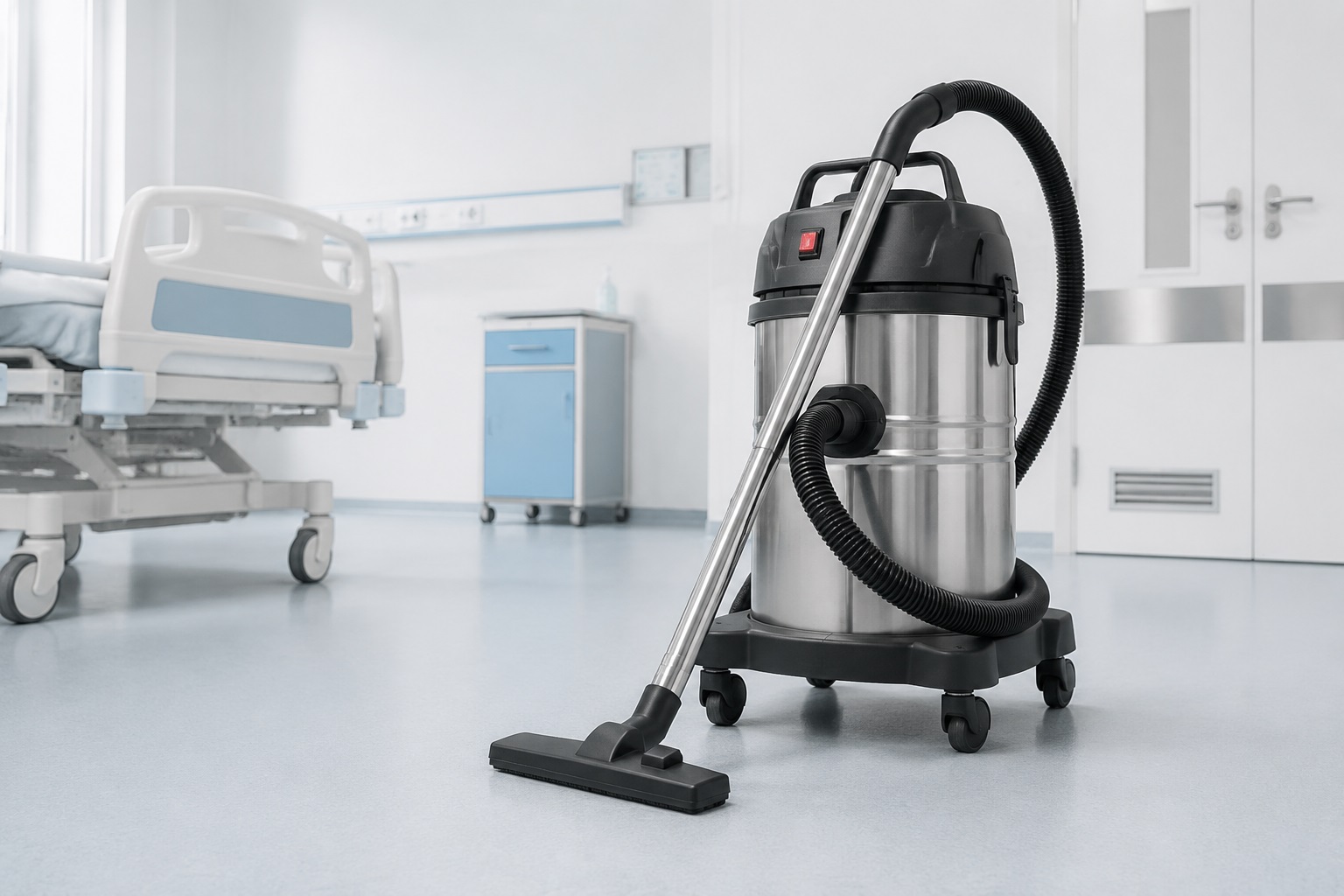
In today’s global healthcare ecosystem, cleaning is no longer a “support function”—it is a clinical risk control system directly tied to patient outcomes, regulatory compliance, and operational continuity. For European and US B2B buyers, hospital engineers, and procurement leaders, selecting the right vacuum infrastructure is increasingly a strategic decision rather than a commodity purchase.
This article breaks down how modern healthcare vacuum solutions are evolving into high-precision engineering systems designed for infection prevention, air quality control, and lifecycle cost optimization—far beyond traditional cleaning equipment thinking.
🧭 1. The Strategic Shift: From Cleaning Equipment to Infection-Control Infrastructure
For decades, vacuum systems in hospitals were treated as simple hospital cleaning equipment. That mindset is now obsolete.
Modern healthcare facilities operate under stricter hygiene standards, including airborne pathogen control, cross-contamination prevention, and regulatory pressure from CDC, ISO 14644, and EU hygiene directives. As a result, procurement teams are shifting toward system-level thinking:
Vacuum systems are now part of medical facility maintenance architecture
Cleaning is integrated into infection prevention protocols
Equipment must support continuous compliance, not just surface cleaning
The most important transformation is this:
Hospitals no longer buy vacuums. They buy contamination control systems.
This shift is driving demand for centralized, modular, and HEPA-integrated vacuum infrastructure that can support 24/7 operations.
🦠 2. Infection-Control Cleaning Requires Engineering Precision, Not Just Suction Power
In infection control cleaning, suction strength alone is not a performance indicator. In fact, excessive turbulence can increase airborne particle dispersion if filtration is inadequate.
Advanced healthcare environments require:
Negative pressure airflow control
Sealed containment pathways
Multi-stage filtration architecture
ISO-classified particulate separation
A modern system must ensure that contaminants are not only removed but also neutralized at filtration level, preventing re-circulation into hospital air systems.
Key engineering insight:
The real performance metric is not airflow volume—it is particle retention efficiency under continuous load.
This is where integrated HEPA vacuum systems become critical, particularly H13 and H14-rated filtration units capable of capturing sub-micron particles including bacterial and viral carriers attached to dust aerosols.
🧪 3. HEPA Vacuum Systems as the Core of Air Safety Architecture
The evolution of HEPA vacuum systems in healthcare is not just incremental—it is structural.
Modern systems are designed around three-layer filtration logic:
Primary cyclonic or bag filtration (bulk debris separation)
Secondary micro-particle filtration (dust and allergen control)
HEPA H13/H14 terminal filtration (biohazard containment)
What separates industrial-grade healthcare systems from commercial cleaners is certification under sustained airflow conditions, not just static lab tests.
Procurement teams should evaluate:
Real-world airflow degradation curves
Filter loading resistance over time
Seal integrity under negative pressure cycles
Micro-leakage rate in operational environments
A system that performs well on paper but fails under continuous hospital operation creates hidden infection risk.
🏗️ 4. Medical Facility Maintenance as a Lifecycle Engineering System
Traditional cleaning procurement focuses on unit price. Modern medical facility maintenance strategy focuses on total lifecycle efficiency.
A hospital vacuum system should be evaluated across a 5–10 year operational horizon:
Energy consumption per cleaning cycle
Filter replacement frequency and cost
Downtime during maintenance
Integration with central vacuum piping systems
Staff training requirements
Centralized vacuum systems are increasingly preferred in large hospitals because they:
Reduce airborne re-contamination risk
Minimize portable equipment handling
Improve cleaning workflow efficiency
Enable centralized maintenance scheduling
This lifecycle approach often reduces total cost of ownership by 20–35% compared to decentralized portable systems.
⚙️ 5. Procurement Framework: How B2B Buyers Should Evaluate Healthcare Vacuum Solutions
For European and US procurement managers, decision-making should move beyond brand comparison into engineering validation.
A structured evaluation model includes:
1. Airflow Stability Index
Does the system maintain suction performance under filter load?
2. Filtration Integrity Score
What is the verified HEPA leakage rate under operational conditions?
3. Contamination Containment Path
Is the debris path fully sealed from intake to disposal?
4. Maintenance Accessibility
Can filters be replaced without exposing staff to biohazards?
5. Integration Compatibility
Can the system connect with existing hospital infrastructure or IoT monitoring systems?
6. Compliance Alignment
Does the system meet CDC infection control cleaning recommendations and EU hospital hygiene standards?
A key procurement mistake is prioritizing initial cost over compliance engineering. In healthcare environments, failure cost is exponentially higher than acquisition cost.
⚠️ 6. Common Mistakes in Hospital Vacuum System Selection
Even experienced procurement teams make critical errors when selecting healthcare facility cleaning systems:
Mistake 1: Overvaluing suction power
High suction without filtration integrity increases airborne redistribution risk.
Mistake 2: Ignoring airflow leakage paths
Even minor seal failures can compromise infection control zones.
Mistake 3: Underestimating maintenance complexity
Systems that require frequent invasive servicing increase contamination exposure risk.
Mistake 4: Treating all HEPA systems as equal
Not all HEPA filters are certified under operational airflow conditions.
Mistake 5: Neglecting workflow integration
Equipment that disrupts hospital cleaning workflows reduces compliance adherence.
The most dangerous assumption is that “any industrial vacuum is good enough for hospitals.” It is not.
📊 7. ROI Model: Why Advanced Vacuum Infrastructure Pays Back Faster Than Expected
Although advanced healthcare vacuum solutions require higher upfront investment, ROI is driven by operational efficiency and risk reduction.
Key ROI drivers include:
Reduced hospital-acquired infection (HAI) risk exposure
Lower staff cleaning time per square meter
Reduced HVAC contamination load
Extended flooring and surface lifespan
Lower emergency decontamination costs
In large healthcare facilities, even a 1–2% reduction in contamination-related incidents can justify the entire vacuum infrastructure upgrade.
A simplified insight:
Infection prevention savings scale faster than cleaning cost reductions.
🚀 8. Future Trends: Smart Vacuum Systems and Data-Driven Hygiene Control
The next generation of healthcare cleaning systems is moving toward intelligent, connected infrastructure.
Emerging trends include:
🧠 IoT-Connected Vacuum Networks
Real-time monitoring of suction performance and filter saturation levels.
🤖 Robotics-Assisted Cleaning Integration
Autonomous cleaning units connected to centralized vacuum systems.
📡 Predictive Maintenance Algorithms
AI models predicting filter failure before performance degradation occurs.
🌬️ Smart Airflow Control Zones
Dynamic adjustment of suction intensity based on contamination risk mapping.
🧾 Compliance Data Logging
Automatic generation of cleaning compliance reports for audits.
These innovations are transforming healthcare vacuum solutions into digital infrastructure assets rather than mechanical tools.
🧾 Conclusion: Vacuum Systems as Silent Guardians of Clinical Safety
Modern healthcare environments depend on invisible infrastructure to maintain visible safety outcomes. Industrial vacuum systems are no longer auxiliary tools—they are foundational components of infection prevention architecture.
For B2B buyers, distributors, and engineering teams in Europe and the US, the competitive advantage will come from selecting systems that combine:
HEPA-grade filtration integrity
Lifecycle cost efficiency
Workflow integration
Compliance-ready engineering design
The future of hospital hygiene will not be defined by how often facilities are cleaned, but by how intelligently contamination is controlled at the system level.
📌 Hashtags
hospitalcleaningsolutions, healthcarevacuumsolutions, HEPAfiltrationsystems, infectioncontrolcleaning, medicalfacilitymaintenance, hospitalcleaningequipment, industrialvacuumsystems, centralizedvacuumsystems, healthcarefacilitycleaning, vacuumengineeringdesign, hospitalhygienestandards, airbornepathogencontrol, negativepressuresystems, cleanroomvacuumtechnology, medicalcleaninginnovation, healthcarecomplianceengineering, B2Bmedicalequipment, hospitalfacilitymanagement, vacuumsystemprocurement, healthcareengineeringsolutions, dustcontainmenttechnology, surgicalenvironmentcleaning, sterilefacilitymaintenance, hospitalairqualitycontrol, filtrationtechnologyHEPA, industrialcleaningsystems, advancedvacuumdesign, healthcareinfrastructure, facilitycleaningoptimization, contaminationcontrolsystems, hospitalmaintenanceengineering, medicalcleaningequipment, vacuumsystemdesigners, infectionpreventiontechnology, healthcareworkflowsystems, cleaningenvironmentcontrol, hospitalprocurementstrategy, industrialhygienesolutions, medicalengineeringdesign, vacuumefficiencystandards, healthcareoperationalsystems, hospitalcleaningautomation, HEPAvacuumintegration, medicalfacilityhygiene, contaminationriskreduction, cleaningtechnologyinnovation, healthcareequipmentbuyers, vacuumperformanceengineering, hospitalcleaninginnovation, Lanxstar