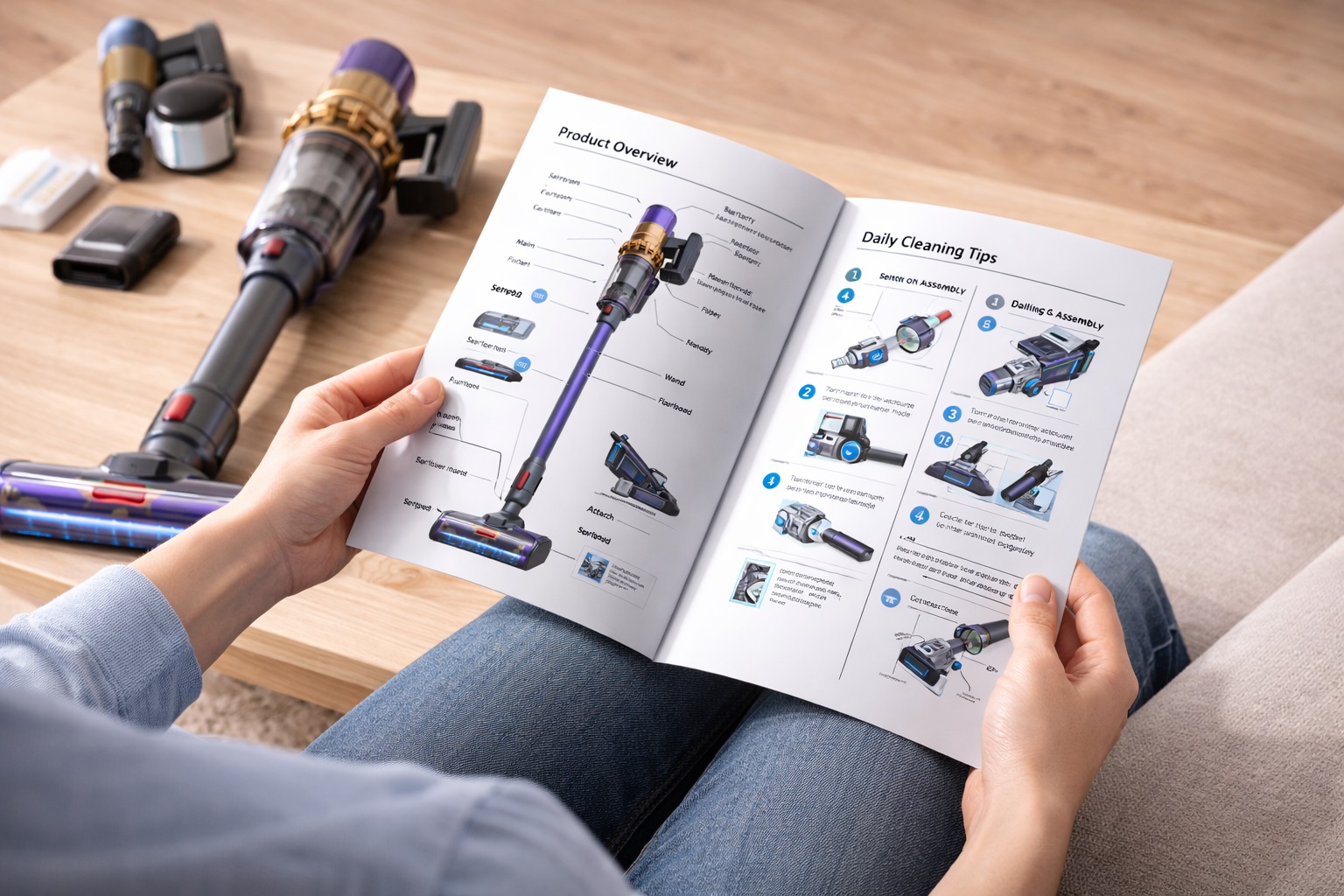
A Practical Guide That Saves Money, Time, and Complaints
🚀 Why the Manual Matters More Than the Machine
Most users believe:
“If I turn it on and it works, I don’t need the manual.”
From a B2B perspective, this belief is expensive.
For distributors and after-sales teams, improper manual use leads to:
“Low suction” complaints
Battery lifespan issues
Noise complaints
Wet/dry misuse damage
Avoidable returns
This article explains how to correctly read a vacuum cleaner manual, especially for wet and dry vacuum cleaner, multi-functional durable vacuum cleaner, high suction vacuum cleaner, energy-saving efficient powerful vacuum cleaner, quiet vacuum for night use, and car vacuum cleaner models.
🧠 First Rule: Manuals Are Not Instructions—They Are Risk Maps
A professional vacuum cleaner manual does three things:
Explains how the product works
Defines safe operating boundaries
Protects the manufacturer and distributor from misuse claims
💡 Expert Insight
If users only read the “Quick Start” section, they miss 80% of the risk information.
📖 Section 1: Identifying Your Vacuum Type (Critical First Page)
Before anything else, users must identify:
Why This Matters
Many wet & dry failures happen because:
💡 B2B Lesson
Manuals clearly explain this—but users often skip the first two pages.
⚙️ Section 2: Understanding “Normal Performance” (Avoid False Complaints)
Manuals usually describe:
Expected suction range
Normal noise levels
Heat generation limits
For a high suction vacuum cleaner, this section prevents:
👉 If it’s listed as normal behavior, it’s not a defect.
🔋 Section 3: Energy & Battery Instructions Are Not Optional
For cordless and efficient models, manuals explain:
Charging time
Recommended power modes
Storage rules
An energy-saving efficient powerful vacuum cleaner often:
💡 Procurement Reality
Many “weak suction” complaints are caused by users unknowingly operating in eco mode.
🔇 Section 4: Quiet Vacuum for Night Use — What the Manual Really Means
When manuals mention:
“Quiet mode”
“Low-noise operation”
They usually include conditions, such as:
Reduced suction
Shorter cleaning width
Specific attachments
A quiet vacuum for night use trades raw power for comfort.
💡 Distributor Insight
Noise complaints drop sharply when users understand this trade-off.
🧼 Section 5: Wet and Dry Rules (The Most Ignored Pages)
Manuals for wet and dry vacuum cleaner models clearly state:
The Cost of Ignoring This
Motor corrosion
Mold buildup
Warranty voiding
💡 B2B Fact
These pages are often skipped—and are the most expensive to ignore.
🚗 Section 6: Car Vacuum Cleaner Warnings Matter More Than You Think
A car vacuum cleaner manual often includes:
Why?
💡 After-Sales Insight
Car vacuum cleaner failures are overwhelmingly caused by manual violations, not defects.
🧩 Section 7: Multi-Functional Durable Vacuum Cleaner — Learn the Priority Order
For multi-functional durable vacuum cleaner models, manuals define:
Using everything at once ≠ better cleaning.
💡 Expert Rule
Manuals show the recommended sequence, not just available features.
❌ The 6 Most Common Manual-Reading Mistakes
Skipping safety warnings
Ignoring mode explanations
Misunderstanding noise vs power trade-offs
Treating wet & dry as “automatic”
Overusing max power
Never reading maintenance sections
Each mistake increases the chance of returns.
🧭 How B2B Buyers Can Use Manuals as a Profit Tool
Smart distributors:
Highlight key manual sections in onboarding
Create short “manual summaries”
Train sales staff on manual language
Result:
🏁 Final Takeaway
Vacuum cleaner manuals are not boring—they are protective tools.
For EU & Middle East distributors, helping customers read manuals properly:
A user who understands the manual is far less likely to call the product “bad”.
📌 Suitable Readers
Vacuum cleaner distributors & wholesalers
After-sales & support teams
B2B sourcing managers
Cleaning equipment entrepreneurs
End users seeking better performance
📌 Hashtags
wet and dry vacuum cleaner, multi-functional durable vacuum cleaner, high suction vacuum cleaner, energy-saving efficient powerful vacuum cleaner, quiet vacuum for night use, car vacuum cleaner, vacuum cleaner distributor, B2B vacuum cleaner, EU vacuum market, Middle East vacuum market,
vacuum cleaner manual, user guide education, home cleaning equipment, cleaning appliance B2B, low noise vacuum cleaner, durable cleaning equipment, vacuum cleaner wholesaler, smart home cleaning,
battery powered vacuum cleaner, portable vacuum cleaner, compact vacuum cleaner, vacuum cleaner R&D, cleaning technology innovation, product sourcing strategy, after sales cost reduction,
user onboarding guide, appliance documentation, household cleaning tools, modern home appliances, appliance distribution, vacuum cleaner business, global vacuum cleaner market, professional cleaning solutions, intelligent vacuum system,
vacuum cleaner market insights, appliance supply chain, cleaning industry trends, Lanxstar, B2B sourcing guide, product education content











