Hi, message us with any questions.
We're happy to help!





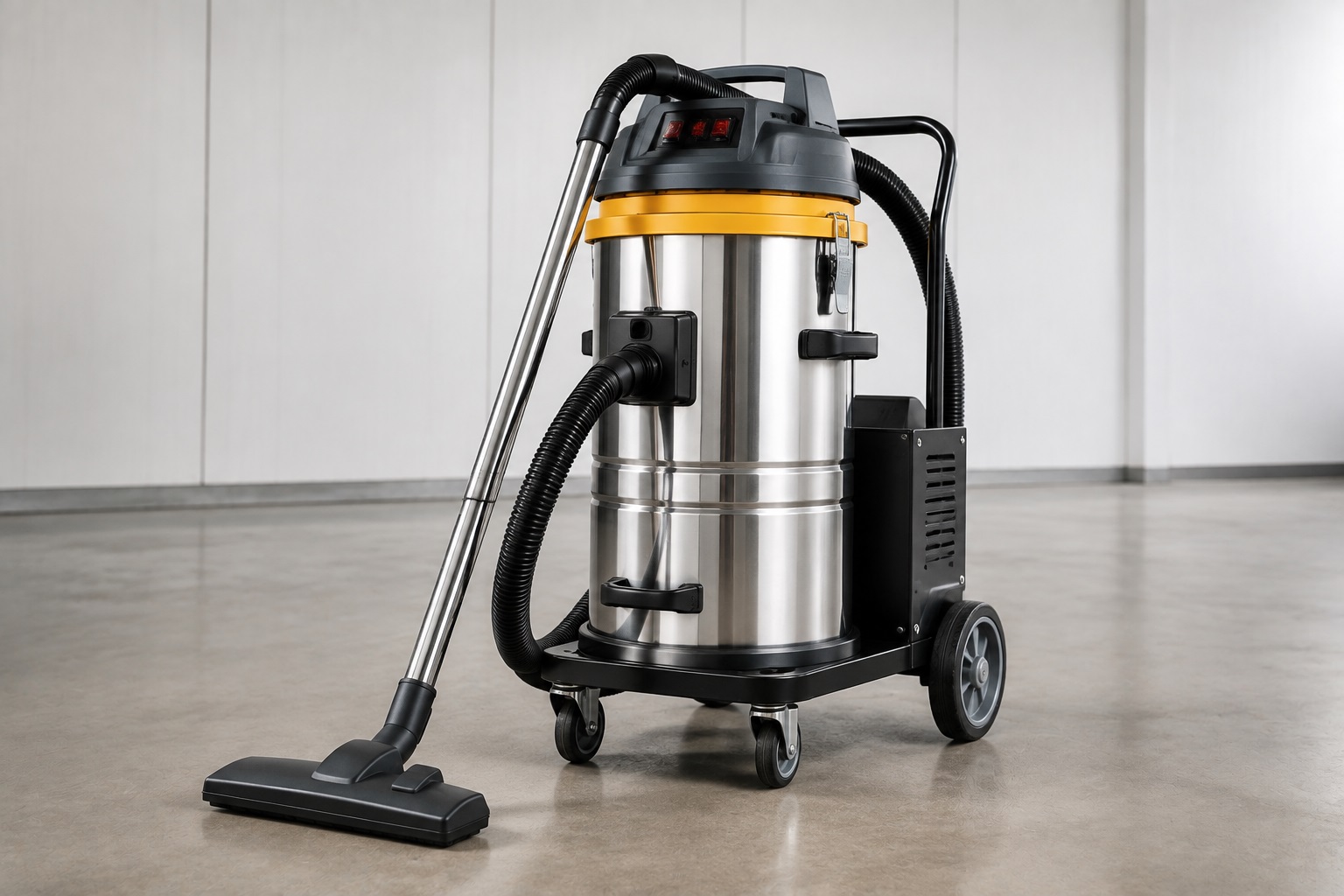
1. Why Choosing the Right Industrial Equipment Supplier Matters
Industrial equipment purchasing is fundamentally different from buying ordinary consumer products. Equipment may operate for long hours, handle difficult materials, work in demanding environments, and become part of a customer's daily production or facility-management process.
For this reason, choosing a reliable industrial equipment supplier can affect far more than the initial purchase price.
Product consistency, downtime, maintenance costs, replacement parts, delivery schedules, regulatory compliance, and technical communication can all influence the real value of a sourcing relationship.
This is particularly important when purchasing industrial cleaning equipment.
A buyer looking for an industrial vacuum cleaner, for example, may need equipment for dust, debris, liquids, workshop waste, warehouse floors, or construction environments. Selecting an unsuitable product can result in poor cleaning efficiency even when its specifications look impressive on paper.
🔍 A reliable supplier should understand the application before recommending the equipment.
2. Start by Defining Your Actual Equipment Requirements
One of the most common procurement mistakes is contacting suppliers before creating a clear requirement specification.
Instead of asking:
“What is your best industrial vacuum cleaner?”
A professional buyer should provide information such as:
intended application
materials to be collected
wet or dry cleaning requirements
expected daily operating time
required tank capacity
filtration expectations
power supply
noise requirements
destination country
order quantity
OEM/ODM requirements
required accessories
For example, a wet dry vacuum cleaner for construction site applications may need different structural characteristics from a commercial vacuum cleaner for hotel use.
Similarly, logistics warehouse cleaning may require a machine with excellent mobility and large collection capacity, whereas hotel environments may benefit from a Portable Quiet Vacuum Cleaner.
The more precise your requirements are, the easier it becomes to compare suppliers objectively.
3. Verify Whether the Supplier Has Real Manufacturing Capability
When searching online, buyers may encounter manufacturers, exporters, trading companies, distributors, and sourcing agents using similar terminology.
None of these business models is automatically unsuitable. The important point is understanding who actually controls production and quality.
If you are seeking a vacuum cleaner manufacturer in China or an industrial vacuum cleaner factory, investigate its manufacturing capabilities.
Useful areas to verify include:
Production Facilities 🏭
Ask about assembly lines, testing areas, warehouses, production equipment, and manufacturing processes.
Video audits, third-party inspections, and factory visits can help international buyers understand a supplier's actual capabilities.
Production Capacity
A supplier may handle a trial order successfully but struggle when monthly volume increases.
For a bulk vacuum cleaner purchase, ask about normal capacity, peak-season capacity, lead times, and how production is scheduled.
Component Supply Chain
Industrial equipment depends on motors, electrical components, filters, hoses, tanks, wheels, switches, cables, and other parts.
A reliable manufacturer should have a controlled component-sourcing process rather than changing critical components without authorization.
4. Evaluate Quality Control Instead of Relying on Claims
Almost every supplier can say that it provides “high quality.”
Professional procurement requires evidence.
When evaluating an industrial vacuum cleaner supplier or cleaning equipment supplier, ask how quality is controlled from incoming components through final shipment.
A practical quality-control process may include:
Incoming inspection: checking important raw materials and components before assembly.
In-process inspection: identifying manufacturing problems before they affect an entire batch.
Performance testing: verifying relevant product functions such as suction, airflow, motor operation, switches, wet suction, filtration, and noise.
Final inspection: checking appearance, accessories, labels, manuals, packaging, and product functionality.
Pre-shipment inspection: confirming order quantity and agreed specifications before shipment.
📋 Buyers placing large orders may also establish an agreed inspection standard with the manufacturer before production begins.
This reduces ambiguity when defects or specification differences are discovered.
5. Compare Engineering and Technical Expertise
A strong industrial supplier should not function only as a salesperson.
Technical expertise becomes particularly important for customized products.
Suppose a buyer requests a High Suction Vacuum Cleaner for factory use. Simply increasing motor wattage may not create the best result.
Real-world performance can also depend on:
motor configuration
airflow path
hose diameter
filter resistance
sealing
tank structure
nozzle design
dust characteristics
Similarly, a Large-Capacity Wet Dry Vacuum Cleaner needs more than a large tank. Drainage, stability, mobility, filter protection, tank cleaning, and wet collection performance also affect usability.
🔧 For this reason, engineering communication is an important criterion when evaluating an OEM industrial vacuum cleaner manufacturer.
6. Check OEM, ODM, and Private-Label Capabilities
International wholesalers and distributors often need products adapted to their own markets.
A capable OEM vacuum cleaner manufacturer may support customization of:
logos
colors
packaging
manuals
labels
accessories
filtration systems
plug specifications
cable configurations
product features
An ODM vacuum cleaner project may involve deeper product modifications or development based on an existing platform.
A private label vacuum cleaner program, meanwhile, can help distributors create differentiated products without establishing their own production facilities.
However, buyers should clearly define what “customization” means.
Changing a sticker is very different from engineering a new structure.
Before choosing an industrial equipment partner, ask which modifications are performed internally, which require outside partners, and how new designs are tested before mass production.
7. Case Study: Selecting Equipment for a Logistics Warehouse 📦
Consider a hypothetical logistics company operating a large distribution warehouse.
Its procurement team initially searches for the best industrial vacuum cleaner and sends inquiries to several suppliers asking mainly about motor power and price.
The quotations are difficult to compare because every supplier recommends a different machine.
The company then creates a more detailed requirement sheet.
Its actual priorities include:
cleaning large floor areas
collecting dry debris and occasional liquids
moving easily between warehouse aisles
reducing tank-emptying frequency
providing durable wheels and hoses
simplifying filter maintenance
supporting long daily cleaning cycles
With these requirements defined, the sourcing team begins evaluating an industrial wet and dry vacuum cleaner for warehouse cleaning supplier rather than simply looking for the highest-powered machine.
A wet and dry vacuum cleaner with appropriate mobility, tank capacity, accessories, and a practical wet and dry suction system may provide better overall value than a machine selected only because it has a higher wattage.
💡 Case takeaway: Define the working environment first and compare equipment second.
8. Evaluate Durability for Industrial Applications
Industrial buyers should carefully examine product durability.
A heavy duty vacuum cleaner may be exposed to rough floors, frequent movement, accidental impacts, demanding debris, and extended operating schedules.
Important areas include:
Tank Construction
A stainless steel vacuum tank may be appropriate for certain professional applications because of its structure, appearance, and cleaning characteristics. However, tank material should always be selected according to the intended application.
Motor Configuration
A dual motor vacuum cleaner can offer advantages for applications requiring greater performance or operational flexibility, depending on its design.
Buyers should ask how the motors are configured and what operating conditions the machine is designed to handle.
Hoses and Accessories
Accessories are frequently overlooked during sourcing.
In real-world industrial use, a durable vacuum with poor-quality hoses, connectors, wheels, or nozzles can still create maintenance problems.
The complete system should therefore be evaluated rather than the main machine alone.
9. Consider Filtration, Noise, and Energy Efficiency
Modern equipment procurement increasingly involves more than raw power.
Filtration 🌬️
A HEPA filter vacuum cleaner may be required for certain fine-dust applications. Buyers should verify the filtration configuration, replacement-filter availability, and suitability for the intended particles.
For specialized hazardous materials, ordinary commercial or industrial vacuum cleaners may not be suitable; application-specific equipment and applicable safety requirements should be evaluated.
Noise
A low noise vacuum cleaner may be particularly valuable in hotels, offices, retail spaces, and other occupied environments.
For these applications, a commercial grade vacuum cleaner should balance cleaning performance with user and customer comfort.
Energy Efficiency ⚡
An energy efficient vacuum cleaner can help commercial operators manage electricity consumption, particularly when many machines operate for extended periods.
An Energy-Saving Efficient Powerful Vacuum Cleaner should therefore be evaluated according to useful cleaning performance rather than power consumption alone.
10. Do Not Choose an Industrial Supplier Based Only on Price
Price matters, especially for wholesalers and distributors. But the lowest quotation can become expensive when hidden costs appear later.
When researching industrial vacuum cleaner cost or vacuum cleaner price wholesale, compare equivalent specifications.
Check whether quotations include the same:
motor configuration
filters
accessories
cable specifications
packaging
testing
spare parts
customization
certification requirements
For a wholesale vacuum cleaner program, even small specification differences can significantly affect unit prices.
The same principle applies to consumer-oriented purchasing terms such as best vacuum on a budget, best budget hoover, best affordable vacuum, best value hoover, and good budget vacuum cleaner.
“Budget” should mean appropriate value at the required performance level—not simply the cheapest available machine.
💰 Purchase price is only one component of total ownership cost.
11. Verify Certifications and Destination-Market Requirements
Industrial equipment regulations differ by market and product category.
Before ordering, buyers should determine which technical, electrical, labeling, environmental, and documentation requirements apply in the destination country.
A vacuum cleaner distributor Europe, for example, may face different obligations from a distributor selling into another region.
Never rely solely on a supplier saying, “This product is suitable for your market.”
Request relevant documentation, check that it corresponds to the actual model being purchased, and obtain professional compliance advice when necessary.
This is especially important for OEM projects because component, electrical, structural, or labeling changes can potentially affect compliance requirements.
🌍 Compliance planning should begin during product selection—not after the container is ready to ship.
12. Case Study: Commercial Cleaning Equipment for a Hotel Group 🏨
Consider a distributor supplying equipment to hotels.
Initially, the distributor evaluates a commercial vacuum cleaner mainly according to suction power.
After receiving feedback from hotel housekeeping teams, it discovers that operators care strongly about:
manageable noise
lightweight movement
easy accessory changes
convenient storage
adequate cable reach
straightforward maintenance
dependable daily operation
The sourcing team therefore adds low noise vacuum cleaner and Fast Lightweight Vacuum Cleaner requirements to its supplier evaluation.
For this application, an oversized industrial machine could actually reduce efficiency because staff must move the equipment repeatedly between guest rooms and corridors.
A properly designed commercial vacuum cleaner for hotel use can therefore deliver more operational value than a more powerful but less suitable alternative.
The case demonstrates another important sourcing principle:
The strongest specification is not always the most appropriate specification.
13. Assess Communication and After-Sales Support
Supplier reliability becomes particularly visible after the purchase order is signed.
Professional buyers should evaluate how quickly and accurately suppliers answer technical questions.
Consider whether the supplier can provide:
manuals
exploded diagrams when applicable
spare-parts lists
replacement filters
hoses and accessories
troubleshooting information
warranty procedures
product updates
For commercial cleaning service equipment and facility management cleaning equipment, downtime can directly affect business operations.
A supplier capable of supporting spare parts and troubleshooting may therefore provide greater long-term value than one offering a slightly lower initial price.
14. Why Lanxstar Can Be Considered for Professional Vacuum Cleaner Sourcing
For international buyers seeking professional vacuum cleaner solutions, Lanxstar can be evaluated as a potential manufacturing partner alongside the buyer's technical, commercial, and quality requirements.
Different customers need different configurations.
A buyer searching for construction site cleaning equipment may prioritize robust construction and strong suction.
A warehouse customer may need capacity and mobility.
A hotel-equipment distributor may focus on quieter operation.
A car-care business may require a suitable car detailing vacuum cleaner with practical accessories.
Factory customers may prioritize factory floor cleaning, while facility-management companies often need versatile commercial cleaning equipment for multiple sites.
For this reason, sourcing decisions should begin with application analysis rather than selecting a standard model based on price alone.
When considering a factory direct vacuum cleaner or bulk order vacuum cleaner, buyers should communicate expected volume, market, operating conditions, customization requirements, and quality standards before requesting final pricing.
15. Supplier Audit Checklist Before Placing a Bulk Order
Before making a bulk vacuum cleaner purchase, buyers can use the following checklist:
Factory Verification
Confirm business identity, manufacturing location, production capability, and supplier role.
Product Verification
Request samples and test them under conditions similar to the intended application.
Quality Verification
Review inspection procedures, testing methods, component controls, and batch-consistency processes.
Engineering Verification
Determine whether technical staff can support product selection and customization.
OEM/ODM Verification
Clarify tooling, artwork, packaging, MOQ, development cost, sample approval, and production lead time.
Compliance Verification
Check applicable certifications, documentation, labeling, and destination-market requirements.
Commercial Verification
Confirm pricing terms, payment terms, production schedules, packaging, and shipment arrangements.
After-Sales Verification
Clarify warranty, spare parts, replacement filters, accessories, and technical support.
📌 For high-value or large-volume orders, third-party factory audits and pre-shipment inspections can provide an additional layer of risk control.
16. Build a Long-Term Supplier Relationship, Not Just a Transaction
The strongest industrial procurement relationships often develop over multiple orders.
Once a buyer and supplier establish stable specifications, quality standards, packaging requirements, communication processes, and forecasts, repeated orders can become more efficient.
This is especially valuable for distributors looking to import vacuum cleaner from China or establish an ongoing OEM vacuum cleaner program.
Long-term cooperation can also make it easier to discuss product upgrades, new accessories, packaging improvements, market feedback, and future models.
For suppliers, understanding the distributor's market helps improve product recommendations.
For buyers, understanding the factory's capabilities helps prevent unrealistic specifications and delivery expectations.
🤝 Reliable supply chains are built through measurable standards, transparent communication, and consistent execution.
Conclusion
Choosing a reliable industrial equipment supplier requires a structured evaluation of manufacturing capability, product expertise, engineering support, quality control, OEM/ODM services, compliance, pricing, delivery performance, and after-sales support.
For buyers sourcing an industrial vacuum cleaner, wet dry vacuum cleaner, commercial vacuum cleaner, or other professional cleaning solution, the intended application should always guide the purchasing decision.
Warehouse cleaning, factory floors, construction sites, hotels, retail environments, and facility-management operations have different requirements. A reliable supplier should be able to understand these differences and recommend equipment accordingly.
Global importers, wholesalers, distributors, retailers, and engineering teams should therefore look beyond the lowest quotation and evaluate the supplier's ability to deliver consistent long-term value.
For more information about professional vacuum cleaners, OEM/ODM projects, wholesale cooperation, and industrial cleaning solutions, visit www.lxvacuum.com.
If you are interested, please feel free to contact us.
50 Related SEO Keywords
industrial equipment supplier, cleaning equipment supplier, industrial cleaning equipment, commercial cleaning equipment, industrial vacuum cleaner supplier, vacuum cleaner supplier, vacuum manufacturer, vacuum cleaner maker, Lanxstar, vacuum cleaner manufacturer, vacuum cleaner manufacturer in China, industrial vacuum cleaner factory, industrial vacuum cleaner, commercial vacuum cleaner, wet and dry vacuum cleaner, wet dry vacuum cleaner, wholesale vacuum cleaner, bulk vacuum cleaner purchase, OEM vacuum cleaner, ODM vacuum cleaner, private label vacuum cleaner, OEM industrial vacuum cleaner manufacturer, industrial equipment manufacturer China, factory direct vacuum cleaner, vacuum cleaner supplier China, heavy duty vacuum cleaner supplier China, high suction power vacuum cleaner, heavy duty vacuum cleaner, dual motor vacuum cleaner, HEPA filter vacuum cleaner, stainless steel vacuum tank, low noise vacuum cleaner, energy efficient vacuum cleaner, wet and dry suction system, industrial dust extractor, commercial grade vacuum cleaner, warehouse cleaning solution, logistics warehouse cleaning, construction site cleaning equipment, factory floor cleaning, hotel cleaning equipment, hospital cleaning equipment, retail cleaning equipment, facility management cleaning equipment, commercial cleaning service equipment, car detailing vacuum cleaner, industrial wet and dry vacuum cleaner for warehouse cleaning supplier, wet dry vacuum cleaner for construction site, commercial vacuum cleaner for hotel use, bulk order vacuum cleaner



