Hi, message us with any questions.
We're happy to help!





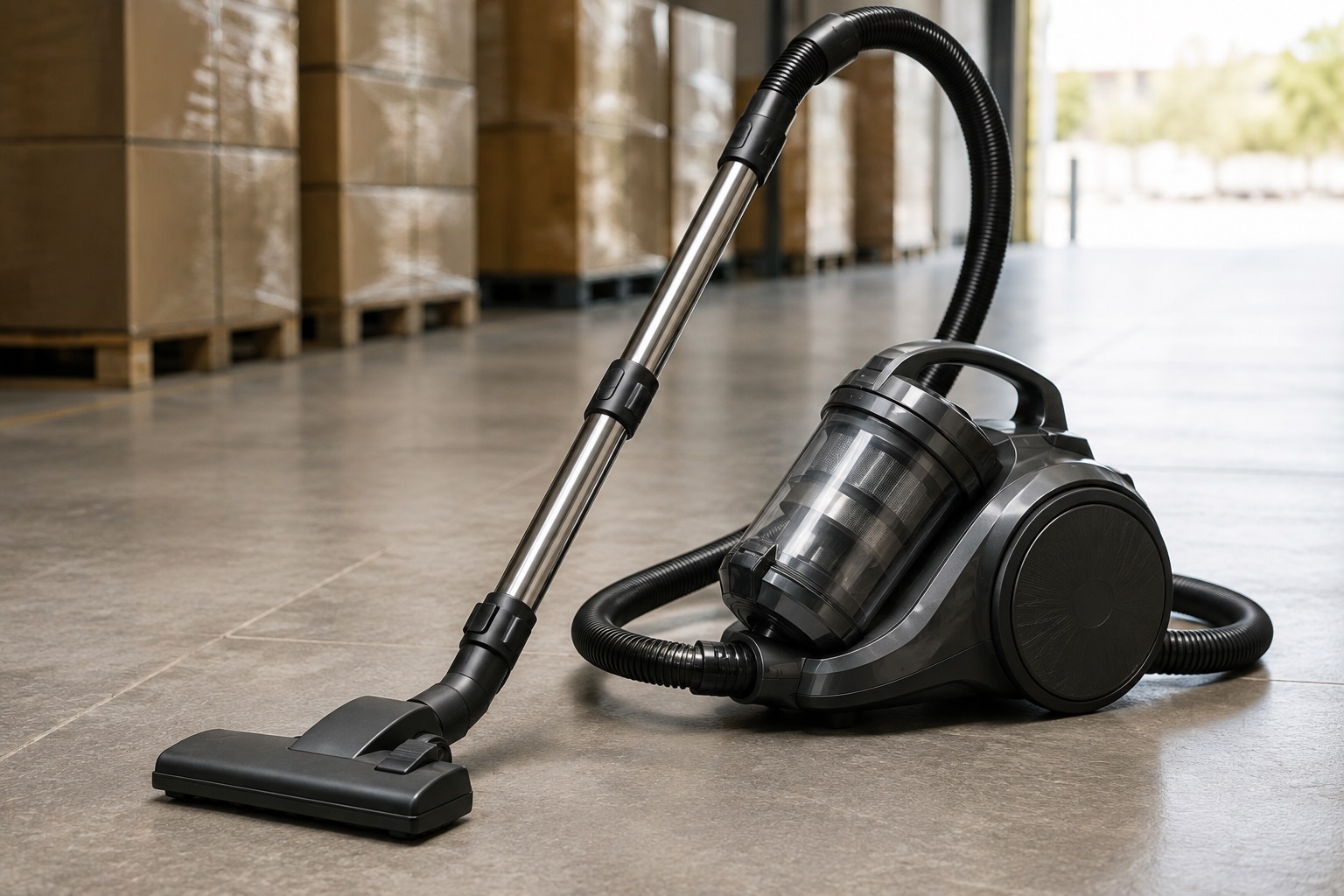
For European distributors, sourcing vacuum cleaners internationally is a multi-stage procurement decision.
A competitive quotation matters, but the lowest factory price does not automatically produce the lowest total business cost.
European buyers need to consider product performance, applicable regulatory requirements, quality consistency, packaging, transportation, inventory, warranty handling and long-term supply continuity.
This is especially important for professional products such as an industrial vacuum cleaner, commercial vacuum cleaner, wet and dry vacuum cleaner, or heavy duty vacuum cleaner.
The sourcing process therefore usually begins with a simple question:
What product does the European market actually need?
A distributor serving construction companies may prioritize a wet dry vacuum cleaner for construction site use. A hospitality supplier may need a commercial vacuum cleaner for hotel use, while a warehouse-equipment distributor could search for an industrial wet and dry vacuum cleaner for warehouse cleaning supplier.
Product-market fit should come before price negotiation.
2. Step One: Define the Target Market and Customer 🔍
European distributors should first define who will purchase and use the machine.
A vacuum cleaner intended for household retail has different requirements from one designed for factories, workshops or professional cleaning contractors.
For example, a distributor may target:
Hotels and hospitality companies
Warehouses and logistics centers
Factories and workshops
Construction contractors
Car-detailing businesses
Professional cleaning companies
Facility-management providers
Retail consumers
Each segment creates different purchasing priorities.
For hotel cleaning equipment, low operating noise and maneuverability may be important.
For factory floor cleaning, buyers may prioritize durability, capacity and continuous practical operation.
A car detailing vacuum cleaner may need a useful combination of hoses and detailing nozzles.
Meanwhile, logistics warehouse cleaning applications can require larger capacity and wet/dry functionality.
Defining the customer first makes supplier selection significantly more efficient.
3. Step Two: Build a Clear Product Specification 📋
European procurement teams should avoid sending suppliers vague inquiries such as:
"Please quote your best industrial vacuum cleaner."
"Best" has no universal technical definition.
A more effective request identifies the application and required configuration.
Depending on the project, specifications can cover:
Vacuum type: dry, wet/dry or another defined configuration
Motor configuration: single or dual motor vacuum cleaner
Tank: capacity and material, such as a stainless steel vacuum tank
Filtration: standard filtration or specified HEPA filter vacuum cleaner requirements
Noise: relevant requirements for a low noise vacuum cleaner
Accessories: hose, tubes, floor tools, brushes and application-specific attachments
Electrical configuration: destination voltage, frequency and plug
Branding: standard, OEM or private label
Packaging: standard export or customized retail packaging
Marketing concepts such as High Suction Vacuum Cleaner, Portable Quiet Vacuum Cleaner, Multi-Functional Durable Vacuum Cleaner, Fast Lightweight Vacuum Cleaner, Energy-Saving Efficient Powerful Vacuum Cleaner, and Large-Capacity Wet Dry Vacuum Cleaner can help define market positioning.
However, procurement decisions should ultimately be based on measurable specifications.
4. Step Three: Identify Potential Manufacturers in China 🏭
Once the requirements are clear, buyers can begin supplier screening.
Many European companies choose to import vacuum cleaner from China because the country has a mature manufacturing ecosystem covering motors, plastic components, metal tanks, hoses, filters, packaging and accessories.
But not every vacuum cleaner supplier China serves the same market.
Some suppliers focus primarily on household products. Others specialize in industrial cleaning equipment and commercial cleaning equipment.
When evaluating a vacuum cleaner manufacturer, European distributors should determine whether the company has relevant experience with the target product category.
For industrial products, buyers can investigate:
Manufacturing capabilities
Product categories
Production processes
Quality-control procedures
Engineering support
OEM/ODM capability
Export experience
Packaging capability
Spare-parts availability
Communication efficiency
The objective is not simply to compile a long supplier list. It is to develop a shortlist of factories capable of supporting the actual project.
5. Step Four: Evaluate Factory Capability, Not Just the Sales Presentation 🧐
Professional procurement requires verification.
A polished catalog does not necessarily reveal how a product is manufactured or controlled.
European buyers evaluating an industrial vacuum cleaner factory should understand what happens behind the quotation.
Questions might include:
How are incoming components inspected?
What tests are performed during production?
How are finished machines checked?
How are product specifications controlled?
How does the factory manage non-conforming products?
Can the supplier trace production information when necessary?
How are engineering changes communicated?
Factory visits, video audits, third-party assessments or other verification methods may be useful depending on order size and procurement risk.
For a large bulk vacuum cleaner purchase, spending additional time on supplier qualification can prevent much larger problems later.
6. Step Five: Understand European Compliance Responsibilities ⚖️
Products placed on European markets may be subject to applicable EU and/or national regulatory requirements depending on the product, configuration and destination.
Vacuum cleaners are electrical products, so compliance should be treated as a core procurement workstream—not as a logo to add to the carton shortly before shipment.
European distributors should identify the legislation and standards applicable to their specific product and market and determine their own legal responsibilities as economic operators.
Depending on the product, relevant areas may include electrical safety, electromagnetic compatibility, hazardous substances, waste electrical equipment, chemicals/material obligations, energy-related requirements where applicable, and other product-specific rules.
The exact requirements can vary, and buyers should verify current obligations for their intended market.
A supplier should be able to provide the technical documentation and test information agreed for the project.
Importantly, a CE marking should not be treated as proof by itself that every regulatory requirement has been satisfied.
Professional buyers should review supporting documentation rather than relying only on markings or marketing statements.
7. Step Six: Request and Evaluate Product Samples 🧪
A sample is one of the most useful tools in international sourcing.
Before approving a wholesale vacuum cleaner order, distributors should evaluate whether the actual product matches the agreed specification.
Sample evaluation can include:
Suction performance
Noise
Assembly quality
Tank construction
Hose and accessory fit
Wheels and maneuverability
Filtration
Cable and plug
Switches and controls
Product appearance
Packaging
User documentation
The evaluation should reflect real applications whenever possible.
For example, a machine intended as construction site cleaning equipment should be evaluated with representative debris and working conditions appropriate to the product's intended use.
A machine designed as a warehouse cleaning solution should be assessed for movement, tank capacity, accessories and practical cleaning efficiency.
Samples help convert specifications on paper into evidence that procurement and engineering teams can review.
8. Case Study: A German Distributor Sourcing Wet and Dry Vacuums 📊
Consider a representative sourcing scenario.
A German cleaning-equipment distributor wants to expand its professional product portfolio with a wet and dry vacuum cleaner for workshops and light industrial environments.
The company initially receives quotations from several suppliers.
Supplier A offers the lowest unit price.
Supplier B offers more customization.
Supplier C provides a slightly higher quotation but demonstrates stronger communication regarding product configuration, documentation, packaging and spare parts.
Instead of selecting purely by unit price, the distributor requests samples from shortlisted suppliers.
During evaluation, the team compares suction performance, accessory quality, tank construction, maneuverability and packaging.
It also reviews the available documentation and discusses future replacement components.
The distributor eventually selects the supplier offering the strongest overall combination of product suitability, supply capability and total commercial value.
The case illustrates an important sourcing principle:
The cheapest quotation is not necessarily the lowest-risk or best-value sourcing solution.
9. Step Seven: Calculate the True Landed Cost 💶
A factory quotation tells only part of the financial story.
European distributors should calculate the landed cost of the vacuum cleaner.
A simplified model may include:
Factory price + packaging + inland transportation + export-related costs + international freight + insurance where applicable + import duties + customs-related costs + local transportation + warehousing + quality costs
VAT treatment and other costs should be considered according to the buyer's jurisdiction and business structure.
This is particularly important when comparing vacuum cleaner price wholesale offers.
Suppose one supplier offers a lower unit price but uses a much larger carton. If fewer units fit into a container, freight cost per machine may increase.
Another supplier might offer a slightly higher product price but achieve better packaging efficiency.
For a bulk order vacuum cleaner, small differences multiplied across hundreds or thousands of units can materially affect profitability.
10. Step Eight: Negotiate MOQ Without Ignoring Supply Economics 📦
Minimum order quantity, or MOQ, is a frequent negotiation point between European distributors and manufacturers.
Buyers naturally want flexibility, particularly when launching a new model.
Factories, however, need to consider material purchasing, production setup, customized packaging and component economics.
The solution is usually to discuss the project structure rather than focusing on MOQ as an isolated number.
A European distributor testing a new commercial grade vacuum cleaner might begin with a smaller market-validation order using relatively standardized specifications.
After demand is proven, the buyer can move toward larger production volumes and deeper customization.
This staged approach can reduce inventory risk while creating a clearer path toward long-term cooperation.
MOQ discussions become especially important for an OEM vacuum cleaner or private label vacuum cleaner, where customized cartons, labels and components can have their own minimum quantities.
11. Step Nine: Develop OEM and Private Label Products 🎨
Many European distributors want to sell under their own brands rather than compete only as resellers.
This is where OEM vacuum cleaner, ODM vacuum cleaner, and private-label programs become valuable.
Customization can include:
Logo
Product color
Labels
Carton artwork
Instruction manuals
Accessories
Hose configurations
Filters
Selected product specifications
Packaging structure
A private label vacuum cleaner program allows distributors to create a recognizable market identity while using an established manufacturing platform.
An ODM project may involve deeper product development.
European companies looking for an OEM industrial vacuum cleaner manufacturer should confirm the scope of customization before placing an order.
They should also establish who owns artwork, tooling or other project-specific assets where applicable.
Clear documentation reduces future misunderstandings.
12. Step Ten: Establish Quality Control for Mass Production 🔎
A good sample does not automatically guarantee that every mass-production unit will be identical.
Quality assurance must therefore continue after sample approval.
European buyers can establish inspection criteria covering the agreed critical characteristics.
For example, inspection of a heavy duty vacuum cleaner might include:
Appearance: tank, motor head, wheels and external surfaces.
Function: switching, suction and agreed operating checks.
Accessories: correct hose, tubes, nozzles and filters.
Electrical configuration: correct voltage and plug.
Branding: logo, labels and model information.
Packaging: carton, manual, protective structure and barcode.
Pre-shipment inspection can provide an additional checkpoint before the goods leave the manufacturing country.
For large orders, finding a problem before shipment is generally far easier than dealing with it after distribution across Europe.
13. Case Study: Private Label Commercial Vacuum Cleaner for Hotels 🏨
Consider a second representative case.
A European hospitality-equipment distributor wants a commercial vacuum cleaner for hotel use under its own brand.
The target customers value manageable noise, convenient movement and straightforward maintenance.
Instead of asking the manufacturer to develop an entirely new machine, the distributor selects an existing commercial platform and begins an OEM customization project.
The product color and logo are adjusted. Packaging is redesigned for the distributor's brand, and accessories are selected around hotel cleaning tasks.
The buyer also evaluates the machine's noise and filtration specifications before confirming marketing claims.
After sample approval, a pilot order is introduced to selected customers.
Feedback from those customers is then used to refine the future order configuration.
This approach limits initial commercial risk while giving the distributor real market data.
It also demonstrates how an experienced vacuum cleaner supplier can support product localization without unnecessary redesign.
14. Step Eleven: Plan European Logistics and Inventory 🚢
After production, the sourcing project becomes a logistics project.
Vacuum cleaners can be relatively bulky compared with their unit value, so carton optimization and container loading deserve attention.
A Large-Capacity Wet Dry Vacuum Cleaner may require substantially more storage and shipping volume than a compact household model.
Distributors should consider:
Container loading quantities
Palletization
Port selection
Freight method
Transit time
Customs clearance
Local warehousing
Safety stock
Reorder points
Seasonal demand
Supply planning is particularly important for distributors serving professional customers.
If a facility-management company needs replacement machines immediately, waiting for the next international production cycle may not be acceptable.
Inventory strategy should therefore reflect lead time and customer service expectations.
15. Step Twelve: Plan Spare Parts and After-Sales Support 🔧
Professional sourcing should not end when the container arrives.
Commercial customers often expect equipment to remain serviceable.
European distributors should discuss spare parts with their vacuum cleaner manufacturer before mass purchasing.
Depending on the product, important parts may include filters, hoses, floor tools, switches, wheels, seals and other replaceable components.
For an industrial dust extractor or professional wet/dry vacuum, parts availability can influence lifetime operating value.
A machine with an attractive purchase price but poor serviceability may become expensive over time.
Distributors can therefore ask:
Which parts are replaceable?
How long are spare parts expected to remain available?
Can parts be ordered with the original shipment?
Are exploded diagrams or service information available where appropriate?
After-sales planning can become a competitive advantage for European distributors serving professional customers.
16. How European Buyers Compare Value, Not Just Price 💡
Consumer searches frequently include phrases such as best vacuum on a budget, best budget hoover, best affordable vacuum, best value hoover, and best vacuum cleaners on a budget.
Professional distributors approach value differently.
They need products that can remain commercially competitive after adding freight, import expenses, warehousing, marketing and after-sales support.
Therefore, a good budget vacuum from a distributor's perspective must deliver a suitable balance of:
Purchase cost + performance + quality consistency + logistics efficiency + serviceability + market positioning
Energy consumption may also influence purchasing decisions in some applications, making an appropriately designed energy efficient vacuum cleaner attractive.
Likewise, a Portable Quiet Vacuum Cleaner can create value in hospitality, offices or other noise-sensitive environments.
The right value proposition depends on the target customer rather than one universal specification.
17. Should European Distributors Buy Factory Direct? 🤝
A factory direct vacuum cleaner sourcing model can provide advantages when buyers need technical communication, OEM customization and larger volumes.
Working directly with a factory may make it easier to discuss:
Motors
Tanks
Filters
Accessories
Packaging
Product modifications
Production schedules
Quality requirements
However, direct sourcing also requires the European buyer to manage more procurement responsibilities.
The distributor may need to handle supplier qualification, product compliance responsibilities, quality assurance, logistics and inventory.
Therefore, "factory direct" should not automatically be interpreted as "better."
The best sourcing structure is the one that gives the buyer sufficient control, transparency and commercial efficiency.
18. Red Flags European Vacuum Cleaner Buyers Should Watch 🚩
European buyers should investigate carefully when a potential supplier:
Cannot clearly explain product specifications
Frequently changes important technical information
Avoids discussing quality-control procedures
Cannot provide agreed documentation for review
Offers unrealistic production schedules
Pushes for mass production before sample approval
Provides unclear packaging information
Cannot explain how specification changes are controlled
Makes unsupported performance claims
Focuses exclusively on price
None of these factors alone automatically proves that a supplier is unsuitable.
However, several warning signs appearing together should trigger deeper due diligence.
A reliable sourcing relationship depends on transparency.
19. From First Order to Long-Term Distribution Partnership 📈
The first purchase should be viewed as the beginning of supplier evaluation rather than the end.
After receiving an order, European distributors can monitor:
Product defect rates
Customer feedback
Packaging performance
Delivery reliability
Spare-parts demand
Sales performance
Communication efficiency
This information creates a supplier performance record.
If the relationship performs well, the distributor can gradually expand the product range or increase order volume.
A buyer might begin with one wet dry vacuum cleaner, then add a high suction power vacuum cleaner, dual motor vacuum cleaner, or other commercial model.
Long-term cooperation should develop based on measurable results.
20. Lanxstar as a Vacuum Cleaner Manufacturing Partner 🌐
European distributors looking for a manufacturing partner need a supplier capable of understanding both product requirements and international procurement workflows.
Lanxstar supports commercial and industrial vacuum cleaner sourcing projects based on agreed specifications, including wet and dry products and OEM/private-label requirements.
For distributors evaluating a vacuum cleaner distributor Europe supply strategy, cooperation with a manufacturing source can include discussions around product configuration, accessories, branding, packaging and bulk-order requirements.
Different applications require different solutions.
A warehouse cleaning solution may emphasize capacity and wet/dry capability, while hotel cleaning equipment may prioritize maneuverability and noise. Construction site cleaning equipment can require durability and strong practical suction.
Rather than forcing one machine into every application, European distributors can build product portfolios around the requirements of specific customer groups.
This application-driven sourcing approach can help transform international procurement from simple product buying into a sustainable distribution strategy.
Conclusion
So, how do European distributors source vacuum cleaners successfully?
The process begins with the market, not the factory.
Buyers first define customers and applications, create clear specifications, shortlist suitable manufacturers and verify supplier capability. They then evaluate samples, applicable compliance requirements, OEM options, quality-control processes, landed costs, logistics and after-sales support.
For companies planning to import vacuum cleaner from China, factory price should therefore be only one part of the decision.
The stronger sourcing model considers the complete lifecycle:
Specification → Supplier → Sample → Compliance → OEM → Quality → Production → Logistics → Inventory → After-sales.
European distributors that manage these stages systematically can reduce procurement risk while building more scalable relationships with their manufacturing partners. 🇪🇺🤝🏭
For industrial, commercial, wet/dry, OEM and private-label vacuum cleaner sourcing information, visit www.lxvacuum.com.
If you are interested, please feel free to contact us.
50 Related SEO Keywords
Lanxstar, vacuum manufacturer, vacuum cleaner maker, vacuum cleaner distributor Europe, European vacuum cleaner distributor, vacuum cleaner manufacturer, vacuum cleaner manufacturer in China, vacuum cleaner supplier China, industrial vacuum cleaner supplier, industrial vacuum cleaner factory, commercial vacuum cleaner, industrial vacuum cleaner, wet and dry vacuum cleaner, wet dry vacuum cleaner, wholesale vacuum cleaner, bulk vacuum cleaner purchase, bulk order vacuum cleaner, OEM vacuum cleaner, ODM vacuum cleaner, private label vacuum cleaner, OEM industrial vacuum cleaner manufacturer, factory direct vacuum cleaner, import vacuum cleaner from China, cleaning equipment supplier, industrial cleaning equipment, commercial cleaning equipment, industrial equipment supplier, warehouse cleaning solution, construction site cleaning equipment, hotel cleaning equipment, hospital cleaning equipment, factory floor cleaning, logistics warehouse cleaning, car detailing vacuum cleaner, facility management cleaning equipment, retail cleaning equipment, HEPA filter vacuum cleaner, high suction power vacuum cleaner, heavy duty vacuum cleaner, dual motor vacuum cleaner, stainless steel vacuum tank, low noise vacuum cleaner, energy efficient vacuum cleaner, wet and dry suction system, industrial dust extractor, commercial grade vacuum cleaner, buy industrial vacuum cleaner, vacuum cleaner price wholesale, commercial vacuum cleaner for sale, industrial wet and dry vacuum cleaner



