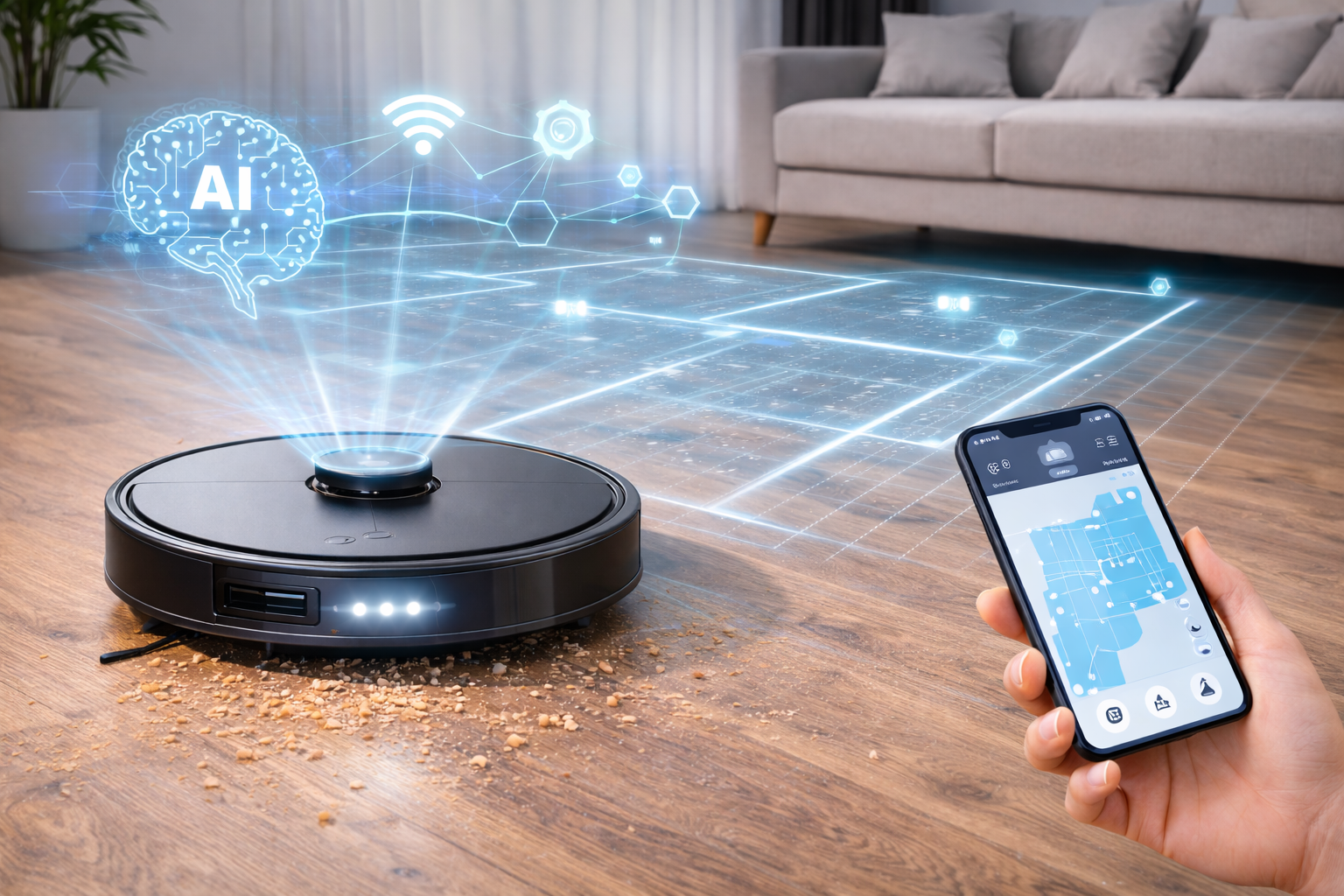
Home cleaning is undergoing a fundamental shift. Vacuum cleaners are no longer simple suction devices; they are becoming intelligent systems capable of learning, adapting, and making decisions.
AI-powered vacuums are redefining what “smart cleaning” means—moving beyond scheduled automation toward real intelligence. For global buyers, engineers, and vacuum cleaner distribution partners, this shift is changing how products are designed, positioned, and evaluated.
From Automation to Intelligence: What AI Really Changes 🧠
Traditional robot vacuums rely on predefined rules. AI-powered vacuums go further by analyzing data and improving performance over time.
AI enables vacuums to:
Learn room layouts and user habits
Adapt cleaning paths dynamically
Adjust suction based on surface type
Reduce repeated or missed cleaning areas
This evolution significantly improves real-world cleaning efficiency and user satisfaction.
AI Navigation: Smarter Mapping, Fewer Mistakes 🗺️
Navigation is where AI delivers the most visible improvement. Instead of following fixed routes, AI-powered vacuums use data from sensors, cameras, and LiDAR to build detailed maps.
Key benefits include:
Faster room coverage
Accurate obstacle recognition
Improved edge and corner cleaning
Reduced collision and wear
For homes with pets and children, AI navigation dramatically lowers error rates and maintenance issues.
Adaptive Cleaning Power: Smarter Suction Control ⚡
AI-powered vacuums can detect surface changes in real time. When moving from hard floors to carpets, the vacuum automatically increases suction. On low-dirt areas, it reduces power to save energy.
This adaptive behavior supports energy-saving efficient powerful vacuum cleaner principles while maintaining strong performance where it matters most.
Predictive Cleaning: Cleaning Before Problems Appear 🔮
AI systems analyze historical cleaning data to predict dirt accumulation patterns. High-traffic zones receive more frequent attention, while low-use areas are cleaned less often.
This predictive cleaning approach:
It also aligns closely with real household behavior.
AI and HEPA Filtration: Smarter Air Quality Control 🌬️
AI-powered vacuums can monitor airflow resistance and filter condition. When filters begin to clog, the system alerts users before performance drops.
For HEPA filter vacuum cleaner models, this means:
This is especially valuable for homes with pets or allergy-sensitive users.
IoT Connectivity Enables Remote Intelligence 📡
While AI handles decision-making, IoT connects vacuums to the broader smart home ecosystem. Through apps and cloud platforms, users can:
For distributors, IoT connectivity adds long-term service and upgrade opportunities.
AI Does Not Replace Manual Vacuums—It Redefines Their Role 🔄
Even with AI, robot vacuums cannot handle every scenario. Wet spills, stairs, furniture, and deep carpet cleaning still require manual vacuum cleaners.
AI-powered vacuums reduce workload but work best when paired with cordless vacuum cleaners or wet dry vacuum cleaners. This hybrid approach remains the most effective cleaning strategy.
Cost, Value, and the Reality of AI Vacuums 💰
AI technology increases product value, but not all markets require premium solutions. Buyers still search for:
Successful brands use AI selectively, focusing on features that deliver real performance gains rather than unnecessary complexity.
Why AI-Powered Vacuums Are Becoming the New Standard 🚀
AI is no longer a future concept in home cleaning. It is becoming a baseline expectation, especially in mid-to-high-end robot vacuum categories.
As AI costs decrease and algorithms mature, intelligent cleaning will spread across more price segments and markets.
Strategic Insights for Buyers and Distributors 🧩
AI-powered vacuums are transforming home cleaning from automation to intelligence. The key is not adopting AI blindly, but integrating it where it improves real-world outcomes.
Brands like Lanxstar focus on scalable AI vacuum platforms that work alongside traditional vacuum solutions. This balanced approach supports smarter vacuums procurement decisions and sustainable vacuum cleaner distribution strategies.
For professional smart vacuum solutions and sourcing insights, visit www.lxvacuum.com.
50 Related Keywords
High Suction Vacuum Cleaner, Portable Quiet Vacuum Cleaner, Self-Cleaning Vacuum Cleaner, Multi-Functional Durable Vacuum Cleaner, Fast Lightweight Vacuum Cleaner, Energy-Saving Efficient Powerful Vacuum Cleaner, Large-Capacity Wet Dry Vacuum Cleaner, Li-ion Cordless Handheld Vacuum Cleaner, Wet Dry Vacuum Cleaners, 4 in 1 Cordless Smart Wet & Dry Vacuum Cleaner, cordless handheld vacuums, Cordless Vacuum Cleaner, Car Vacuum Cleaner, quiet vacuum cleaner, wet dry vacuum, Portable Vacuum for Travel, HEPA Filter Vacuum Cleaner, Apartment Vacuum Cleaner, Wet and Dry Vacuum Cleaner, Quiet Vacuum for Night Use, Vacuum Cleaner for Pet Hair, best vacuum on a budget, best budget hoover, good budget vacuum, best affordable vacuum, best budget vacuum, best value for money hoover, best value hoover, best vacuum cleaners on a budget, good budget vacuum cleaner, Lanxstar, vacuums procurement, vacuum cleaner distribution, AI vacuum cleaner, smart vacuum technology, IoT vacuum cleaner, intelligent cleaning system