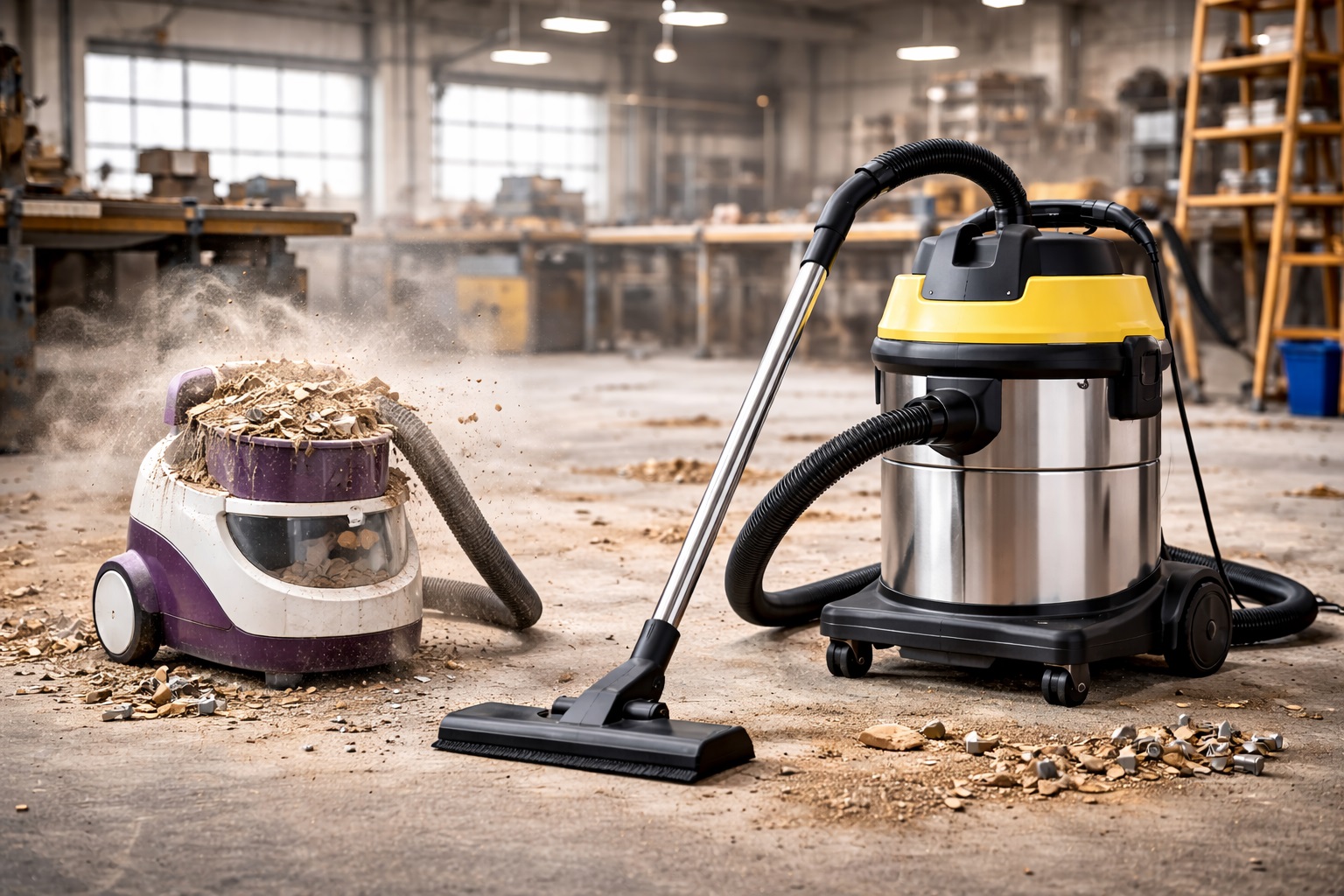
On paper, many household vacuum cleaners look impressive.
High suction. Compact design. Attractive price.
This leads some buyers to believe:
“Why not use household models for industrial or commercial cleaning?”
The answer is simple—and expensive:
Industrial environments expose design limits faster than any lab test.
Household vacuums don’t fail because they are poorly made.
They fail because they were never designed for industrial reality.
This article explains why household vacuum cleaners consistently underperform in industrial cleaning environments, what actually causes their failure, and how professional buyers avoid repeating this mistake.
🧠 1. Design Intent: Residential Comfort vs Industrial Endurance
Household vacuum cleaners are engineered for:
Industrial cleaning environments—even light industrial sites—demand:
Long operating hours
Higher debris volume
Continuous daily use
In heavy industrial environments, the gap becomes even more obvious.
A Multi-Functional Durable Vacuum Cleaner is built for endurance:
A household vacuum may perform well for 15–20 minutes.
Industrial cleaning demands reliable performance for hours, every day.
⚠️ 2. “High Suction” Without Stability Is a Liability
Many household vacuums advertise strong suction numbers.
In industrial environments, this often becomes a weakness.
Why?
A true High Suction Vacuum Cleaner maintains stable airflow under load, not just peak suction under ideal conditions.
Household models typically:
Industrial cleaning requires sustained suction, not marketing numbers.
🕒 3. Duty Cycle: The Silent Failure Point
Duty cycle—the amount of time a machine can run continuously—is one of the most overlooked factors in vacuum selection.
Household vacuums are designed for:
Intermittent operation
Frequent cooling breaks
Low daily runtime
Industrial environments require machines that can:
This is why industrial teams rely on Multi-Functional Durable Vacuum Cleaner platforms instead of residential designs.
🧹 4. Capacity Mismatch Creates Hidden Labor Loss
Industrial sites generate far more debris than homes—both in volume and weight.
Small household dust containers lead to:
Frequent emptying
Interrupted workflows
Lost productivity
A Large-Capacity Wet Dry Vacuum Cleaner allows:
Reality check:
Every trip to empty a small container is paid labor time—not savings.
💧 5. Wet & Dry Reality: Immediate Failure Risk
Industrial environments rarely separate “dry” and “wet” tasks cleanly.
Common situations include:
Liquid spills
Sludge and residue
Mixed debris
A true wet and dry vacuum cleaner (or Wet and Dry Vacuum Cleaner) is designed with:
Sealed electrical systems
Corrosion-resistant components
Drain-friendly tank structures
Household vacuums are not designed for liquids.
Using them in wet conditions risks:
Electrical damage
Immediate failure
Serious safety hazards
In industrial settings, this is not a “maybe”—it is a certainty.
🌬️ 6. HEPA Filtration Needs Industrial Support Systems
Some household vacuums include HEPA filters, which creates false confidence.
In industrial environments:
A true HEPA Filter Vacuum Cleaner for industrial use requires:
Without this system-level support, HEPA filters clog rapidly and reduce performance—turning a “feature” into a bottleneck.
📌 Case Insight: When “Cost Saving” Turned Into Downtime
A cleaning contractor attempted to reduce costs by deploying household vacuums across a light industrial facility.
Within months:
After switching to:
the operation stabilized.
The conclusion was unavoidable:
Household vacuums didn’t fail unexpectedly—they failed exactly as designed.
🚀 How Professional Buyers Avoid This Mistake
Experienced buyers don’t ask:
“Can this vacuum clean well?”
They ask:
Was it designed for continuous operation?
Can it handle mixed debris and liquids safely?
Is capacity matched to industrial output?
Will performance remain stable over full shifts?
They understand a fundamental rule:
Industrial environments punish equipment that was designed for comfort, not endurance.
✅ Quick Reality Check: Are You Using the Wrong Category?
If your cleaning environment includes:
Long shifts
High debris volume
Wet & dry tasks
Heavy dust loads
Then household equipment is not a cost-saving option—it is an operational risk.
Industrial environments require:
wet and dry vacuum cleaner capability
Multi-Functional Durable Vacuum Cleaner construction
Large-Capacity Wet Dry Vacuum Cleaner efficiency
Stable High Suction Vacuum Cleaner performance
Proper HEPA Filter Vacuum Cleaner system design
✅ Conclusion: Wrong Category, Guaranteed Failure
Household vacuum cleaners perform excellently—in households.
In industrial cleaning environments, they fail because:
Choosing the wrong category doesn’t reduce cost.
It guarantees higher long-term expense and downtime.
If a vacuum was designed for comfort, not endurance,
industrial environments will expose it—quickly.