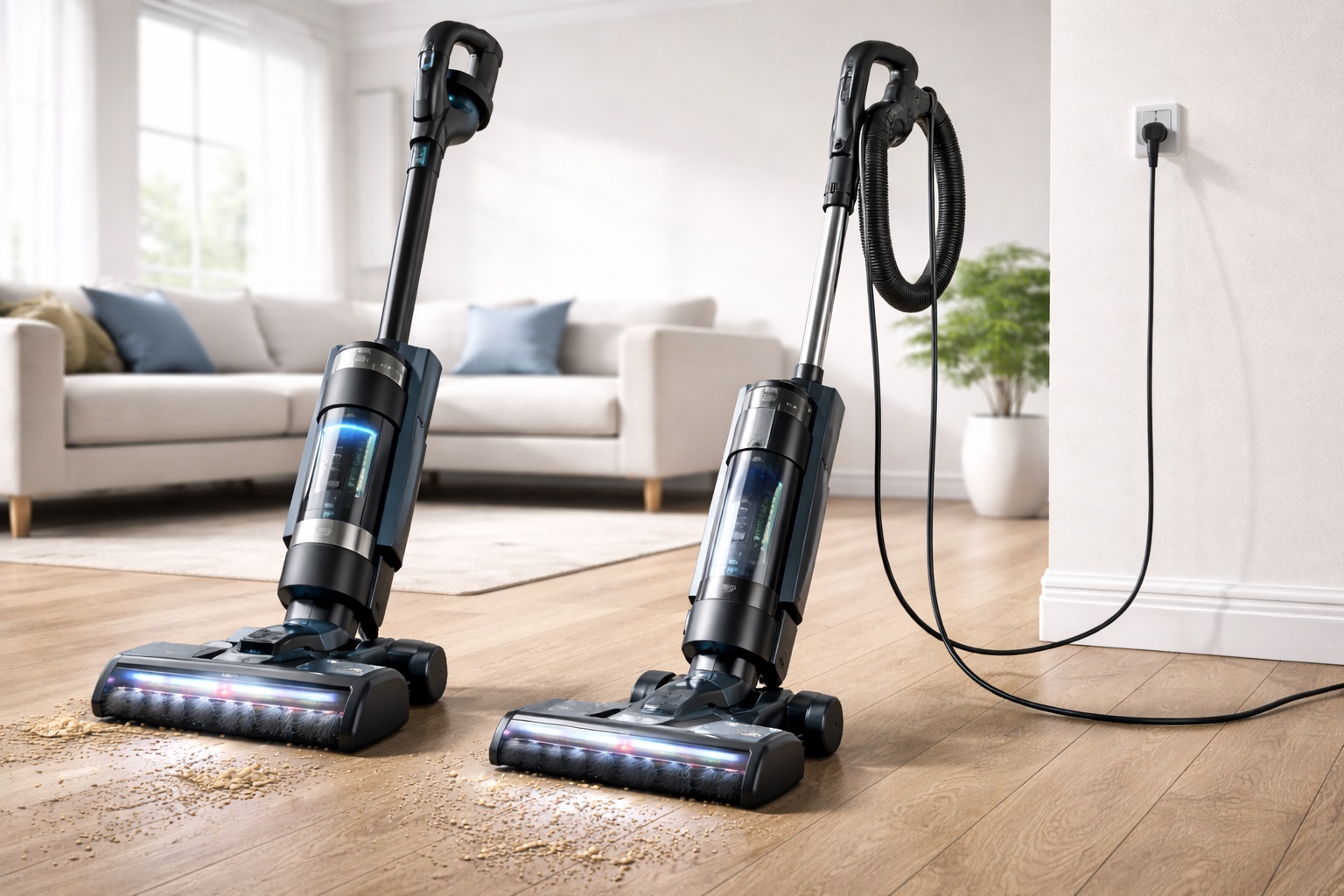
For vacuum cleaner manufacturers, distributors, and B2B buyers, one of the most common strategic questions is simple on the surface—but complex in reality:
Cordless or corded—which one sells better?
The truth is that sales performance varies significantly across regions, usage scenarios, and buyer expectations. In Europe, the Middle East, and global export markets, the answer is not about technology preference—it is about lifestyle, infrastructure, and operational habits.
This article explains how cordless and corded vacuum cleaners perform across different regions, and how B2B buyers should position products accordingly.
🧭 1. The Wrong Question: “Which Is Better?”
Many buyers approach this decision by asking:
But experienced B2B buyers ask instead:
Which fits the region’s cleaning behavior?
Which fits the daily usage pattern?
Which fits distribution and after-sales realities?
A multi-functional durable vacuum cleaner is not defined by its power source—but by how well it integrates into real usage environments.
🔋 2. Where Cordless Vacuum Cleaners Sell Better
Europe & High-Income Urban Markets
In much of Europe, cordless models dominate growth because:
A cordless handheld vacuum cleaner performs well because it:
Encourages quick daily cleaning
Eliminates cable management
Fits modern living habits
Cordless models combined with fast lightweight vacuum cleaner design see especially strong adoption.
Regional insight:
Convenience-driven markets favor cordless—even if power is slightly lower.
🐾 3. Pet Ownership Drives Cordless Demand
Across Europe and parts of the Middle East, rising pet ownership changes buying behavior.
A vacuum cleaner for pet hair sells better when it:
Is easy to grab
Can be used multiple times per day
Works on sofas, stairs, and cars
Cordless handheld formats outperform corded models here—not because they are stronger, but because they are used more often.
Sales truth:
Frequency of use drives repeat sales and reviews.
🚗 4. Car Cleaning Is a Cordless-Led Segment
The car vacuum cleaner category is overwhelmingly cordless in most regions.
Why?
In Europe and the Middle East, car-detailing services and personal car care strongly favor cordless handheld designs.
B2B insight:
If car use is a key scenario, cordless is not optional.
⚡ 5. Where Corded Vacuum Cleaners Still Win
Middle East & Power-Intensive Use Cases
In many Middle Eastern markets:
Corded vacuums remain competitive because:
Runtime is unlimited
Suction is sustained
Maintenance is simpler
For wet cleaning and heavier debris, corded wet and dry vacuum cleaner models still perform strongly in professional and semi-professional use.
Regional reality:
Endurance matters more than convenience in some markets.
💧 6. Wet & Dry Capability Changes the Equation
When wet cleaning is required, buyer preference shifts.
A wet and dry vacuum cleaner often sells better in corded form because:
Water pickup consumes more power
Continuous operation is required
Battery limitations become visible
However, hybrid designs are emerging where cordless models handle light wet tasks, while corded units manage heavy-duty cleaning.
Trend:
Wet & dry use still favors corded platforms in B2B markets.
🧩 7. Fast & Lightweight Design Narrows the Gap
Modern fast lightweight vacuum cleaner designs reduce the historical disadvantages of cordless models:
Improved motor efficiency
Better battery management
Lighter structural materials
As a result, cordless sales are expanding into scenarios once dominated by corded machines—especially in residential and light commercial segments.
📊 8. How Successful Brands Position Both
Top-performing brands rarely choose one side.
Instead, they:
Use cordless models for lifestyle, pet, and car cleaning
Use corded models for wet & dry and heavy-duty tasks
Share design language and accessories
A multi-functional durable vacuum cleaner platform that supports both power types performs best across regions.
Distribution insight:
Choice sells better than ideology.
❌ 9. Common Regional Sales Mistakes
Manufacturers and distributors often fail by:
Pushing cordless into power-heavy markets
Selling corded models as “old technology”
Ignoring car and pet use cases
Underestimating battery replacement concerns
Offering only one power option
Each mistake limits regional scalability.
✅ Conclusion: Cordless or Corded Depends on the Region, Not the Trend
There is no universal winner between cordless and corded vacuum cleaners.
In Europe, cordless handheld and lightweight models dominate daily-use and lifestyle-driven segments.
In the Middle East and power-intensive scenarios, corded and wet & dry models remain essential.
For B2B buyers and distributors, the strongest sales results come from matching power type to regional behavior and use cases, not from following global hype.
The best-selling strategy is not choosing sides—but choosing fit.
📌 Suitable Readers
Global B2B vacuum cleaner buyers
Importers and distributors
Regional sales managers
Product planners and OEM teams
Private label brand owners
📌 Hashtags
wet and dry vacuum cleaner, multi-functional durable vacuum cleaner, cordless handheld vacuum cleaner, fast lightweight vacuum cleaner, vacuum cleaner for pet hair, car vacuum cleaner, cordless vs corded vacuum, regional vacuum sales, global vacuum market, professional vacuum cleaner, B2B vacuum sourcing, cleaning appliance trends, pet cleaning solutions, car cleaning tools, portable vacuum cleaner, lightweight cleaning equipment, durable vacuum design, energy efficient cleaning, vacuum distributor, vacuum importer, European vacuum market, Middle East vacuum market, commercial vacuum cleaner, household cleaning appliances, multi application vacuum, carpet and hard floor vacuum, cordless cleaning solutions, corded vacuum systems, wet and dry cleaning equipment, after sales service vacuum, spare parts vacuum cleaner, long lifespan vacuum, cleaning equipment buyer, B2B cleaning solutions, vacuum cleaner manufacturer, OEM vacuum cleaner, private label vacuum, product positioning strategy, regional product fit, global distribution strategy, modern cleaning habits, Lanxstar











