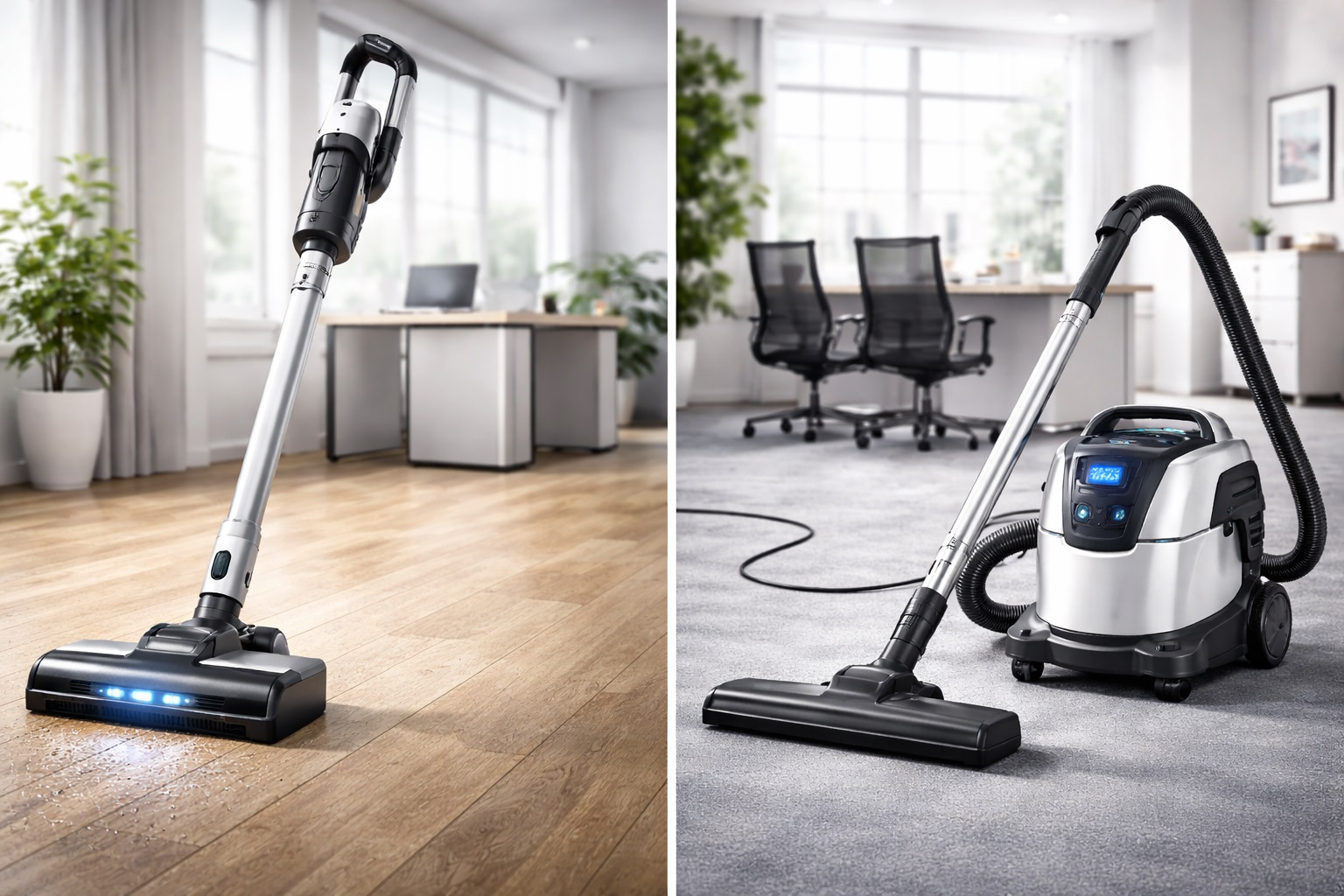
Businesses today operate in faster, more flexible environments than ever before. Cleaning equipment must keep pace with evolving workflows, space constraints, and efficiency targets. As a result, many organizations are re-evaluating whether traditional corded vacuum cleaners still meet their needs—or if cordless alternatives offer greater value.
Understanding the differences between these two categories is essential for making the right investment decision.
1. Mobility and Operational Flexibility
Mobility is where cordless models excel.
A Cordless Vacuum Cleaner allows staff to move freely between rooms, floors, and tight spaces without managing cables or searching for outlets. This flexibility is especially valuable in offices, hotels, clinics, and retail spaces.
Traditional models limit movement but offer predictable power.
2. Setup Time and Workflow Efficiency
Time lost to setup adds up.
Cordless vacuum cleaners are ready to use instantly, making them ideal for short, frequent cleaning tasks. Traditional models require cable management, which slows down workflow in dynamic environments.
For businesses focused on speed, cordless options often win.
3. Suction Power and Performance Stability
Power remains a core consideration.
Traditional corded vacuums often deliver continuous high output, making them reliable High Suction Vacuum Cleaner solutions for long cleaning cycles. However, modern cordless models have significantly narrowed this gap through improved motors and batteries.
Performance parity is increasingly common.
4. Battery Life vs Continuous Power 🔋
Energy delivery defines usage patterns.
Cordless vacuum cleaners rely on battery capacity, which limits runtime but offers flexibility. Traditional models provide continuous power but restrict mobility.
The better choice depends on cleaning duration and space size.
5. Weight, Ergonomics, and Operator Comfort
Comfort affects productivity.
Cordless models are often designed as Fast Lightweight Vacuum Cleaner solutions, reducing fatigue during frequent use. Traditional machines may be heavier but balance weight with stability for longer sessions.
Ergonomics influence staff efficiency.
6. Noise Level and Environment Sensitivity 🤫
Noise impacts user experience.
Many cordless models function as quiet vacuum cleaner solutions, suitable for shared or occupied spaces. Traditional models may produce higher noise levels, especially at peak power.
Quiet operation supports daytime cleaning.
7. Maintenance and Reliability
Maintenance complexity differs.
Cordless vacuum cleaners require battery care and eventual replacement. Traditional models rely more on motor longevity and cable integrity. Both require regular filter and component maintenance.
Maintenance planning affects lifecycle cost.
8. Energy Efficiency and Cost Control ⚡
Efficiency matters over time.
An Energy-Saving Efficient Powerful Vacuum Cleaner design can be found in both cordless and corded categories. However, cordless models often optimize power usage to extend runtime, reducing energy waste.
Efficiency supports sustainability goals.
9. Application Suitability by Business Type
Different businesses have different needs.
Cordless vacuum cleaners suit offices, hotels, retail stores, and service providers. Traditional models are often preferred in warehouses, factories, and large-area cleaning operations.
Application context determines value.
10. Total Cost of Ownership
Upfront price is only part of the equation.
Cordless models may have higher initial costs due to batteries, while traditional models may incur higher labor costs due to reduced flexibility. Evaluating total cost of ownership provides a clearer picture.
Long-term cost matters more than sticker price.
11. Distribution and Procurement Considerations
Procurement strategies are evolving.
From a vacuums procurement perspective, many organizations adopt mixed fleets, combining cordless and traditional models to cover different scenarios. This hybrid approach maximizes flexibility.
Balanced portfolios reduce risk.
12. Making the Right Choice for Your Business
There is no universal answer.
The best solution depends on space layout, cleaning frequency, staff availability, and budget. Manufacturers such as Lanxstar offer both cordless and traditional vacuum platforms, enabling businesses to select the right tool for each application.
Choice drives performance.
Conclusion
Cordless vacuum cleaners and traditional models each offer unique advantages. Cordless solutions excel in flexibility and speed, while traditional models deliver consistent power for extended cleaning tasks.
For businesses, the optimal strategy often lies in matching the right technology to the right application. Informed selection leads to higher efficiency, lower costs, and better cleaning outcomes.
To explore professional cordless and traditional vacuum cleaner solutions for business use, visit
www.lxvacuum.com
50 Related Keyword Groups
Lanxstar vacuum cleaner, Cordless Vacuum Cleaner, traditional vacuum cleaner, High Suction Vacuum Cleaner, Fast Lightweight Vacuum Cleaner, Energy-Saving Efficient Powerful Vacuum Cleaner, quiet vacuum cleaner, cordless handheld vacuums, Li-ion Cordless Handheld Vacuum Cleaner, commercial vacuum cleaner, business cleaning equipment, office cleaning vacuum, hotel cleaning equipment, retail cleaning solutions, professional vacuum cleaner, industrial cleaning equipment, battery powered vacuum, corded vacuum cleaner, maintenance friendly vacuum, ergonomic vacuum cleaner, energy efficient cleaning machines, facility management equipment, vacuums procurement, vacuum cleaner distribution, wholesale vacuum cleaner, B2B cleaning equipment solutions











