Hi, message us with any questions.
We're happy to help!





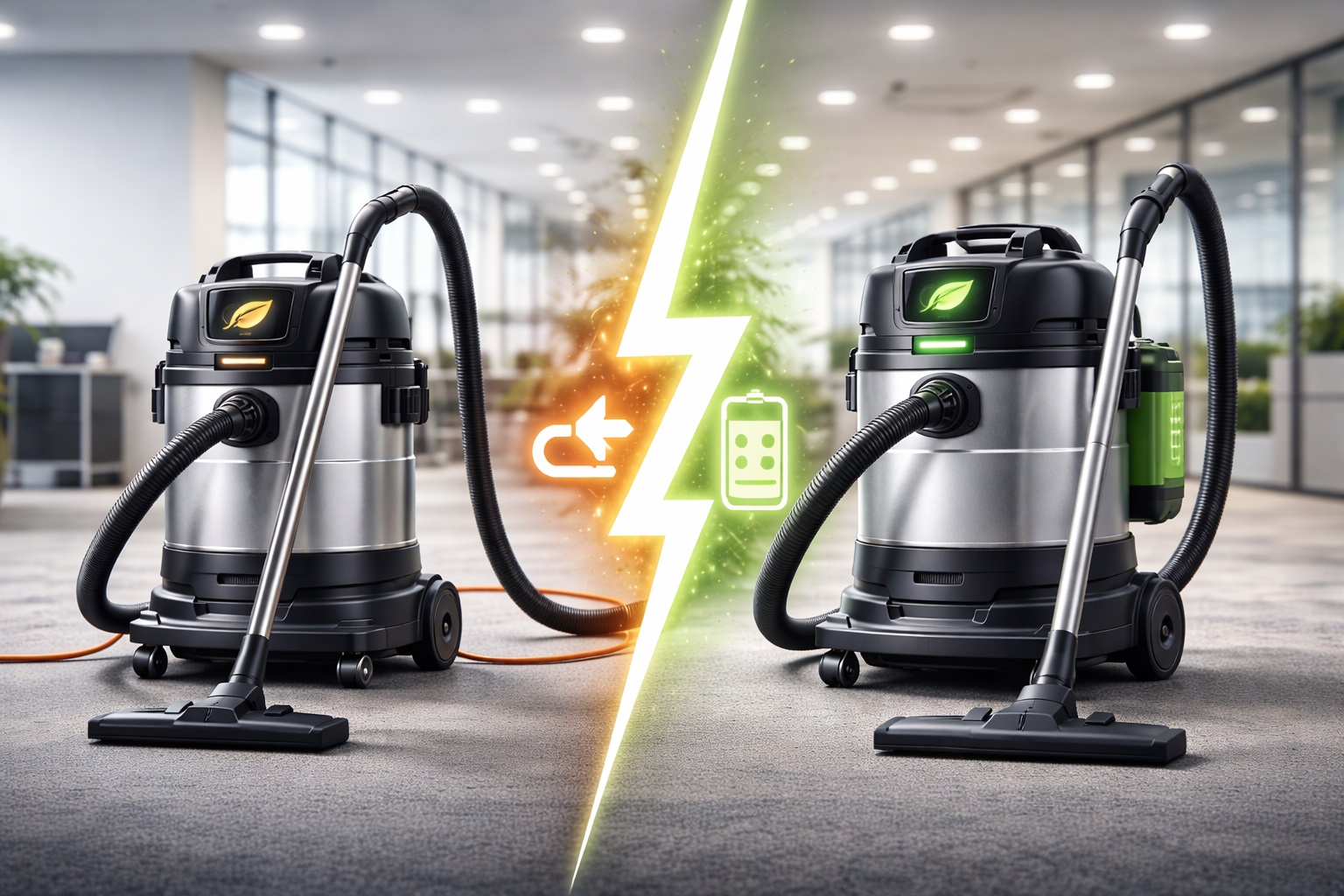
For years, corded commercial vacuums dominated professional cleaning.
They were powerful, familiar, and widely perceived as more reliable.
Today, that assumption is being challenged.
Across Europe and the Middle East, more cleaning companies and facility managers are reassessing whether corded or cordless systems better support modern operations — especially in environments where speed, flexibility, and labor efficiency increasingly define profitability.
This article examines where the commercial vacuum market is heading, what is driving the shift, and how professional buyers should evaluate corded versus cordless solutions from an operational and long-term business perspective.
🔌 1️⃣ Why Corded Vacuums Still Exist in Commercial Cleaning
Corded machines are not disappearing — and they still play a role.
They continue to offer:
Continuous runtime without battery planning
Stable performance for long, uninterrupted cleaning cycles
Familiar workflows for traditional cleaning teams
In large industrial or fixed-route environments, corded wet and dry vacuum cleaner systems can remain efficient.
However, their limitations become increasingly visible in dynamic, multi-site operations.
🔋 2️⃣ What Is Driving the Shift Toward Cordless Vacuum Cleaners
The rise of the Cordless Vacuum Cleaner in commercial cleaning is not driven by convenience — it is driven by workflow economics.
Cordless systems remove:
Time lost managing power cables
Safety risks caused by trailing cords
Productivity loss from limited movement
For cleaning companies operating across offices, apartments, and mixed-use facilities, mobility directly translates into higher daily output per operator.
⚡ 3️⃣ Speed and Weight Are Reshaping Equipment Expectations
In competitive cleaning markets, speed equals margin protection.
A Fast Lightweight Vacuum Cleaner enables:
Faster room-to-room transitions
Easier movement across stairs and corridors
Lower physical strain during long shifts
This is especially critical for Apartment Vacuum Cleaner applications, where tight layouts, multiple floors, and short service windows are common. Lightweight cordless designs allow teams to clean more spaces without increasing labor hours.
🔄 4️⃣ Cordless Does Not Mean Single-Function
A common concern among buyers is whether cordless systems can replace multiple machines.
Modern cordless platforms increasingly integrate wet and dry vacuum cleaner functionality, allowing operators to manage spills, debris, and routine cleaning with one unit.
A Multi-Functional Durable Vacuum Cleaner — whether corded or cordless — is now valued for:
Task versatility
Reduced equipment count
Simplified training and maintenance
The market direction is clear: single-purpose machines are losing relevance.
🏢 5️⃣ Apartment and Mixed-Use Buildings Are Leading the Shift
Demand patterns often change first at the edges of the market.
Apartment complexes, serviced residences, and mixed-use buildings are accelerating cordless adoption because they require:
Quiet operation
Rapid setup and teardown
Flexible movement across varied layouts
In these environments, power cords are no longer a minor inconvenience — they are a structural productivity barrier.
📉 6️⃣ Cost Comparison: Upfront Price vs Multi-Year Operational Reality
Cordless systems usually involve higher upfront investment due to battery technology.
However, professional buyers increasingly evaluate total cost of ownership across multi-year service contracts, not purchase price alone.
In real operations, cordless solutions often reduce:
Cleaning time per site
Labor fatigue and injury risk
Downtime caused by cable damage or setup delays
Over multi-year contracts, these operational gains frequently offset the initial investment and improve overall contract profitability.
🔍 Practical Example: Transitioning from Corded to Cordless
A regional cleaning company servicing offices and apartment buildings in the Middle East tested cordless units alongside traditional corded machines.
The results were consistent:
Setup time between tasks decreased noticeably
Operators completed daily routes faster
Fewer interruptions occurred due to cable handling
While corded machines were retained for certain long-duration tasks, cordless systems became the preferred option for routine and high-mobility cleaning.
The company adopted a hybrid equipment strategy, aligning vacuum type with task requirements rather than forcing a single solution.
📊 7️⃣ How Professional Buyers Are Framing the Decision Today
Experienced buyers are no longer asking “corded or cordless?”
They are asking:
Which environments benefit most from cordless mobility?
Can a cordless wet and dry vacuum cleaner meet performance expectations?
How does battery lifecycle affect long-term cost planning?
Is durability sufficient for continuous commercial use?
This reflects a shift from product comparison to workflow-driven procurement.
🚀 Final Insight: The Market Is Moving Toward Integration, Not Extremes
Most professional buyers are no longer debating whether to go cordless —
they are deciding how to integrate cordless systems into existing workflows.
The commercial vacuum market is heading toward:
Cordless solutions for speed, mobility, and apartment cleaning
Corded systems for continuous, heavy-duty applications
Multi-functional durable platforms that reduce equipment complexity
The winning strategy is not choosing sides.
It is choosing the right technology for each operational scenario.
📌 Suitable Readers
Commercial vacuum cleaner buyers
Cleaning company owners and operations managers
Facility management procurement teams
Apartment and mixed-use property service providers
Cleaning equipment distributors
📌 Hashtags
wet and dry vacuum cleaner, Multi-Functional Durable Vacuum Cleaner, Cordless Vacuum Cleaner, Fast Lightweight Vacuum Cleaner, Apartment Vacuum Cleaner, Wet and Dry Vacuum Cleaner, commercial vacuum cleaner, cordless commercial vacuum, corded vacuum systems, professional cleaning equipment, facility cleaning solutions, apartment cleaning equipment, lightweight commercial vacuum, B2B cleaning solutions, industrial vacuum systems, cleaning equipment strategy, cleaning workflow efficiency, modern cleaning technology, commercial hygiene solutions, vacuum equipment procurement, cleaning company operations, janitorial equipment professional, scalable cleaning operations, mixed-use building cleaning, battery powered vacuum systems, cleaning productivity tools, professional vacuum solutions, commercial cleaning market trends, EU cleaning standards, Middle East cleaning market, cleaning equipment distributor, advanced cleaning machines, durable vacuum systems, commercial cleaning ROI, facility maintenance equipment, vacuum system comparison, cleaning business scalability, portable cleaning equipment, Lanxstar



