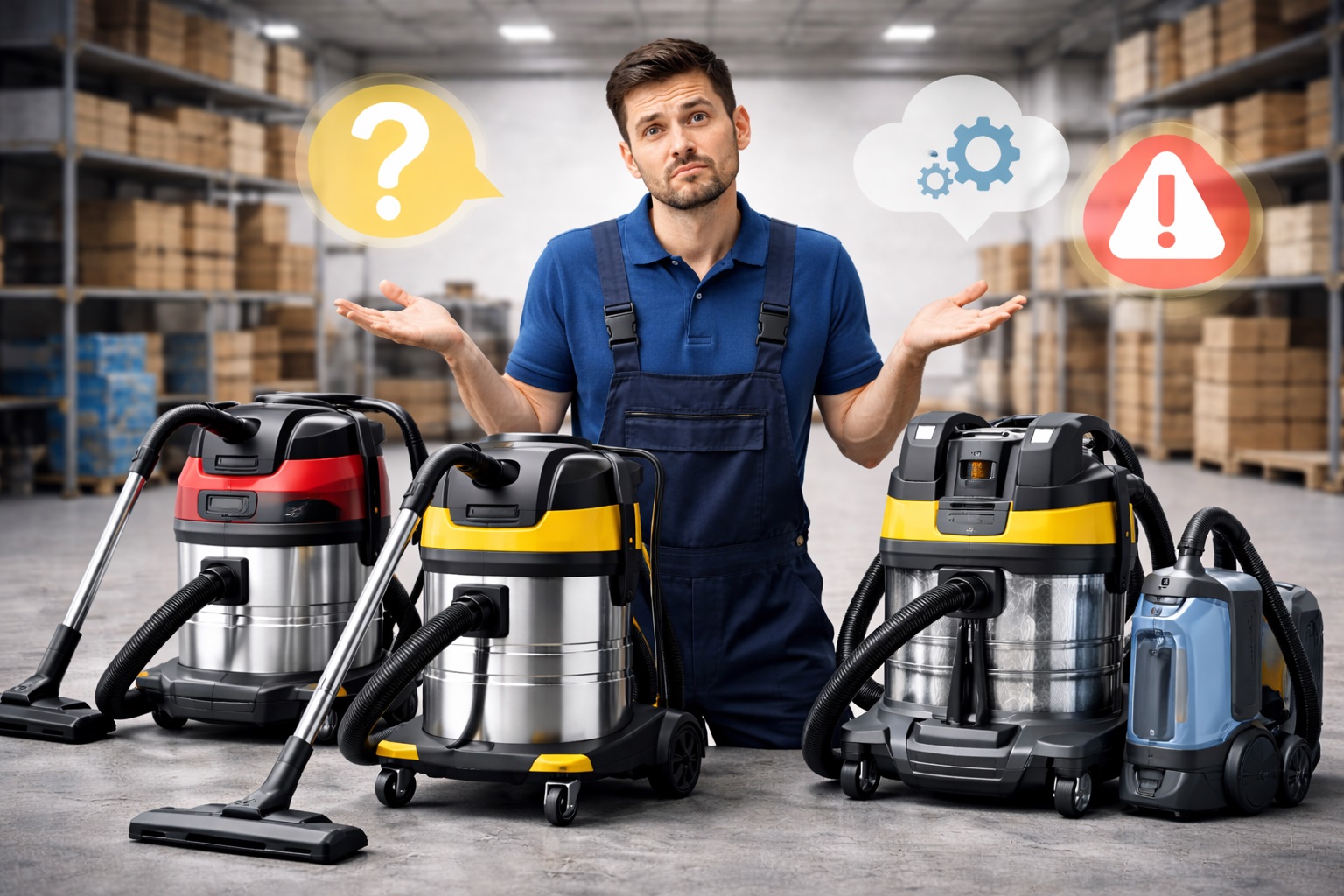
In the commercial cleaning industry, many purchasing decisions are still driven by assumptions that sound logical—but fail in real-world use.
For B2B buyers in Europe and the Middle East, these misconceptions often lead to higher operating costs, damaged client relationships, and avoidable equipment replacement.
This article breaks down the most common misunderstandings about commercial vacuum cleaners and explains what professional buyers should focus on instead.
🧭 Misconception 1: “Higher Suction Always Means Better Cleaning”
Many buyers assume that a high suction vacuum cleaner automatically delivers superior performance.
In reality, what matters most is sustained suction, not peak power.
Commercial environments require machines that:
Maintain airflow over long cleaning cycles
Perform consistently as filters load
Avoid overheating during continuous use
Machines optimized only for peak suction often lose effectiveness quickly, creating uneven cleaning results.
Reality check:
Professional cleaning values consistency over short-term power.
💧 Misconception 2: “Wet and Dry Is Just an Optional Upgrade”
Some buyers treat wet-and-dry capability as a non-essential feature.
In practice, a wet and dry vacuum cleaner often determines whether a team can respond professionally to:
In mixed-use facilities—common across Europe and the Middle East—wet dry vacuum cleaners reduce the need for multiple machines and simplify staff training.
Reality check:
Wet-and-dry capability is about operational flexibility, not luxury.
🧱 Misconception 3: “All Commercial Vacuums Are Durable Enough”
Not all machines labeled “commercial” are built for the same workload.
A true multi-functional durable vacuum cleaner is designed to withstand:
Lower-cost models may look similar but often rely on lighter materials and simplified internal structures.
Reality check:
Durability is engineered, not advertised.
🌬️ Misconception 4: “Filtration Only Matters for Sensitive Environments”
Filtration is often associated only with hospitals or allergy-specific use cases.
However, a vacuum cleaner for allergies also benefits:
Poor filtration allows fine dust to re-enter the air, undermining cleaning results and indoor air quality.
Reality check:
Clean floors do not equal clean air.
🧩 Misconception 5: “One Machine Cannot Handle Multiple Surfaces Well”
Some buyers believe that specialized machines are always better than versatile ones.
Modern commercial designs prove otherwise. A vacuum for multi-surface environments can effectively clean:
Carpets
Tiles
Stone and mixed flooring
When properly engineered, multi-surface machines reduce SKU complexity and improve operational efficiency for distributors and contractors.
Reality check:
Versatility, when engineered correctly, increases professionalism—not compromise.
🔊 Misconception 6: “Noise Is a Minor Issue”
Noise is often overlooked during procurement, yet it strongly affects client perception.
In offices, hotels, and healthcare facilities:
Buyers increasingly evaluate noise levels as part of overall service quality.
Reality check:
Noise control is part of professional image.
💸 Misconception 7: “Lower Price Means Better Cost Control”
Upfront price is easy to compare. Long-term cost is not.
Lower-priced machines often result in:
Over a 3–5 year lifecycle, a cheaper unit can cost significantly more than a higher-quality alternative.
Reality check:
Cost control comes from predictability, not discounts.
🛠️ Misconception 8: “After-Sales Service Is a Secondary Concern”
Many buyers focus heavily on product specifications but underestimate after-sales realities.
Commercial vacuum cleaners should be:
Without reliable after-sales support, even a well-designed machine becomes a liability.
Reality check:
Serviceability is part of product design.
📊 How Professional Buyers Avoid These Misconceptions
Experienced B2B buyers use a different evaluation mindset:
They assess workload suitability, not just specs
They calculate cost per operating hour, not unit price
They prioritize consistency and serviceability
This approach consistently leads to better long-term outcomes.
✅ Conclusion: Correcting Misconceptions Protects Margins
Misconceptions about commercial vacuum cleaners often feel harmless—until they translate into operational problems.
For European and Middle Eastern B2B buyers, understanding what truly matters in commercial vacuum design helps avoid costly mistakes, improve service quality, and protect long-term business performance.
📌 Suitable Readers
European & Middle Eastern B2B vacuum cleaner buyers
Importers and distributors
Commercial cleaning contractors
Facility management companies
Cleaning industry entrepreneurs
📌 Hashtags
wet and dry vacuum cleaner, wet dry vacuum cleaners, multi-functional durable vacuum cleaner, high suction vacuum cleaner, vacuum cleaner for allergies, vacuum for multi-surface, commercial vacuum cleaner, professional cleaning equipment, industrial cleaning equipment, B2B vacuum sourcing, commercial cleaning solutions, EU vacuum compliance, Middle East cleaning market, hotel cleaning equipment, office cleaning machines, healthcare cleaning tools, facility management equipment, durable cleaning machines, heavy duty vacuum, low maintenance vacuum, energy efficient cleaning, sustainable cleaning equipment, vacuum distributor, vacuum importer, cleaning industry myths, professional cleaning tools, commercial floor care, industrial vacuum system, multi application vacuum, hard floor vacuum, carpet and hard floor vacuum, after sales service vacuum, spare parts vacuum cleaner, long lifespan vacuum, cleaning equipment buyer, B2B cleaning solutions, vacuum cleaner manufacturer, OEM vacuum cleaner, private label vacuum, allergy filtration vacuum, HEPA vacuum alternative, modern cleaning equipment, facility service tools, smart procurement cleaning, Lanxstar