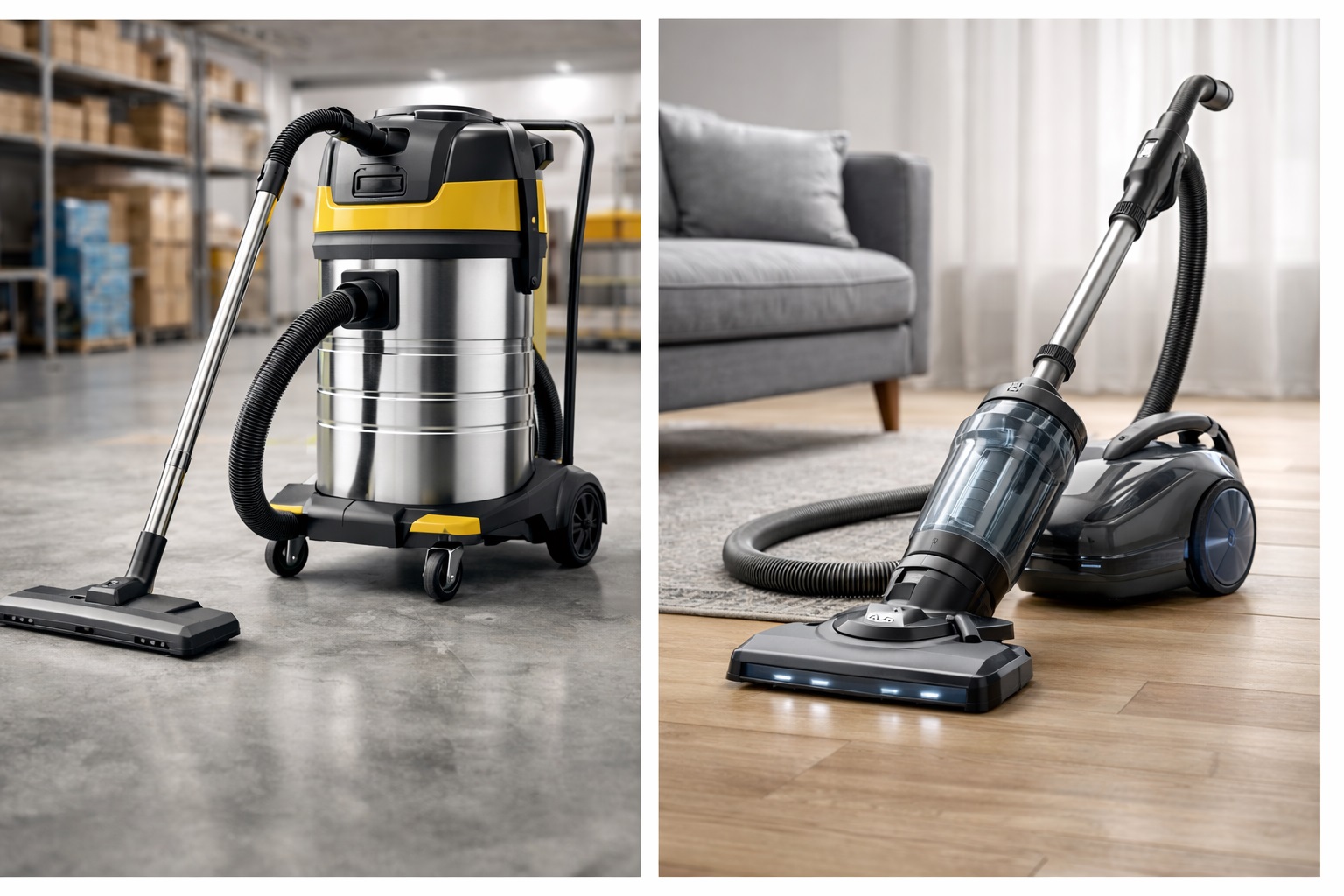
Audience focus: European & Middle Eastern B2B vacuum cleaner buyers, importers, distributors, and procurement managers
For professional buyers, choosing between commercial and residential vacuum cleaners is not a technical debate—it is a procurement risk decision. Misalignment between machine design and real-world usage leads to downtime, warranty disputes, and hidden operating costs that only appear months after purchase.
This revised version strengthens the original article by adding buyer checklists, common sourcing mistakes, and decision frameworks that experienced procurement teams actually use.
🧭 1. Usage Intensity: The First Procurement Filter
Residential vacuum cleaners are designed for low-duty, intermittent use. Commercial vacuum cleaners are engineered for continuous operation, often across multiple shifts.
Procurement insight:
If a vacuum is operated by paid staff rather than homeowners, residential models usually fail within 3–6 months—even when suction specs look similar on paper.
⚙️ 2. Motor Architecture & Sustained Suction
Many residential units advertise impressive peak suction numbers. Commercial machines prioritize thermal stability and airflow consistency.
A professional high suction vacuum cleaner maintains performance under load, even as filters fill with debris.
Why buyers should care:
🧱 3. Structural Durability & Lifetime Value
Commercial vacuum cleaners use reinforced housings, impact-resistant materials, and heavy-duty connectors.
A true multi-functional durable vacuum cleaner is designed for transport, daily handling, and varied environments—not showroom appeal.
Hidden value: fewer warranty claims and simplified distributor logistics.
💧 4. Wet and Dry Capability as a Market Multiplier
A wet and dry vacuum cleaner expands addressable markets instantly:
In Middle Eastern markets especially, mixed-use buildings make wet-and-dry functionality a commercial advantage rather than an upgrade.
🌱 5. Energy Efficiency Under Real Regulations
An energy-saving efficient powerful vacuum cleaner is increasingly required for compliance, tenders, and sustainability-driven procurement.
Professional buyers evaluate:
Power draw per cleaning hour
Efficiency with partially clogged filters
Long-term electricity cost
🧩 6. Multi-Surface Capability Reduces SKU Complexity
A vacuum for multi-surface environments allows distributors to serve offices, hotels, and retail spaces with fewer product lines.
This reduces:
Training costs
Inventory pressure
After-sales complexity
🪵 7. Hardwood Floors: Precision Over Power
A commercial vacuum cleaner for hardwood floors must balance suction control with surface protection.
Over-aggressive brush systems common in residential units often cause long-term floor damage in professional environments.
🛠️ 8. Maintenance Reality: What Happens After Delivery
Commercial units are designed for:
Residential models are often treated as disposable—an unacceptable risk for B2B buyers.
📋 9. Buyer Checklist: Commercial or Residential?
Before approving any vacuum cleaner, professional buyers should confirm:
Can the motor operate continuously for 6–8 hours?
Are spare parts available regionally?
Is the unit suitable for wet and dry cleaning?
Does it support multiple floor types?
What is the cost per operating hour?
If more than two answers are uncertain, a residential unit is likely the wrong choice.
❌ 10. Common Sourcing Mistakes B2B Buyers Make
Even experienced buyers repeat these errors:
Choosing based on peak suction instead of sustained performance
Ignoring serviceability and spare-part logistics
Using residential models in commercial contracts
Underestimating energy cost over product lifetime
Buying too many SKUs instead of versatile platforms
Avoiding these mistakes often saves more money than negotiating unit price.
📊 11. Procurement Decision Framework
Professional buyers evaluate vacuum cleaners using three lenses:
Operational fit: real usage conditions
Financial fit: total cost of ownership
Scalability: ability to support multiple clients and environments
Commercial vacuum cleaners consistently outperform residential models when all three are applied.
✅ Conclusion: Buy for Reality, Not Brochures
The difference between commercial and residential vacuum cleaners is not cosmetic—it is structural, financial, and strategic.
For European and Middle Eastern B2B buyers, commercial solutions deliver reliability, compliance, and predictable long-term value. Choosing correctly protects margins, reputation, and customer relationships.
📌 Suitable Readers
European & Middle Eastern B2B vacuum cleaner buyers
Importers and distributors
Facility management companies
Cleaning equipment entrepreneurs
Product and R&D engineers
📌 Hashtags
wet and dry vacuum cleaner, commercial vacuum cleaner, residential vacuum cleaner, multi-functional durable vacuum cleaner, high suction vacuum cleaner, energy-saving efficient powerful vacuum cleaner, vacuum for multi-surface, vacuum cleaner for hardwood floors, industrial cleaning equipment, professional vacuum cleaner, B2B vacuum sourcing, commercial cleaning solutions, EU vacuum compliance, Middle East cleaning market, hotel cleaning equipment, office cleaning machines, airport cleaning solutions, durable cleaning machines, heavy duty vacuum, low maintenance vacuum, energy efficient cleaning, sustainable cleaning equipment, vacuum distributor, vacuum importer, cleaning industry trends, commercial janitorial tools, floor care equipment, hard floor vacuum, carpet and hard floor vacuum, after sales service vacuum, spare parts vacuum cleaner, long lifespan vacuum, professional cleaning tools, commercial floor care, industrial vacuum system, multi application vacuum, cleaning equipment buyer, B2B cleaning solutions, vacuum cleaner manufacturer, OEM vacuum cleaner, private label vacuum, hotel housekeeping equipment, facility management tools, smart procurement cleaning, Lanxstar