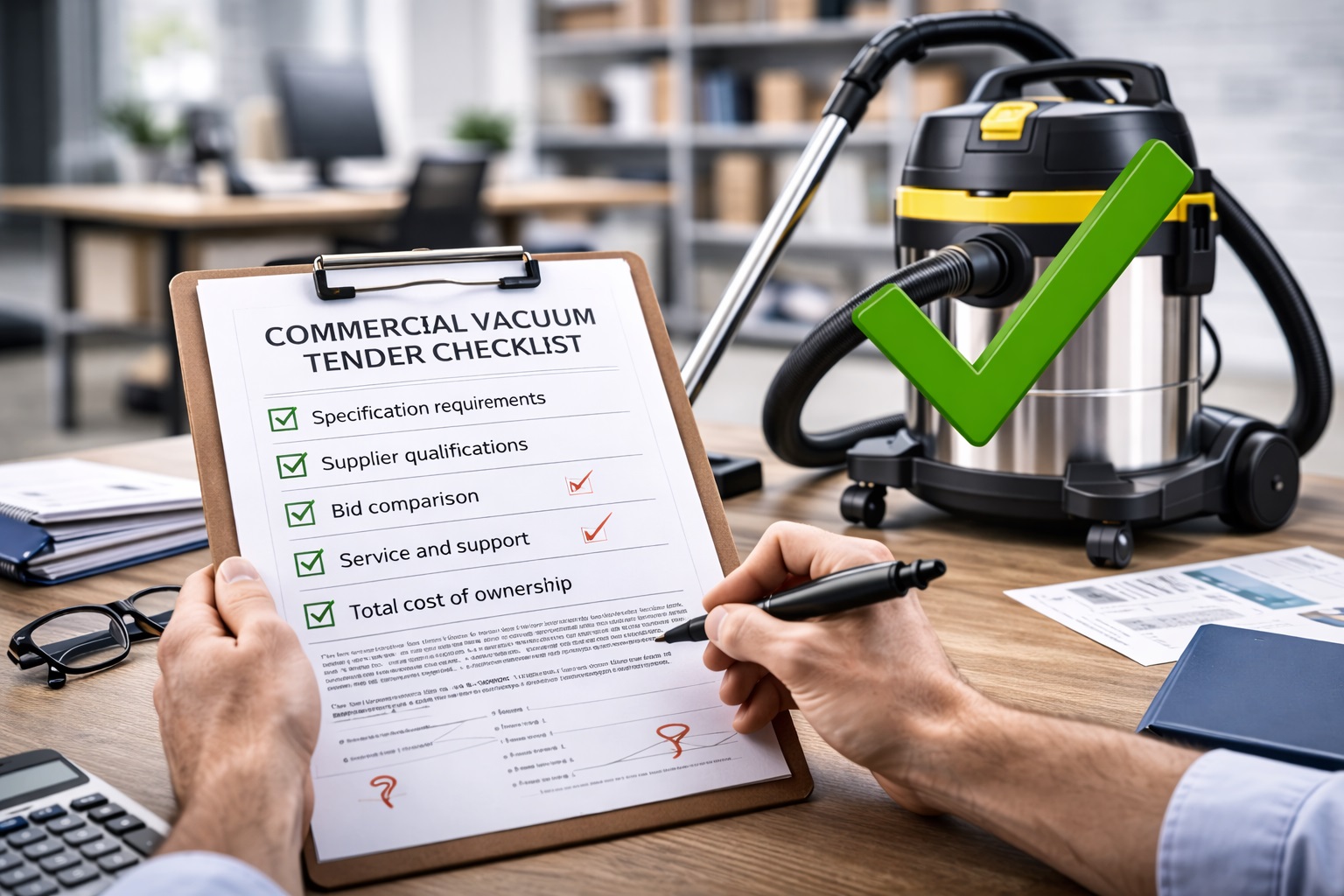
Most tender mistakes are discovered after the award — not during evaluation.
Winning a commercial vacuum tender often feels like success.
But for experienced procurement teams, the real question is:
Will this tender decision still make sense
after months of real operation, complaints, and maintenance?
For European and Middle Eastern B2B buyers, commercial vacuum tenders are frequently designed around pricing formulas, technical checklists, and compliance boxes.
Yet the most expensive mistakes rarely come from missing documents —
they come from rewarding the wrong risk profile.
This article explains how costly mistakes are made in commercial vacuum tenders, and how professional buyers redesign tender logic to avoid them.
📉 1. Letting Price Weight Quietly Override Risk Evaluation
The most common tender failure is not “choosing the cheapest bid.”
It is giving price too much influence over risk.
This approach unintentionally rewards:
For equipment like a wet and dry vacuum cleaner, price-heavy scoring ignores:
Professional tender logic:
Price should reduce entry cost — not determine long-term operational risk.
⚙️ 2. Treating “Durable” as a Specification Instead of a Usage Commitment
Many tenders request “industrial-grade” or “heavy-duty” equipment.
For a Multi-Functional Durable Vacuum Cleaner, durability only has meaning when tied to:
Common mistake:
Durability is evaluated on paper, without defining usage assumptions.
Professional fix:
Force bidders to declare durability conditions — and align scoring with those assumptions.
💨 3. Rewarding Peak Suction Instead of Real Productivity
Tenders often favor the highest advertised suction, rewarding a High Suction Vacuum Cleaner on paper.
What this ignores:
Suction stability under filter load
Performance consistency over time
Cleaned area per labor hour
Operational reality:
Peak suction wins tender points.
Stable suction protects budgets.
Professional tenders score productivity consistency, not peak numbers.
⚡ 4. Ignoring Energy Efficiency Degradation Over the Lifecycle
An Energy-Saving Efficient Powerful Vacuum Cleaner should be evaluated beyond initial testing.
Common tender gaps:
No efficiency degradation limits
No lifecycle compliance responsibility
No penalty for post-install efficiency loss
In Europe-facing tenders, this creates:
Professional approach:
Energy efficiency must be a lifecycle obligation, not a one-time claim.
🌬️ 5. Treating Filtration as a Checkbox Instead of an Operational Risk
A Vacuum Cleaner for Allergies is often included as a mandatory line item.
But filtration failure causes:
Secondary dust circulation
Re-cleaning labor
Complaints in hospitals, offices, and hospitality environments
Tender mistake:
Evaluating filtration by filter grade only, without sealed system validation.
Professional buyers require:
Clear filtration architecture and test methodology — not just filter labels.
🔇 6. Underestimating Noise as an Operational Constraint
A Quiet Vacuum for Night Use is essential in:
Hotels
Hospitals
Residential facilities
Tenders often list noise limits but fail to define:
Hidden cost:
Noise issues restrict cleaning schedules and reduce service flexibility.
Professional tenders treat noise as an operational constraint, not a cosmetic feature.
🛠️ 7. Evaluating Equipment Without Evaluating Service Capability
Many tenders score technical specs heavily — and service capability lightly.
This is dangerous.
Common oversights:
No service response-time scoring
No spare-part availability commitments
No escalation or resolution mechanism
Tender reality:
Weak service capability converts minor failures into contract-level disputes.
Professional tenders score service structure, not promises.
📉 8. Separating Tender Evaluation From Contract Risk
Tenders and contracts are often treated as two separate stages.
This creates a dangerous gap:
Experienced buyers align:
Tender criteria, scoring logic, and contract clauses into one risk-controlled system.
🧠 Final Insight: Tenders Select Risk Profiles, Not Just Suppliers
Experienced procurement teams understand:
A commercial vacuum tender does not select the lowest bidder.
It selects the risk profile you will live with for years.
Well-designed tenders:
Poorly designed tenders simply delay cost — they don’t eliminate it.
🔍 A Tender Sanity Check
If a tender:
Rewards lowest price disproportionately
Evaluates specifications without usage context
Treats service as secondary
Then the most expensive mistake has likely already been made.
📌 Suitable Reading Audience
European & Middle Eastern B2B vacuum buyers
Commercial vacuum distributors
Facility management procurement teams
Cleaning industry entrepreneurs
Public & private tender committees
Professional cleaning associations
📌 Hashtags
commercial vacuum tender, vacuum tender mistakes, wet and dry vacuum cleaner, multi-functional durable vacuum cleaner, high suction vacuum cleaner, energy-saving efficient powerful vacuum cleaner, vacuum cleaner for allergies, quiet vacuum for night use, industrial vacuum system, professional cleaning equipment, B2B cleaning equipment, vacuum distributor, European vacuum market, Middle East cleaning equipment, commercial cleaning systems, facility management tools, warehouse cleaning equipment, hotel cleaning solutions, hospital cleaning equipment, night shift cleaning tools, energy efficient cleaning, long life vacuum motor, low maintenance vacuum, commercial cleaning ROI, total cost of ownership, procurement strategy, industrial sourcing, B2B buyer insights, cleaning industry innovation, vacuum technology, dust control solutions, indoor air quality tools, professional hygiene equipment, commercial equipment sourcing, supply chain reliability, private label vacuum, vacuum brand building, B2B distribution model, cleaning equipment growth, after-sales service system, industrial equipment buyers, facility operations efficiency, Lanxstar











