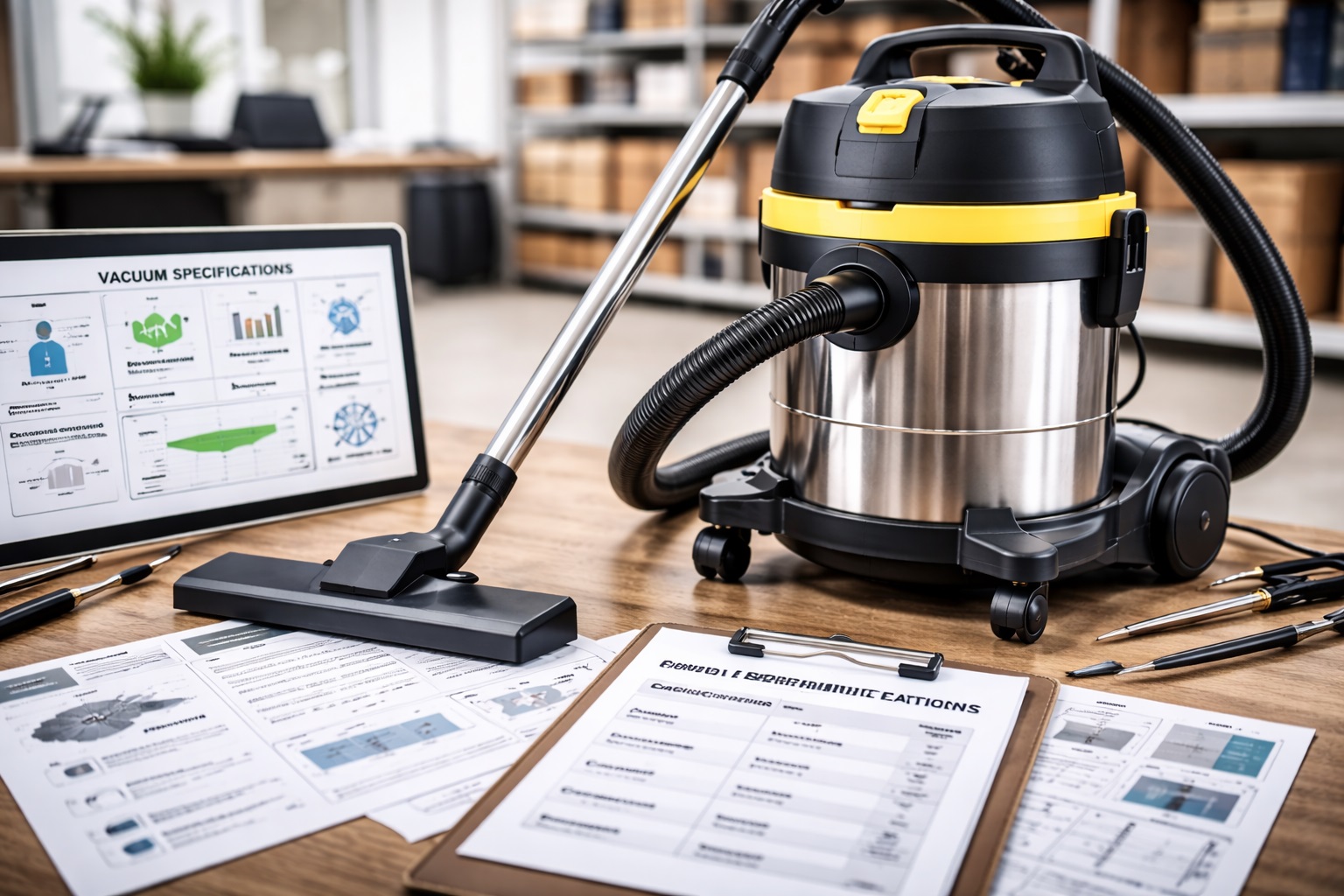
Most buyers read specifications.
Very few know how to read them correctly.
Commercial vacuum specifications don’t lie —
but they regularly mislead purchasing decisions.
For European and Middle Eastern B2B buyers, specification sheets are often packed with impressive numbers: higher suction, bigger motors, larger tanks, more features.
Yet many procurement mistakes happen not because buyers ignore specs —
but because they trust the wrong specifications to represent long-term commercial value.
This guide explains how professional buyers actually interpret commercial vacuum specifications, separating decision-critical data from marketing noise.
📊 1. Suction Power: Peak Numbers vs Long-Term Stability
Many products position themselves as a High Suction Vacuum Cleaner, highlighting peak air watts or kPa values.
What specifications usually show:
Maximum suction values
Peak motor output
What they rarely show:
In real commercial use:
Buyer insight:
Stable suction across long working cycles matters far more than impressive peak numbers on day one.
💧 2. Wet & Dry Capability: A Checkbox or a System?
A wet and dry vacuum cleaner (often grouped under Wet Dry Vacuum Cleaners) is frequently listed as a simple feature.
In reality, wet & dry performance is a system-level specification, not a checkbox.
Professional buyers look beyond the label and evaluate:
Motor protection architecture
Seal materials and positioning
Drainage efficiency
Filtration separation between wet and dry modes
Reality check:
If the specification sheet cannot explain how wet and dry modes are isolated, durability risks are high.
⚙️ 3. Durability Is Hidden in Indirect Specifications
You will almost never see a line called “durability” on a specification sheet.
Instead, durability reveals itself through:
Motor cooling design
Bearing ratings
Seal materials
Structural reinforcement
A true Multi-Functional Durable Vacuum Cleaner shows consistency across these indirect indicators.
Experienced buyers ask:
Which components define lifespan — and which ones fail first under continuous use?
🧼 4. Capacity Numbers Mean Nothing Without Structural Context
Tank capacity is one of the easiest numbers to market — and one of the easiest to misunderstand.
A larger tank only adds value if:
The structure supports the load
Seals remain stable under pressure
Drainage does not require frequent manual handling
For Wet Dry Vacuum Cleaners, large capacity without reinforcement leads to:
Tank deformation
Seal leakage
Reduced service life
Spec-reading rule:
Capacity must always be evaluated together with material thickness and structural design.
🌬️ 5. Filtration Specifications Define Workload, Not Just Air Quality
A Vacuum Cleaner for Allergies is defined less by filter grade alone and more by airflow sealing quality.
Specifications that matter most:
Poor filtration leads to:
Secondary dust settlement
Re-cleaning work
Complaints in hotels, offices, and healthcare facilities
Key insight:
Filtration performance directly impacts labor cost, not just hygiene compliance.
🧭 6. Multi-Surface Performance Is Rarely Captured on Spec Sheets
A Vacuum for Multi-Surface environments must handle transitions smoothly:
Most specification sheets list suction and motor power —
they do not show what happens after repeated surface transitions.
Professional evaluation method:
Test performance after transitions, not on isolated surfaces.
🔍 7. Maintenance Predictability Never Appears in Specifications — Ask for It
Specification sheets almost never include:
Yet these factors define long-term operating cost.
Experienced buyers ask suppliers:
Which parts wear fastest?
Are spare parts standardized across models?
How does maintenance scale with usage intensity?
Rule of thumb:
Predictability beats “low maintenance” every time.
🧠 Final Insight: Specifications Are Inputs, Not Decisions
Professional B2B buyers understand:
Specifications inform decisions —
they do not make them.
The smartest buyers:
That mindset prevents expensive surprises after deployment.
🔍 A Buyer’s Specification Reality Check
If a specification sheet focuses heavily on:
Peak suction
Motor wattage
Tank size
But says little about:
Performance stability
Filtration sealing
Maintenance logic
Then the real cost is hidden — not eliminated.
📌 Suitable Reading Audience
European & Middle Eastern B2B vacuum buyers
Commercial vacuum distributors
Facility management procurement teams
Cleaning industry entrepreneurs
Vacuum product development engineers
Professional cleaning associations
📌 Hashtags
commercial vacuum cleaner, wet and dry vacuum cleaner, wet dry vacuum cleaners, multi-functional durable vacuum cleaner, high suction vacuum cleaner, vacuum for multi-surface, vacuum cleaner for allergies, industrial vacuum system, professional cleaning equipment, B2B cleaning equipment, vacuum distributor, European vacuum market, Middle East cleaning equipment, commercial cleaning systems, facility management tools, warehouse cleaning equipment, hotel cleaning solutions, hospital cleaning equipment, energy efficient cleaning, long life vacuum motor, low maintenance vacuum, commercial cleaning ROI, total cost of ownership, procurement strategy, industrial sourcing, B2B buyer insights, cleaning industry innovation, vacuum technology, dust control solutions, indoor air quality tools, professional hygiene equipment, commercial equipment sourcing, supply chain reliability, private label vacuum, vacuum brand building, B2B distribution model, cleaning equipment growth, after-sales support system, industrial equipment buyers, facility operations efficiency, Lanxstar











