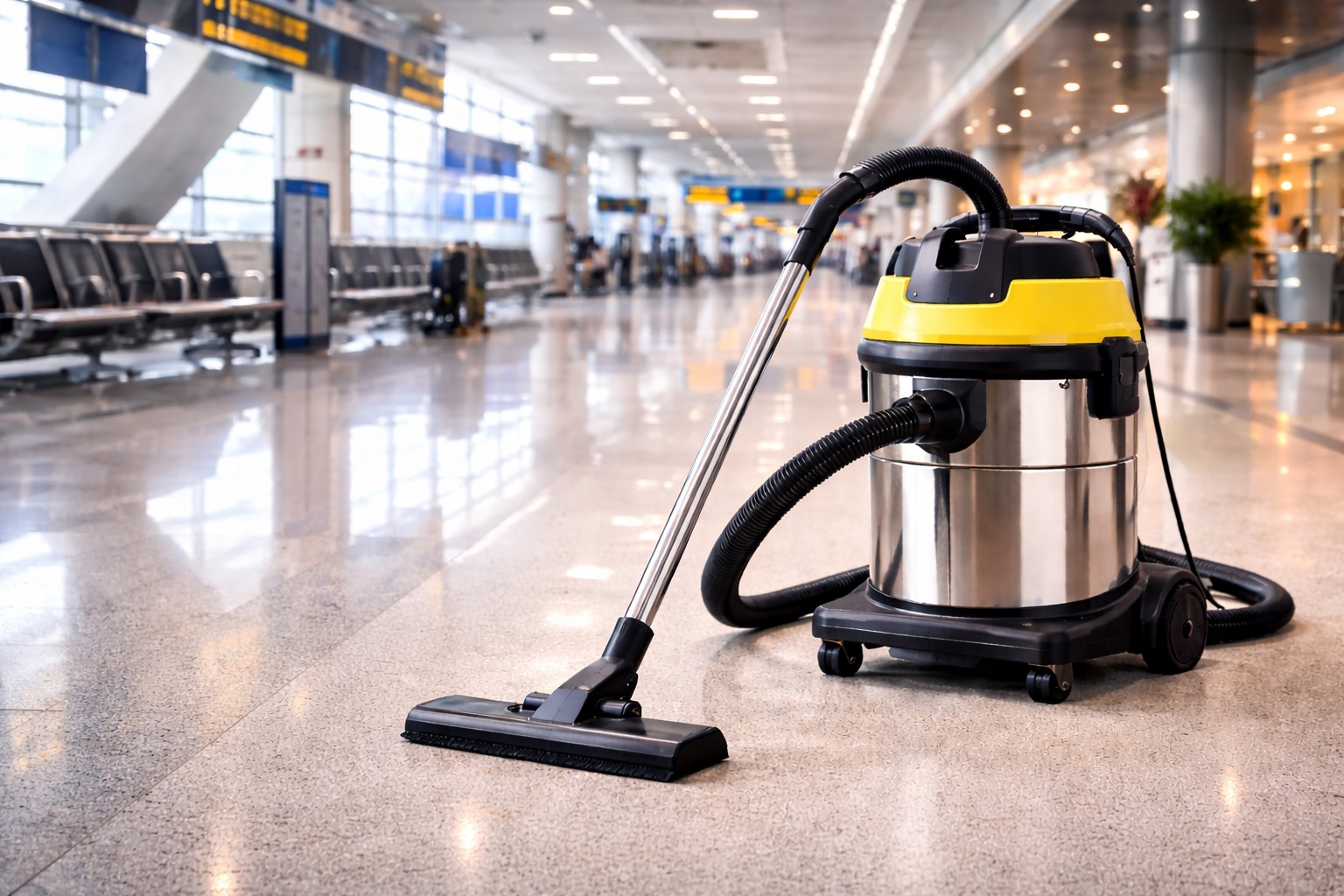
Airports and train stations are not just large buildings.
They are living systems.
They operate nearly 24/7, handle massive and unpredictable foot traffic, and function under zero tolerance for disruption.
In these environments, cleaning equipment is not a background tool—it is part of the operational infrastructure.
In transportation hubs, cleaning efficiency is inseparable from passenger flow and safety.
This article explains what really matters when selecting vacuum solutions for airports and train stations—and why conventional commercial thinking often breaks down at this scale.
🧠 1. Large Facilities Multiply Small Inefficiencies
In small buildings, inefficiencies stay small.
In airports and train stations, they scale exponentially.
Consider:
A vacuum that loses even a few minutes per cycle creates hours of lost productivity across teams.
This is why large facilities require a Multi-Functional Durable Vacuum Cleaner that can:
Replace multiple specialized machines
Maintain performance over long shifts
Reduce tool switching across zones
💧 2. Wet & Dry Capability Is a Baseline Requirement
Spills are constant in transportation hubs:
Drinks and food
Rainwater and snow
Cleaning residues
Stopping to switch equipment is not just inefficient—it is unsafe.
A true wet and dry vacuum cleaner (or Wet and Dry Vacuum Cleaner) allows teams to:
In airports and stations, wet & dry capability is not an upgrade—it is a baseline.
🧹 3. Capacity Determines How Far a Team Can Go
Distance matters in large facilities.
Small tanks mean:
A Large-Capacity Wet Dry Vacuum Cleaner enables:
Operational reality:
In a terminal or station, walking to empty a tank can take longer than cleaning an entire zone.
💨 4. High Suction Must Be Stable, Not Aggressive
Large facilities generate mixed and heavy debris:
Fine dust
Grit and sand
Packaging waste
A High Suction Vacuum Cleaner is essential—but only when suction is stable under continuous load.
Unstable suction leads to:
At scale, unstable performance costs more than insufficient peak power.
🌬️ 5. HEPA Filtration Supports Air Quality in Enclosed Hubs
Airports and train stations are enclosed environments with:
A HEPA Filter Vacuum Cleaner helps:
Capture fine particulate matter
Reduce airborne dust during cleaning
Support healthier indoor air
However, HEPA filtration must be supported by:
Without this, HEPA becomes a bottleneck instead of a benefit.
📌 Case Insight: Why One Terminal Changed Its Cleaning Standard
A regional airport struggled with:
After transitioning to:
Large-capacity wet & dry systems
Durable, multi-functional platforms
Stable high-suction designs with HEPA support
the airport achieved:
The number of cleaners didn’t change.
The system did.
🚀 How Transportation Buyers Should Think
Experienced buyers for large facilities don’t ask:
“Which vacuum has the highest specs?”
They ask:
How far can one machine go before stopping?
Can it handle wet and dry hazards instantly?
Will suction remain stable across long shifts?
Does filtration support air quality without slowing work?
They understand one core principle:
In large facilities, equipment must scale with operations—or it becomes the bottleneck.
✅ Large-Facility Decision Checklist
Before approving vacuum solutions for airports or train stations, confirm:
True wet and dry vacuum cleaner capability
Large-Capacity Wet Dry Vacuum Cleaner design
Stable High Suction Vacuum Cleaner performance
Multi-Functional Durable Vacuum Cleaner construction
HEPA Filter Vacuum Cleaner with sealed airflow
Built for continuous, high-traffic environments
If any item is missing, inefficiency will multiply at scale.
✅ Conclusion: In Transportation Hubs, Systems Matter More Than Specs
Airports and train stations demand more than powerful machines.
They demand systems that move as smoothly as passengers do.
By choosing:
Multi-Functional Durable Vacuum Cleaner platforms
Large-Capacity Wet Dry Vacuum Cleaner solutions
Stable High Suction Vacuum Cleaner performance
Proper HEPA Filter Vacuum Cleaner systems
Reliable wet and dry vacuum cleaner capability
large facilities protect safety, efficiency, and passenger experience.
In large transportation hubs, the right vacuum doesn’t just clean floors.
It keeps the entire operation moving.
👥 Suitable Readers
Airport and railway procurement managers
Transportation facility FM teams
Large-scale cleaning contractors
Infrastructure operations managers
EU & Middle East public transportation authorities
🔖 Hashtags
wet and dry vacuum cleaner, Multi-Functional Durable Vacuum Cleaner, Large-Capacity Wet Dry Vacuum Cleaner, High Suction Vacuum Cleaner, HEPA Filter Vacuum Cleaner, Wet and Dry Vacuum Cleaner, airport cleaning equipment, train station cleaning solutions, transportation hub cleaning, large facility vacuum
high traffic cleaning equipment, continuous duty vacuum, large area cleaning systems, spill response cleaning tools, public transport hygiene, durable cleaning machines, terminal maintenance tools, station operations cleaning, airflow stability vacuum, professional vacuum systems
commercial cleaning at scale, facility management transportation, cleaning workflow optimization, hazard response cleaning, industrial grade vacuum, infrastructure maintenance equipment, scalable cleaning solutions, public space safety tools, cleaning system design, operational efficiency cleaning
EU airport cleaning market, Middle East transportation facilities, airport procurement strategy, railway facility management, commercial vacuum solutions, passenger safety cleaning, large infrastructure hygiene, continuous operation equipment, public transport maintenance, Lanxstar











