Hi, message us with any questions.
We're happy to help!





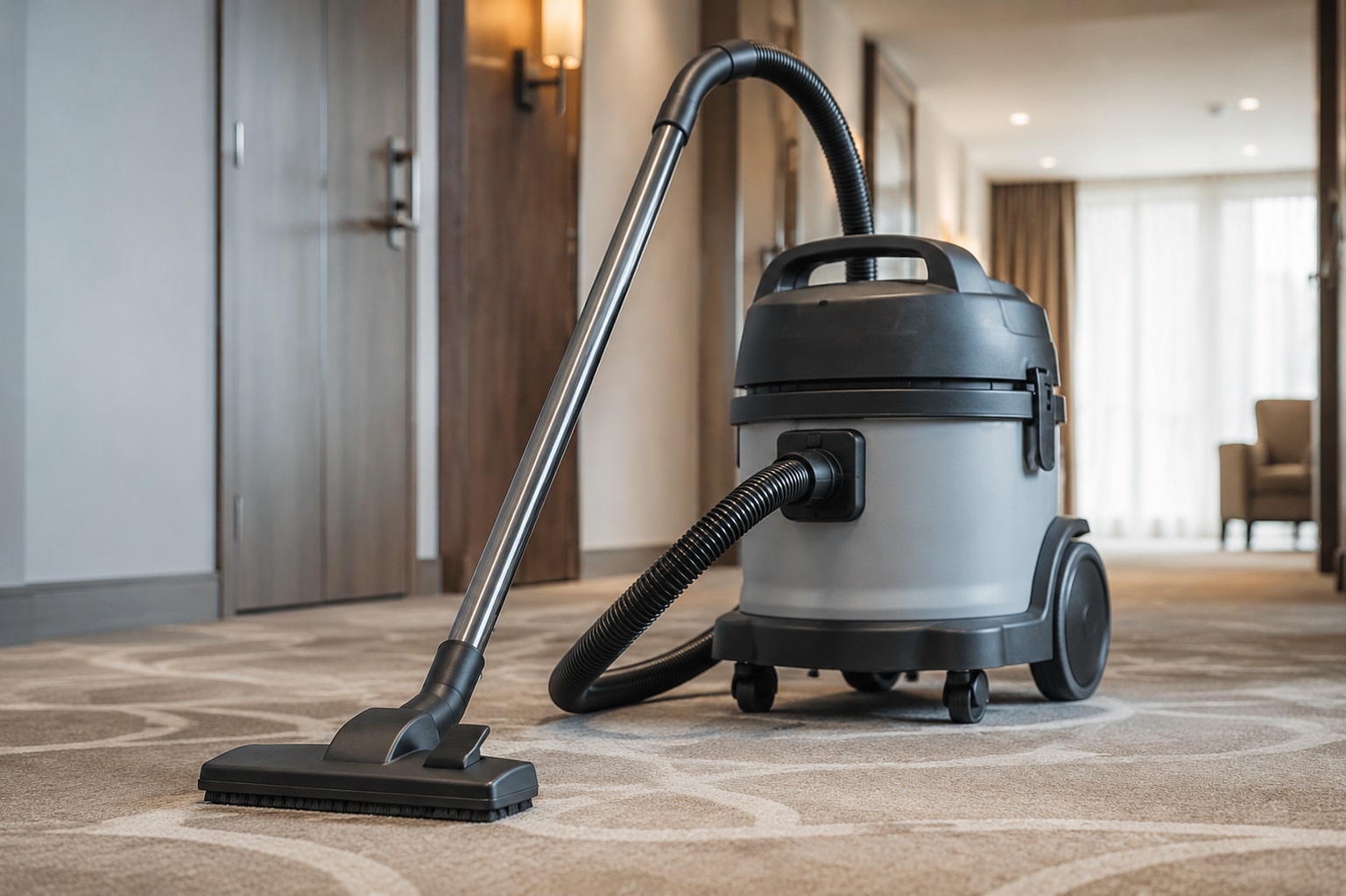
In today’s hospitality industry, cleanliness is no longer just a brand promise—it is a measurable operational KPI that directly impacts occupancy rates, guest reviews, and long-term revenue performance. For hotel operators and B2B vacuum procurement teams in Europe and North America, the evolution of commercial vacuum for hotels technology has become a strategic investment rather than a simple equipment purchase.
This article provides a deep engineering and operational breakdown of how modern vacuum systems improve hotel cleaning efficiency, reduce labor cost, and support scalable hospitality maintenance systems across multi-property hotel groups.
🧭 1. The Hidden Bottleneck in Hotel Cleaning Operations
Most hotels do not fail at cleaning because of staff effort—they fail because of system inefficiency.
Traditional hotel cleaning equipment setups rely heavily on portable vacuum units, inconsistent workflows, and manual coordination between housekeeping teams. The result is predictable:
Uneven cleaning quality across rooms
High labor fatigue and turnover
Slow turnaround between guest check-in cycles
Increased operational cost per square meter
The real problem is not manpower—it is lack of systemized airflow and cleaning architecture.
Modern commercial vacuum systems solve this by transforming cleaning into a structured engineering process rather than a manual activity.
🧹 2. Why Commercial Vacuum Systems Outperform Traditional Hotel Cleaning Equipment
A modern commercial floor cleaning system is not just a stronger vacuum. It is a coordinated ecosystem designed for high-frequency, high-consistency cleaning cycles.
The key performance differences include:
✔ Stable suction under continuous load
Unlike portable units that lose efficiency as dust accumulates, centralized systems maintain stable airflow performance.
✔ Reduced room-to-room contamination
Sealed suction pathways prevent dust re-release during movement between rooms.
✔ Workflow optimization
Housekeeping staff spend less time handling equipment and more time executing cleaning tasks.
✔ Lower lifecycle maintenance cost
Fewer motor replacements and longer filter life cycles significantly reduce total ownership cost.
The real value is not suction power—it is predictable cleaning output per hour per staff member.
🏗️ 3. Engineering Structure Behind High-Efficiency Hotel Vacuum Systems
Modern facility cleaning solutions in hotels are built on three engineering layers:
🧱 1. Centralized vacuum infrastructure
Instead of multiple portable machines, suction is generated from a centralized unit connected via piping across floors.
🌪️ 2. Airflow optimization design
Air pathways are engineered to minimize pressure loss across long distances, ensuring consistent suction in every room.
🧪 3. Multi-stage filtration systems
Advanced systems include:
Primary debris separation
Secondary dust filtration
Final fine particulate control
This architecture ensures that dust is not reintroduced into the hotel environment during cleaning cycles.
A key insight for B2B buyers:
The performance of a hotel vacuum system is determined more by airflow architecture than motor power.
🏨 4. Hospitality Maintenance as a Time-Critical Operation
In hospitality environments, time is more valuable than cost.
A delayed room turnover directly translates into lost revenue. Therefore, hospitality maintenance systems must prioritize speed and predictability.
Advanced vacuum systems contribute to:
Faster room turnaround time (RTT)
Reduced dependency on cleaning shifts
Standardized cleaning output regardless of staff experience
Predictable housekeeping scheduling
Hotels operating under high occupancy rates (75%+) often see cleaning inefficiencies become a bottleneck that directly limits revenue expansion.
By integrating structured vacuum systems, hotels effectively convert cleaning from a variable process into a repeatable production system.
⚙️ 5. Procurement Framework for B2B Buyers in the Hotel Vacuum Market
For commercial vacuum for hotels procurement teams, decision-making should move beyond price comparison.
A structured evaluation model should include:
1. Cleaning output consistency index
Can the system maintain performance across peak operational hours?
2. Multi-floor pressure stability
Does suction strength remain stable across long piping systems?
3. Staff workflow integration
Does the system reduce or increase housekeeping complexity?
4. Maintenance accessibility
How quickly can filters and motors be serviced without disrupting operations?
5. Scalability across properties
Can the system be expanded across hotel chains without redesign?
6. Energy efficiency per cleaned room
What is the energy cost per standardized cleaning cycle?
Many hotel buyers make the mistake of focusing on upfront price instead of cost per cleaned room over system lifespan.
⚠️ 6. Common Mistakes in Hotel Vacuum System Selection
Even experienced procurement managers in hotel cleaning equipment purchasing make critical errors:
Mistake 1: Overestimating portable vacuum flexibility
Portable systems appear flexible but create workflow fragmentation.
Mistake 2: Ignoring suction degradation over time
Many systems lose efficiency after months of continuous use.
Mistake 3: Underestimating labor fatigue impact
Heavy portable equipment increases staff turnover.
Mistake 4: Focusing only on motor wattage
High wattage does not equal better cleaning efficiency in distributed systems.
Mistake 5: Neglecting cleaning standardization
Without systemized airflow, cleaning quality depends entirely on individual staff performance.
The most expensive mistake is assuming all vacuum systems are functionally interchangeable.
📊 7. ROI Model: Why Commercial Vacuum Systems Pay Back Faster Than Expected
A properly designed commercial floor cleaning infrastructure delivers ROI through multiple channels:
💰 Labor cost reduction
Fewer cleaning minutes per room significantly reduces staffing needs per shift.
🏨 Faster room turnover
Even a 10–15% improvement in cleaning speed increases revenue capacity.
🧼 Reduced re-cleaning frequency
Consistent suction reduces missed debris and repeat cleaning cycles.
🛠️ Lower equipment replacement cost
Centralized systems last significantly longer than portable units.
⚡ Energy optimization
Modern systems distribute energy more efficiently than multiple standalone vacuums.
In large hotel chains, ROI is often achieved within 18–36 months depending on occupancy rate.
🚀 8. The Future of Hotel Cleaning: Smart Vacuum Infrastructure
The next generation of facility cleaning solutions is becoming increasingly intelligent and data-driven.
Key emerging trends include:
🧠 Smart suction monitoring systems
Real-time airflow tracking to detect performance degradation.
📡 IoT-enabled cleaning analytics
Hotels can track cleaning performance per floor, per room, and per staff shift.
🤖 Automated cleaning coordination
Integration with robotic cleaning systems for hybrid workflows.
📊 Predictive maintenance models
AI predicts filter replacement cycles before performance drops.
🌐 Centralized cloud-based management
Hotel chains can monitor cleaning infrastructure across multiple properties globally.
This shift transforms vacuum systems from mechanical tools into digital facility assets.
🧾 Conclusion: Cleaning Efficiency as a Competitive Advantage in Hospitality
Hotel competitiveness today is not only determined by location or design—it is increasingly influenced by operational efficiency behind the scenes.
Advanced commercial vacuum for hotels systems are no longer optional upgrades. They are foundational infrastructure that directly impacts:
Guest satisfaction
Operational speed
Labor efficiency
Cost control
Brand consistency
For B2B buyers, distributors, and hospitality engineers, the key takeaway is clear:
The future of hotel cleaning is not about stronger machines—it is about smarter systems.
📌 Hashtags
hotelcleaningefficiency, commercialvacuumforhotels, hospitalitymaintenance, hotelcleaningequipment, commercialfloorcleaning, facilitycleaningsolutions, housekeepingequipment, hospitalityoperations, hotelhousekeeping, vacuumsystemdesign, centralizedvacuumsystem, hotelcleaningautomation, B2Bvacuumsolutions, hospitalityengineering, hoteloperationsmanagement, cleaningworkflowoptimization, roomturnaroundefficiency, hotelcleaningtechnology, industrialvacuumdesign, cleaninginfrastructure, hotelfacilitymanagement, suctionperformanceengineering, vacuumsystemintegration, hospitalitycleaningtools, energyefficientcleaning, hotelcleaningsystems, cleaningcostreduction, vacuumefficiencyoptimization, hospitalityservicequality, hotelmaintenanceengineering, cleaninglaborreduction, facilitymanagementtools, hotelcleaninginnovation, vacuumsystemprocurement, hospitalityworkflowdesign, cleaningproductivitysystems, hotelcleaningstandards, commercialcleaningtechnology, vacuummotorsystemdesign, hospitalitycleaningstrategy, hotelcleaningROI, vacuumsystemmaintenance, housekeepingefficiencytools, hotelcleaningautomationtools, cleaningprocessengineering, vacuumsystemscalability, hospitalityequipmentbuyers, hotelcleaningsolutionsprovider, cleaningperformanceanalytics, Lanxstar