Hi, message us with any questions.
We're happy to help!





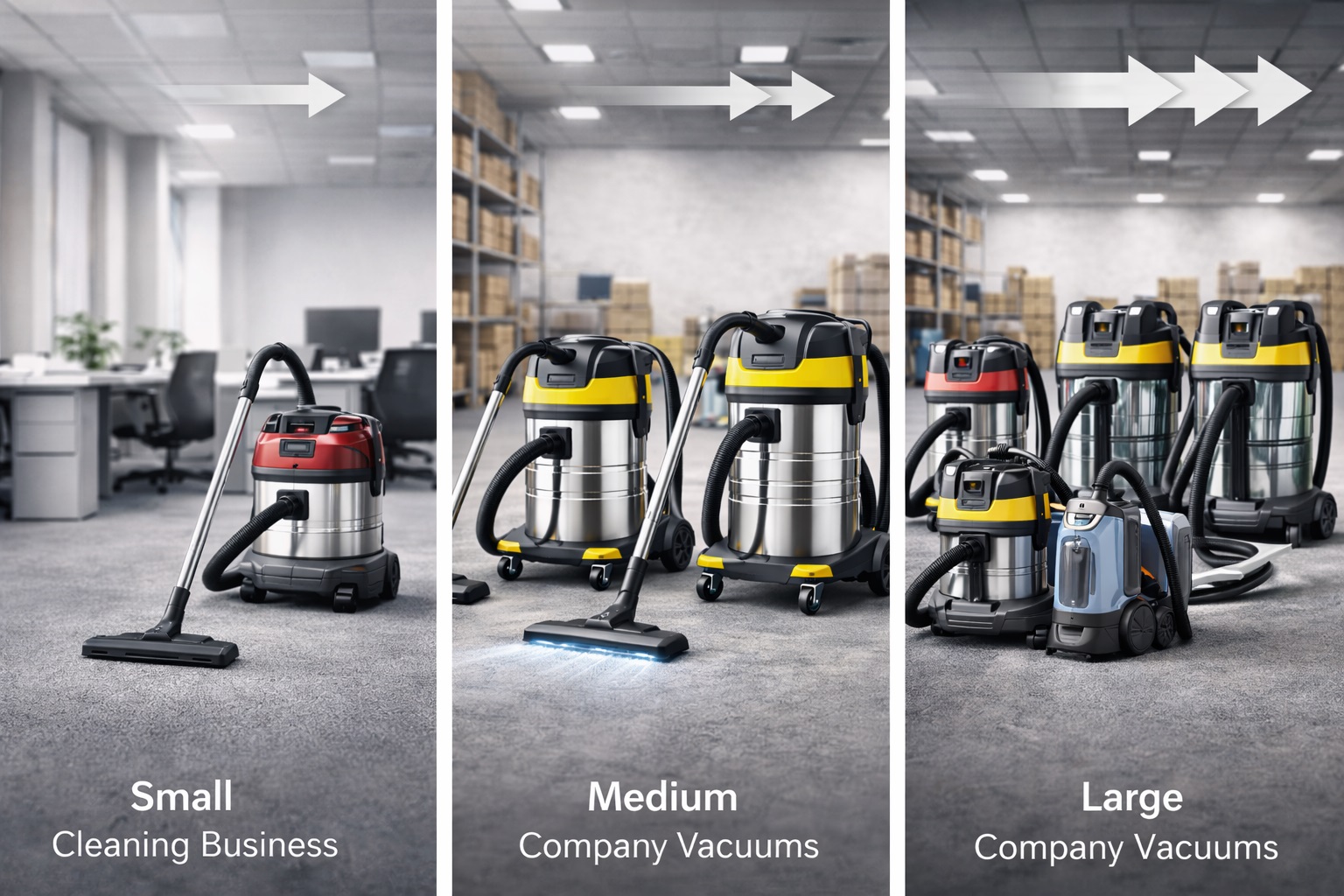
(With Real-World Configuration Cases)
For cleaning companies, vacuum cleaners are not individual tools—they are components of an operating system.
Yet many B2B buyers in Europe and the Middle East still source vacuum cleaners one unit at a time, without aligning equipment configuration with company size, service model, or growth stage. The result is often inefficiency, hidden cost, and operational friction.
This article explains how cleaning companies of different sizes should configure their vacuum equipment strategically—and includes real configuration scenarios from the field to show what works in practice.
🧭 1. Why “One-Size-Fits-All” Fails in Real Operations
Cleaning companies differ in:
Team size
Job duration
Mobility requirements
Surface diversity
A single machine type cannot support all tasks efficiently.
Smart configuration strategies focus on:
Workflow continuity
Operator movement
Job frequency
Risk management
Key principle:
Configuration is about how machines work together, not how powerful one machine is.
🏢 2. Small Cleaning Companies (1–5 Teams): Flexibility Beats Capacity
Small companies usually handle:
Multiple short jobs per day
Residential + light commercial sites
Frequent transport between locations
Recommended configuration:
Vacuum for multi-surface environments as the core unit
Cordless handheld vacuum cleaner for stairs, corners, and quick tasks
Portable vacuum for travel for vehicle-based teams
A multi-functional durable vacuum cleaner helps reduce equipment overlap while keeping teams agile.
🔎 Real Configuration Case: Small European Cleaning Startup
Situation:
A 3-team cleaning startup in a European city initially invested only in large wet & dry machines, assuming “bigger is more efficient.”
Problem:
Slow loading and unloading
Poor maneuverability in apartments
Longer time per site
Adjustment:
One main multi-surface unit
One cordless handheld per team
Result:
👉 Average cleaning time per location dropped 20–25%
Lesson:
At small scale, mobility and flexibility matter more than tank size.
🏬 3. Medium Cleaning Companies (5–20 Teams): Standardization Drives Profit
Mid-sized companies typically serve:
Office buildings
Retail spaces
Hotels and managed properties
At this stage, inefficiency often comes from equipment inconsistency across teams.
Recommended configuration:
Wet and dry vacuum cleaner as the standard platform
Large-capacity wet dry vacuum cleaner for long-duration or high-traffic sites
Limited use of cordless handheld vacuum cleaner for detailing
🔎 Real Configuration Case: Middle East Facility Service Company
Situation:
A GCC-based company with 12 teams used mixed vacuum models sourced over time.
Problems:
Long training cycles
Complicated spare parts inventory
Inconsistent cleaning speed
Adjustment:
Standardized on wet & dry units
Large-capacity models assigned only to malls and parking areas
Result:
👉 Faster onboarding, simpler maintenance, smoother team rotation
Lesson:
At medium scale, standardization reduces cost faster than price negotiation.
🏭 4. Large Cleaning Companies (20+ Teams): Configuration Is Risk Control
Large operators manage:
Multi-shift operations
High-visibility contracts
SLA penalties for delays or failures
At this level, downtime is not inconvenience—it is financial risk.
Recommended configuration:
Core fleet of multi-functional durable vacuum cleaner units
Dedicated large-capacity wet dry vacuum cleaner machines for heavy-duty zones
Portable vacuum for travel units for emergency response and mobile crews
🔎 Real Configuration Case: European Cleaning Group
Situation:
A large cleaning group serving airports and hospitals faced penalties when equipment failure delayed shifts.
Strategy:
Redundant core machines per region
Portable units reserved for backup and emergency tasks
Internal logic:
“One spare vacuum costs less than one SLA breach.”
Lesson:
At large scale, redundancy is risk management, not waste.
💧 5. Wet & Dry Allocation: Match Capacity to Job Duration
Not every team needs maximum tank capacity.
Short, frequent jobs → compact wet and dry vacuum cleaner
Long, high-debris jobs → large-capacity wet dry vacuum cleaner
Configuration rule:
Choose tank size based on average job duration, not worst-case scenarios.
🧩 6. Multi-Surface Coverage Reduces Training Burden
A vacuum for multi-surface environments allows companies to:
Train staff faster
Reduce operational errors
Maintain consistent quality
Fewer machine types mean fewer mistakes—and better client perception.
🚗 7. Mobility as a Productivity Multiplier
Mobile teams lose time through:
Cable management
Equipment setup
Transport weight
Using cordless handheld vacuum cleaner and portable vacuum for travel solutions:
Improves on-site professionalism
Speeds up short jobs
Reduces operator fatigue
This is especially effective in dense European cities and multi-location Middle Eastern contracts.
❌ 8. Common Configuration Mistakes
Across all company sizes, these mistakes appear repeatedly:
Buying only one machine type
Scaling headcount without scaling equipment strategy
Over-investing in large-capacity units too early
Ignoring mobility needs
Mixing incompatible platforms
Each mistake increases cost without improving output.
✅ Conclusion: Configuration Is a Competitive Advantage
Vacuum configuration is not a purchasing detail—it is a strategic lever.
Cleaning companies that align equipment mix with company size, job structure, and growth plans consistently achieve:
Faster job completion
Lower operational friction
Better scalability
In competitive European and Middle Eastern markets, companies that configure smarter—not bigger—outperform their peers.
📌 Suitable Readers
Cleaning company owners and operations managers
European & Middle Eastern B2B vacuum cleaner buyers
Facility management companies
Cleaning service entrepreneurs
Procurement and growth teams
📌 Hashtags
wet and dry vacuum cleaner, multi-functional durable vacuum cleaner, cordless handheld vacuum cleaner, large-capacity wet dry vacuum cleaner, portable vacuum for travel, vacuum for multi-surface, commercial vacuum configuration, professional cleaning equipment, cleaning company operations, facility management tools, hotel housekeeping equipment, office cleaning solutions, industrial cleaning equipment, B2B vacuum sourcing, cleaning contractor tools, scalable cleaning operations, mobile cleaning solutions, durable cleaning machines, low maintenance vacuum, energy efficient cleaning, sustainable cleaning equipment, vacuum distributor, vacuum importer, cleaning industry strategy, professional cleaning tools, commercial floor care, industrial vacuum system, multi application vacuum, hard floor vacuum, carpet and hard floor vacuum, after sales service vacuum, spare parts vacuum cleaner, long lifespan vacuum, cleaning equipment buyer, B2B cleaning solutions, vacuum cleaner manufacturer, OEM vacuum cleaner, private label vacuum, cleaning company growth, operational efficiency cleaning, facility service equipment, smart procurement cleaning, Lanxstar



