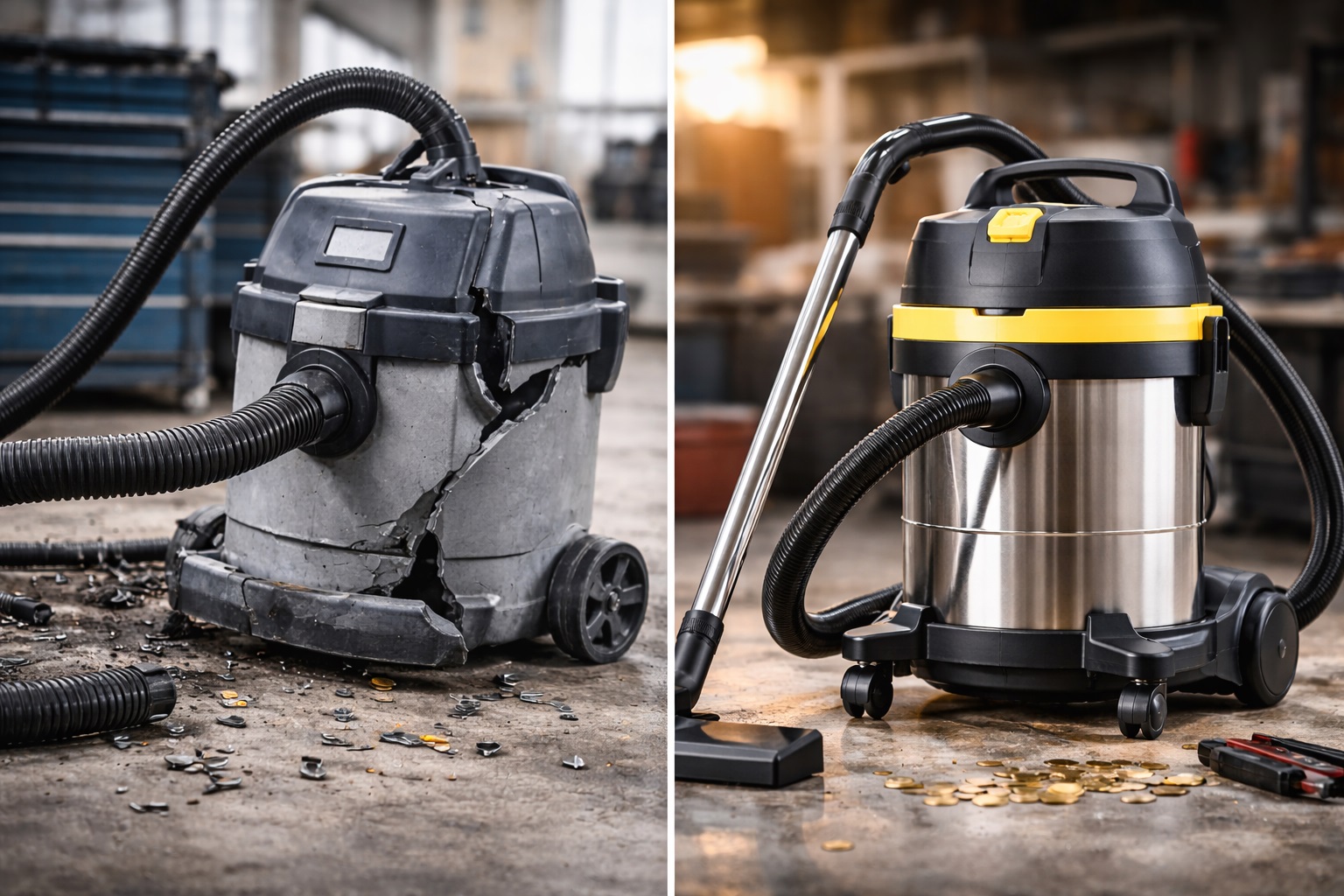
Cheap equipment doesn’t hurt your budget.
It hurts your operation.
Cheap commercial vacuum cleaners rarely fail on day one.
They fail slowly, quietly, and expensively.
For European and Middle Eastern B2B buyers, low-priced commercial vacuums often look like a smart financial decision: lower upfront cost, faster approval, less short-term risk.
But experienced distributors and procurement leaders know the truth:
The real cost of a commercial vacuum is not the purchase price.
It’s the operational damage that appears after deployment.
This article explains why cheap commercial vacuum cleaners almost always cost more over time, and how professional buyers evaluate the real cost.
💰 1. Low Purchase Price Creates a Steep Operating Cost Curve
Cheap commercial vacuums usually reduce cost by:
In the first few months, they seem “good enough.”
But a wet and dry vacuum cleaner used in hotels, factories, or large facilities is exposed to:
Low-cost designs are not built for this reality.
What happens next is predictable:
More breakdowns, unstable performance, and rising maintenance frequency.
Cheap upfront cost simply delays the bill.
⚙️ 2. Durability Is Not a Feature — It’s an Engineering System
A Multi-Functional Durable Vacuum Cleaner is not defined by thick plastic or metal casing.
True durability depends on:
Cheap machines often:
Critical insight:
Durability problems don’t appear during testing.
They appear during routine, repetitive, real-world use.
💨 3. “High Suction” Without Stability Multiplies Labor Cost
Many low-priced machines promote themselves as a High Suction Vacuum Cleaner.
What they don’t mention is suction stability over time.
In real operations:
Operators compensate by:
Repeating cleaning passes
Slowing down cleaning routes
Spending more time per area
Hidden cost:
Labor inefficiency often exceeds equipment savings within the first year.
💧 4. Large Capacity Means Nothing Without Structural Strength
A Large-Capacity Wet Dry Vacuum Cleaner is only an advantage if the structure supports the load.
Cheap models often suffer from:
Tank deformation under weight
Seal leakage during wet use
Inefficient drainage design
In high-frequency environments, this leads to:
Professional buyers understand:
Capacity without engineering strength is a liability.
🌬️ 5. Poor Filtration Turns Hygiene Into a Recurring Expense
A Vacuum Cleaner for Allergies is not a luxury—it’s an operational requirement.
Low-cost machines often:
Use basic filtration systems
Leak fine particles back into the air
Require frequent filter replacement
This results in:
Secondary dust settlement
Re-cleaning tasks
Complaints in hotels, offices, and healthcare facilities
Reality:
Poor filtration doesn’t reduce cost.
It multiplies cleaning workload.
🔇 6. Noise Is an Operational Constraint, Not a Minor Detail
A Quiet Vacuum for Night Use is critical for:
Hotels
Hospitals
Office buildings
Residential facilities
Cheap vacuums often exceed acceptable noise levels, forcing:
Hidden consequence:
Noise limits reduce operational flexibility—and flexibility is money.
📉 7. Cheap Vacuums Destroy the Total Cost of Ownership Model
Professional buyers evaluate equipment using TCO (Total Cost of Ownership), not invoice price.
Cheap commercial vacuum cleaners increase:
Maintenance frequency
Spare part uncertainty
Downtime risk
Labor inefficiency
Over a 3–5 year lifecycle, they frequently cost more than premium alternatives, even before accounting for compliance and reputation risk.
🧠 Final Insight: Cheap Equipment Is a Strategic Risk
Experienced B2B buyers understand:
You don’t save money by buying cheap equipment.
You save money by buying predictable systems.
A reliable commercial vacuum:
Protects labor productivity
Stabilizes operating cost
Supports long-term scalability
Cheap machines undermine all three.
🔍 A Simple Buyer Reality Check
If a vacuum is cheap because it cuts:
The cost will return—
through labor, downtime, or lost credibility.
📌 Hashtags
commercial vacuum cleaner, cheap commercial vacuum, wet and dry vacuum cleaner, multi-functional durable vacuum cleaner, high suction vacuum cleaner, large-capacity wet dry vacuum cleaner, vacuum cleaner for allergies, quiet vacuum for night use, industrial vacuum system, professional cleaning equipment, B2B cleaning equipment, vacuum distributor, European vacuum market, Middle East cleaning equipment, commercial cleaning systems, industrial hygiene solutions, facility management tools, warehouse cleaning equipment, hotel cleaning solutions, hospital cleaning equipment, night shift cleaning tools, energy efficient cleaning, long life vacuum motor, low maintenance vacuum, commercial cleaning ROI, total cost of ownership, procurement strategy, industrial sourcing, B2B buyer insights, cleaning industry innovation, vacuum technology, dust control solutions, indoor air quality tools, professional hygiene equipment, commercial equipment sourcing, supply chain reliability, private label vacuum, vacuum brand building, B2B distribution model, cleaning equipment growth, after-sales support system, industrial equipment buyers, facility operations efficiency, Lanxstar











