Hi, message us with any questions.
We're happy to help!





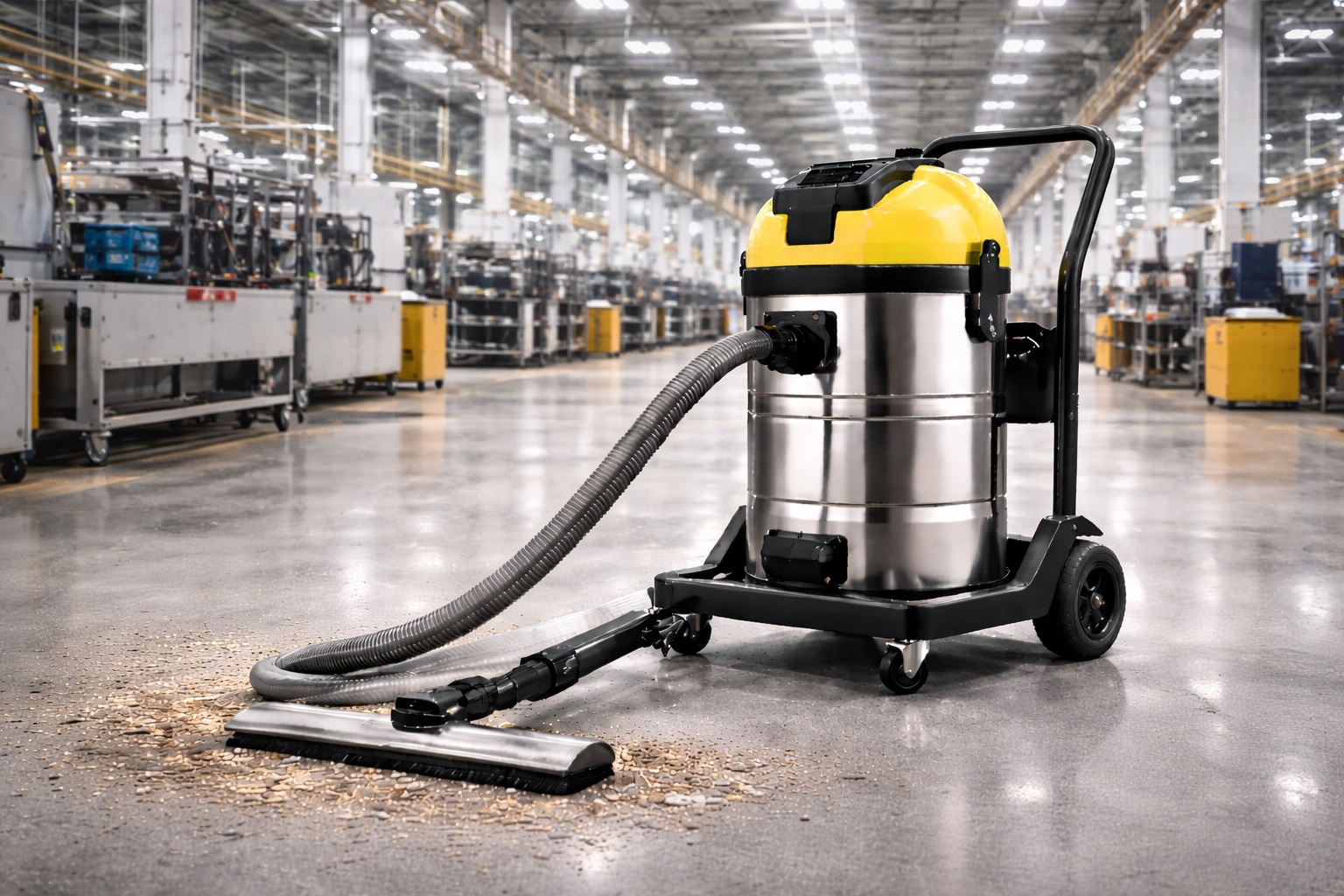
🏭 The 3 hidden reasons large factories “clean all day” and still look messy
Walking time is the real cost: crews lose minutes moving tools across huge footprints.
Micro-stoppages compound: small spills and debris create repeated stops, especially near lines and aisles.
Wrong vacuum deployment: one machine is forced into every task, causing clogs, slow pickup, and re-cleaning.
Large factories don’t need “more cleaners.” They need a system that makes cleaning predictable: fewer emptying interruptions, faster response, and less repeated work. That’s where barrel vacuum cleaners (drum-style, high-capacity units) shine—especially when paired with point-of-use cordless tools and disciplined wet/dry workflows.
This guide is written for EU & Middle East B2B vacuum cleaner procurement buyers serving large industrial factories. You’ll get a practical deployment method, route design tactics, and a scorecard that makes supplier comparison easy.
I. 🧭 Where barrel vacuum cleaners create the biggest efficiency gains
Barrel units provide the most value where volume + distance + continuity are the constraints:
Main aisles and logistics routes (long routes, high debris accumulation)
Under-line voids and edges (dust traps that cause repeat cleaning)
Maintenance shutdown cleaning (bulk recovery with fewer emptying stops)
High-output areas (packaging, palletizing, raw material staging)
Wet incident zones (coolant, water, washdown footprints)
Where they are not the default:
Tight workstations and quick touch-ups → Cordless Handheld Vacuum Cleaner wins.
Offices and carpeted admin areas → Upright Vacuum Cleaners are fastest; Household Vacuum Cleaners may be acceptable only in non-process zones if policy allows.
Procurement takeaway: Barrel vacuum cleaners are the route backbone, not the only tool.
II. 🗺️ Step 1: Build a “vacuum map” (the fastest route to fewer labor minutes)
Factories often lose time because vacuums are stored in one corner. The fix is simple: map your plant like a logistics network.
✅ The vacuum map method
Divide the plant into zones (Aisles, Lines, Maintenance, Raw Materials, Wet Risk Areas)
Assign each zone:
one barrel vacuum “route unit” (bulk cleaning)
one or more point-of-use cordless units (instant response)
Define route nodes (storage points every X meters) so crews don’t walk back to a single closet
Standardize accessories per zone (crevice tools for edges, wide head for aisles)
Result: Cleaning becomes route-based instead of reactive—this is how you reduce “invisible labor.”
III. 🧱 Step 2: Match suction to the contaminant (why power specs alone fail)
Factories deal with different debris types:
light dust and packaging scraps
heavy debris and granules
long-hose recovery behind machines
wet incidents (coolant, water, slurry)
When you need a High Suction Vacuum Cleaner
A High Suction Vacuum Cleaner configuration matters for:
long hose runs across machines
heavy debris, corners, and under-equipment voids
stable pickup when filters begin to load
But suction alone isn’t enough—deploy filtration staging and proper accessories to avoid clogging and repeated passes.
When a Large-Capacity Wet Dry Vacuum Cleaner matters
If your factory has:
coolant leaks, washdowns, frequent water tracking
large spill footprints
then a Large-Capacity Wet Dry Vacuum Cleaner staged as a response asset reduces downtime and “wet floor time.”
IV. ⚡ Step 3: Use the hybrid fleet (drum + cordless) to eliminate micro-stoppages
Micro-stoppages are where factories bleed productivity.
Hybrid deployment that works
Barrel vacuum cleaners parked at route nodes for bulk work
Cordless Handheld Vacuum Cleaner units assigned to operators or line-side kits for:
quick debris pickup during cycle gaps
control panels, fixtures, and tight corners
preventing small messes from becoming downtime
This is the fastest way to improve cleaning efficiency because it removes the “find the vacuum” delay.
V. 💧 Step 4: Wet/dry discipline (the rule that prevents downtime)
Most wet/dry failures come from poor discipline, not poor equipment.
Two-mode discipline
Mode A — Dry routes
dust, debris, packaging waste
dry tools and dry filtration only
Mode B — Wet incidents
coolant, water, slurry
wet tools (squeegee), wet disposal workflow
Procurement should enforce either:
dedicated dry + dedicated wet units, or
a wet/dry system with quick conversion and an SOP teams will follow
This is how a wet/dry system stays reliable at scale.
VI. 🧾 Step 5: Standardize accessories and consumables across the factory
Large factories lose money through “small chaos”:
incompatible hoses
missing nozzles
random filter SKUs
broken tools that no one replaces
Standardization checklist
one hose diameter standard across fleet
shared floor head + crevice tool + brush tool kit
consistent filters and gaskets across units
site spares plan (hoses, heads, filters)
This is what turns an Industrial Vacuum Cleaner purchase into a manageable system.
VII. 🧯 Real application cases inside large factories
📦 Case 1: Packaging and palletizing zone
Problem: constant cardboard fiber, film scraps, and debris build-up.
Deployment: barrel route unit + cordless for immediate line-side cleanup.
Result: fewer stoppages and cleaner walkways.
🔧 Case 2: Maintenance shutdown cleaning
Problem: tight downtime windows and large debris volume.
Deployment: multiple barrel units staged at shutdown nodes; high-suction setup for under-line voids.
Result: shorter downtime windows and faster restart.
💧 Case 3: Coolant or water tracking
Problem: spills slow operations and create slip hazards.
Deployment: dedicated Large-Capacity Wet Dry Vacuum Cleaner staged at wet-risk zones.
Result: faster reopen and fewer safety reports.
VIII. 📊 Procurement scorecard (screenshot-friendly) for large factories
Rate each supplier 1–5. Total /50.
✅ 10-point scorecard
Route efficiency (large-footprint practicality)
Bulk capacity (fewer emptying interruptions)
High-suction performance (long hose and heavy debris)
Wet incident readiness (true wet recovery tools + workflow)
Maintainability (fast access, predictable filter care)
Accessory standardization support (shared tools across fleet)
Durability (hoses, wheels, fittings)
Cordless integration strategy (point-of-use deployment)
EU/MENA parts and service support
Documentation support (SOP templates, maintenance schedules)
Interpretation:
40–50: strong large-factory fit
30–39: workable with SOP discipline
<30: expect repeated cleaning and tool chaos
Conclusion: large factories improve cleaning efficiency when cleaning becomes logistics
Barrel vacuum cleaners improve factory cleaning efficiency when deployed like a logistics system: route nodes, zone ownership, standardized tooling, and disciplined wet/dry response. Pair drum units with Cordless Handheld Vacuum Cleaner tools to eliminate micro-stoppages, stage a Large-Capacity Wet Dry Vacuum Cleaner for wet risks, and specify High Suction Vacuum Cleaner performance for long hose runs and under-line voids.
Keep Upright Vacuum Cleaners and Household Vacuum Cleaners in non-process office zones only, and treat your Industrial Vacuum Cleaner fleet as a standardized system—not a random collection of machines. That’s how you reduce labor minutes, cut downtime, and keep large factories consistently clean.
Hashtags
LargeFactoryCleaning, IndustrialHousekeeping, BarrelVacuumCleaners, DrumVacuumSystem, IndustrialVacuumCleaner, HighSuctionVacuumCleaner, LargeCapacityWetDryVacuumCleaner, WetDryVacuumCleaners, CordlessHandheldVacuumCleaner, CleaningEfficiency, VacuumRouteMapping, RouteNodeStaging, ZoneBasedCleaning, 5SFactoryProgram, MicroStoppageReduction, LineSideCleaningKits, PackagingAreaCleanup, PalletizingZoneCleaning, UnderLineVoidCleaning, MaintenanceShutdownCleaning, DowntimeWindowReduction, CoolantSpillRecovery, WaterTrackingControl, WetIncidentResponse, TwoModeWetDryDiscipline, StandardizedAccessories, SharedConsumables, HoseDiameterStandard, CreviceToolKit, WideFloorTool, BrushToolHead, FilterCloggingPrevention, SqueegeeRecoveryTool, MobilityAndErgonomics, DurabilityOnSite, SparePartsPlanning, ServiceSupportEU, ServiceSupportMENA, DistributorReadyConfig, ProcurementScorecard, TCOModel, MinutesSavedPerShift, UprightVacuumCleaners, HouseholdVacuumCleaners, OfficeZoneCleaning, NonProcessAreaCleaning, BulkDebrisRecovery, LongHoseVacuuming, FactoryAisleCleaning, LogisticsRouteCleaning, StandardWorkSOP, Lanxstar