Hi, message us with any questions.
We're happy to help!





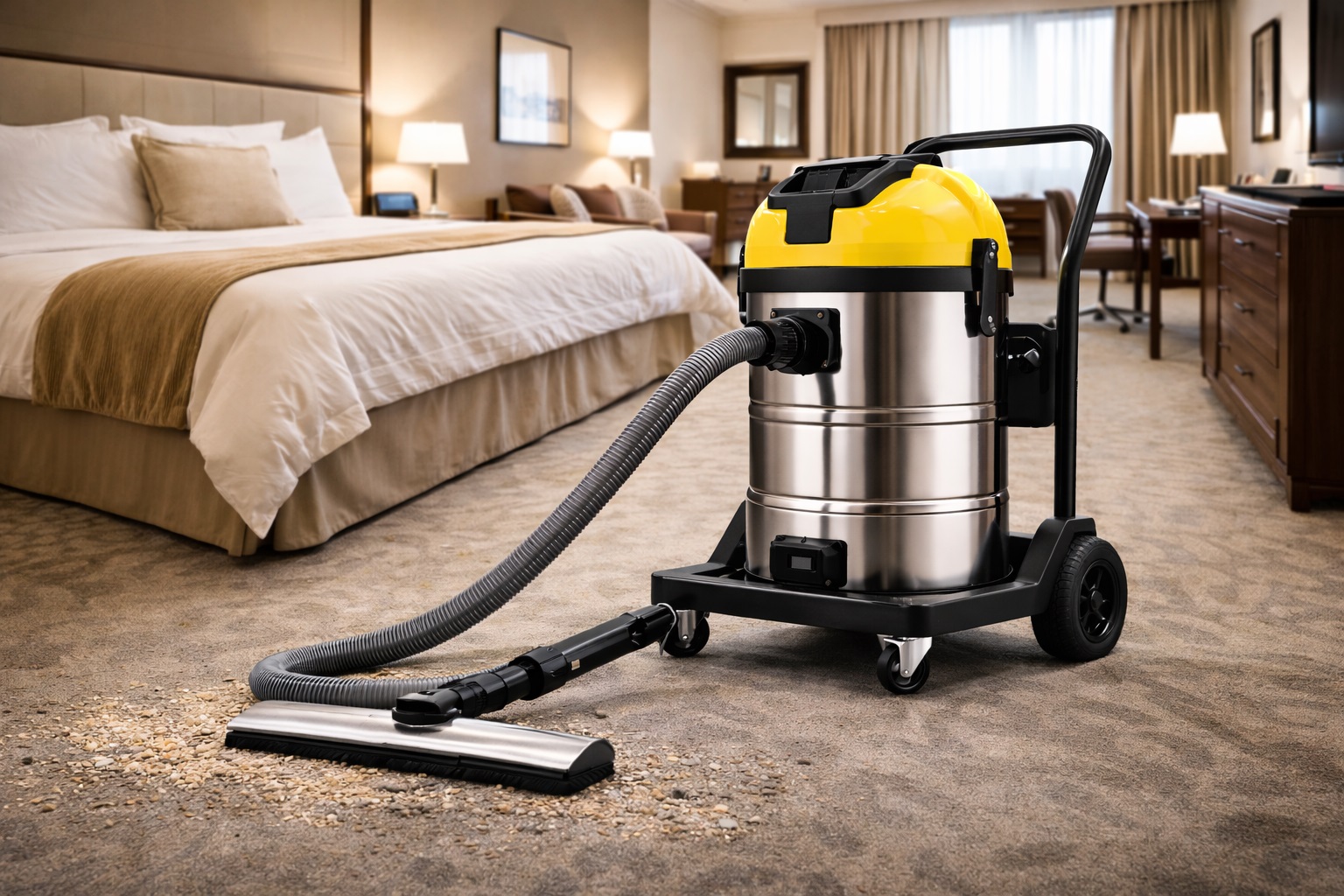
🏨 The 3 “hygiene gaps” that quietly hurt hotel ratings
Visible dust returns fast: lobbies, corridors, and room edges look clean—then dust and debris reappear within hours.
Spills become “guest moments”: a drink spill in the lobby or banquet hall becomes a safety issue and a reputation issue.
Tool mismatch slows housekeeping: crews waste time switching tools, emptying small tanks, or re-cleaning areas because the vacuum wasn’t built for the surface or the workload.
Hotels don’t need “stronger cleaning.” They need repeatable hygiene outcomes across guest rooms, public spaces, and back-of-house—under strict time windows. That’s where barrel vacuum cleaners (drum-style, large-capacity systems) can play a surprisingly important role: they help teams complete long routes with fewer interruptions, keep waste contained, and support fast wet-incident recovery when paired with the right wet/dry capability.
This guide is written for EU & Middle East B2B procurement buyers serving hotels and hospitality cleaning contractors—with practical deployment models that protect hygiene standards and improve cleaning efficiency without keyword stuffing.
I. 🧭 Hotel cleaning is a “zone system,” not one job
A hotel is multiple environments under one roof. Hygiene improves when you match vacuum types to zones:
Guest rooms & suites: fast, quiet, detail-oriented cleaning
Corridors: long routes, high traffic, repetitive work
Lobbies & reception: high-visibility, mixed surfaces, constant spot cleaning
Restaurants & banquet areas: frequent spills + crumbs + high turnover
Back-of-house: service corridors, staff areas, storage, loading docks
Where barrel vacuum cleaners fit best:
long corridor routes, large floorplates, banquet turnaround cleaning, and back-of-house bulk pickup.
Where they should not be the only tool:
guest rooms with tight furniture layouts or quick spot tasks—these zones often need smaller or specialized equipment.
Procurement takeaway: Hygiene improves when you buy a fleet, not a single “do-it-all” unit.
II. 🧩 The hospitality fleet model that reduces re-cleaning
Here’s a simple, scalable hotel setup that works across brands and property sizes:
1) 🛞 Barrel vacuum cleaners = route backbone
Use for:
corridors and service corridors
ballroom / conference pre- and post-event cleanup
back-of-house bulk debris pickup
2) 🧹 Upright Vacuum Cleaners = carpet productivity
Use for:
carpeted corridors and large carpeted public areas
quick coverage where speed matters and furniture density is low
Why it matters: In many hotels, Upright Vacuum Cleaners are the fastest way to maintain carpet appearance day-to-day—while barrel units handle longer, heavier routes and waste volume.
3) 🧼 Wet Dry Vacuum Cleaners = spill & restroom response
Use for:
drink spills in lobbies and banquet areas
restroom incidents
rainy-day tracking near entrances
A staged wet/dry asset prevents “cones up forever” situations and improves safety compliance.
4) 🧽 Vacuum Cleaner for Multi-Surface = the real differentiator
Hotels have marble, tile, LVT, carpet, rugs, and textured anti-slip zones. A true Vacuum Cleaner for Multi-Surface approach means a tool kit that prevents scratches and cleans edges, elevator tracks, and bathroom corners efficiently.
5) 🫧 Vacuum Cleaner for Allergies = guest trust
Many guests are sensitive to dust, fragrances, and airborne particles. In hospitality, Vacuum Cleaner for Allergies isn’t a “nice-to-have”—it’s a practical path to fewer complaints and a better perception of cleanliness (especially in rooms and VIP floors).
6) ⚡ Energy-Saving Efficient Powerful Vacuum Cleaner = shift efficiency
In hotels, “energy-saving” should mean less runtime per area cleaned, not simply lower wattage. An Energy-Saving Efficient Powerful Vacuum Cleaner should finish routes faster, maintain stable suction, and reduce repeat passes.
Where Household Vacuum Cleaners fit:
Use Household Vacuum Cleaners only in low-demand, non-guest areas (back office, small admin rooms) if policy allows. They typically don’t scale well for corridor routes, frequent spill response, or heavy daily use.
III. 🧼 Case 1: Corridor hygiene routes (the “never-ending hallway” problem)
Problem
Corridors collect dust, grit, and fibers continuously. Small tanks and frequent emptying slow teams, especially during high occupancy.
Solution
Use barrel vacuum cleaners as the corridor route backbone
Pair with Upright Vacuum Cleaners for carpet-heavy wings (fast coverage)
Standardize route timing: one pass for bulk + a second pass only for edges/thresholds
Why it improves hygiene
fewer missed areas due to rushing
less dust migration into rooms
more consistent “always clean” appearance, especially near elevators and corners
Procurement note: Corridor work is where an Energy-Saving Efficient Powerful Vacuum Cleaner matters operationally—stable performance means fewer repeated passes and less labor time per floor.
IV. 🍽️ Case 2: Restaurant & banquet turnaround (spills + crumbs + speed)
Problem
Banquet turnover is time-critical and messy: crumbs, napkins, drink spills, and sticky residue.
Solution
Keep a dedicated Wet Dry Vacuum Cleaners unit staged near banquet storage
Use barrel vacuum cleaners for bulk dry debris routes (cups, wrappers, crumbs)
Use wet/dry mode for drink zones and sticky areas with a squeegee tool
Effectiveness
faster reopening of event spaces
reduced slip incidents
cleaner “edge zones” where debris accumulates (under buffet tables, entry thresholds)
Key discipline: Wet/dry systems must be managed as two controlled modes. If teams mix wet recovery with powdery debris without a workflow, performance drops and hygiene outcomes become inconsistent.
V. 🛁 Case 3: Guest room “detail hygiene” without slowing housekeeping
Problem
Rooms are tight, and cleaning is timed. Dust hides in:
baseboards, behind doors
under beds and furniture skirts
bathroom corners and thresholds
Solution
Use a Vacuum Cleaner for Multi-Surface tool strategy: crevice tools, soft brush heads, no-mark floor tools
Reserve barrel vacuum cleaners for back-of-house staging and corridor bulk work
Use Vacuum Cleaner for Allergies-aligned filtration and sealed airflow in room-focused vacuums to reduce particle re-emission
Why it improves guest perception
Guests judge cleanliness by corners, edges, and air feel. Proper filtration and tool control reduce visible dust return and “stale dust” sensations.
VI. 🧠 Multi-surface reality in hotels: what “multi-surface” should actually mean
A Vacuum Cleaner for Multi-Surface setup should include:
Wide floor head for marble/tile/LVT (fast and scratch-safe)
Soft brush/no-mark head for delicate surfaces and skirting boards
Crevice tool for elevator tracks, baseboards, and bathroom edges
Upholstery tool for lobby seating and fabric headboards
Squeegee head (when using wet/dry) for spills and restroom incidents
Procurement tip: Don’t accept “multi-surface” as a label—require a standardized accessory pack and confirm replacements are easy to source for EU/MENA operations.
VII. ⚡ Energy efficiency that hotel operators actually feel
Hotels don’t measure energy savings in theory; they feel it in:
shorter cleaning windows
fewer staff hours per floor
fewer repeat passes
An Energy-Saving Efficient Powerful Vacuum Cleaner should be evaluated by:
minutes to complete a corridor route
number of stops per route (emptying, tool changes, unclogging)
repeat-clean rate (how often a zone is re-cleaned due to visible return)
This makes “energy-saving” a productivity metric: work done per shift.
VIII. 🌿 Allergy and dust control: turning “comfort” into a hygiene standard
A Vacuum Cleaner for Allergies concept usually implies:
higher-efficiency filtration
better sealing to reduce leakage
less particle re-emission
In hotels, this can reduce:
guest complaints about dust sensitivity
visible dust return on dark surfaces
“musty” corridor feel caused by recirculated fine debris
Practical policy: Define which floors/zones require allergy-oriented filtration (VIP floors, suites, long-stay rooms), and standardize that spec across your procurement.
IX. 🧾 Procurement scorecard for hotels (screenshot-friendly)
Rate each supplier 1–5. Total /50.
✅ 10-point hotel scorecard
Corridor route efficiency (distance + time per floor)
Multi-surface tooling depth (hard floors, edges, upholstery)
Carpet coverage speed (upright performance where needed)
Wet incident readiness (true wet/dry tools + workflow)
Large debris capacity (fewer emptying interruptions)
Filtration & containment (supports allergy/dust expectations)
Ease of maintenance (fast access, predictable consumables)
Ergonomics (staff-friendly, reduces fatigue)
EU/MENA service and spare parts availability
Standardization potential across properties (same tools/consumables)
Interpretation:
40–50: strong hospitality fleet fit
30–39: workable with strict SOPs
<30: expect route delays and inconsistent hygiene outcomes
Conclusion: hotel hygiene improves when cleaning becomes route-based and response-ready
Barrel vacuum cleaners support hotel hygiene standards when used for what they do best: long routes, bulk pickup, and consistent back-of-house and corridor performance. Pair them with Upright Vacuum Cleaners for carpet productivity, deploy Wet Dry Vacuum Cleaners for spill and restroom incidents, and implement a true Vacuum Cleaner for Multi-Surface tool strategy to protect premium finishes and reach problem edges.
Use Vacuum Cleaner for Allergies-aligned filtration where guest sensitivity and dust control matter most, and evaluate an Energy-Saving Efficient Powerful Vacuum Cleaner by minutes saved per shift—not marketing specs. Keep Household Vacuum Cleaners limited to light-duty admin spaces only.
That’s how hotels reduce re-cleaning, cut complaints, and maintain a hygiene standard guests actually notice.
Hashtags
HotelHygieneStandards, HospitalityCleaning, BarrelVacuumCleaners, DrumVacuumSystem, CorridorRouteCleaning, GuestRoomHousekeeping, PublicAreaCleaning, BanquetTurnaroundCleaning, RestaurantSpillResponse, WetDryVacuumCleaners, WetAndDryVacuumCleaner, LargeAreaRouteEfficiency, UprightVacuumCleaners, HouseholdVacuumCleaners, VacuumCleanerForMultiSurface, MultiSurfaceToolKit, VacuumCleanerForAllergies, AllergyFriendlyCleaning, DustControlInHotels, EnergySavingEfficientPowerfulVacuumCleaner, WorkDonePerShift, MinutesPerRoomMetric, LobbyCleaning, ElevatorTrackCleaning, BaseboardEdgeCleaning, UnderBedVacuuming, UpholsteryToolCleaning, LuxuryVinylFloorCare, MarbleFloorCleaning, HardwoodSafeCleaning, SqueegeeRecoveryTool, SlipHazardReduction, RestroomIncidentResponse, RainyDayWaterTracking, BackOfHouseCleaning, ServiceCorridorMaintenance, CarpetTileCleaning, VIPFloorStandards, SuiteCleaningProtocol, ConsumablesPlanning, MaintenanceChecklist, StandardizedCleaningFleet, ProcurementScorecard, EUHospitalitySupply, MENAHotelProcurement, ServiceSupportEU, ServiceSupportMENA, ComplaintRateReduction, CleanWhileOccupied, NightShiftCleaningRoutes, Lanxstar



