Hi, message us with any questions.
We're happy to help!





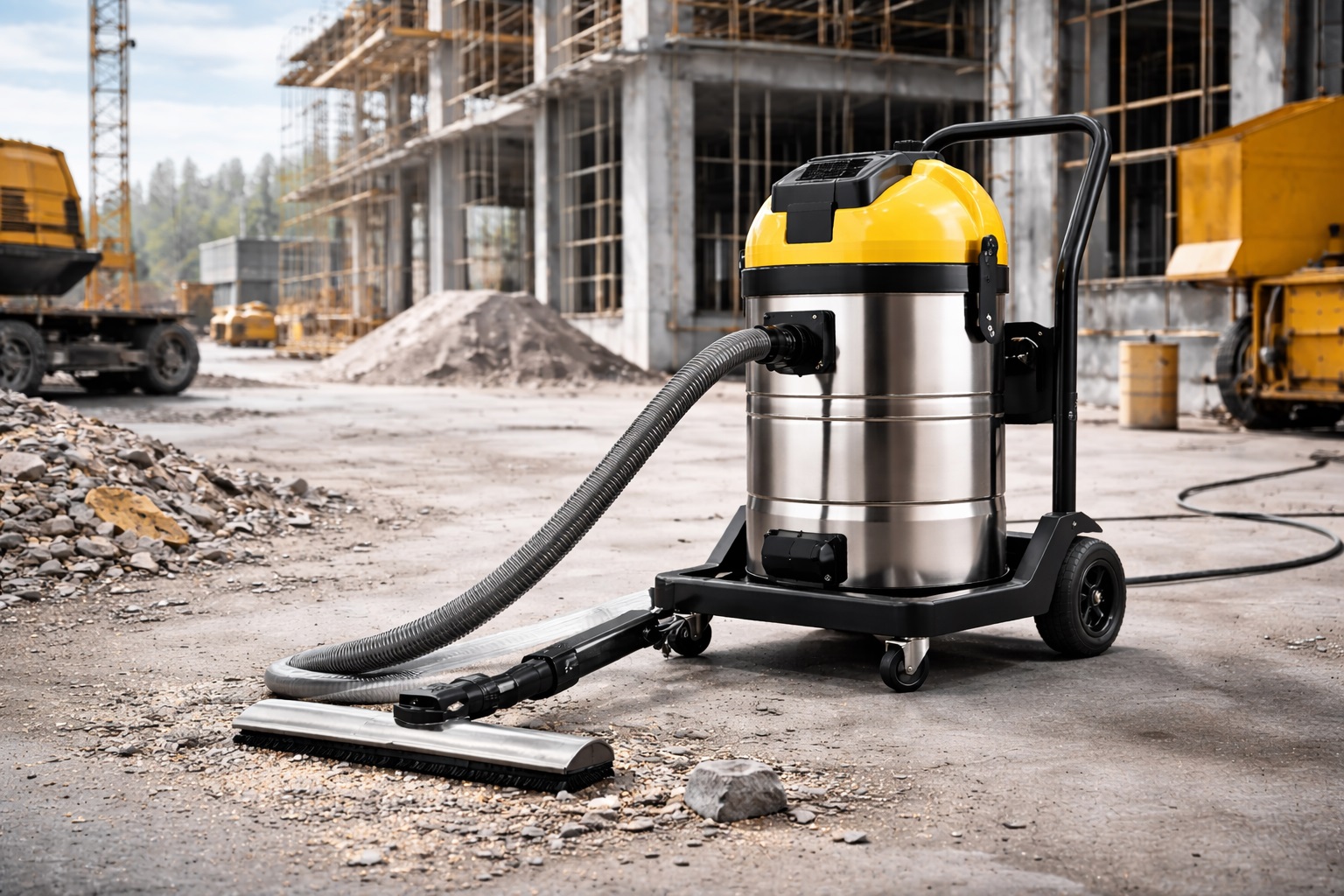
🏗️ The 3 jobsite “profit leaks” most crews don’t track
Cleanup micro-stoppages: constant sweeping, re-sweeping, and moving debris wastes more time than people admit.
Dust-driven rework: fine dust settles back onto fresh surfaces, paint, adhesive zones, and electrical cabinets.
Wrong vacuum mix: using a small household unit where an Industrial Vacuum Cleaner is required (or dragging a drum unit where a Cordless Vacuum Cleaner would be faster).
Construction sites are chaotic by default. The crews that win don’t “clean more”—they clean smarter, with predictable tools and repeatable routines. That’s where barrel vacuum cleaners (drum-style, high-capacity systems) earn their place: they let you recover large volumes of dust, debris, and liquids with fewer interruptions, fewer emptying cycles, and less mess.
This guide is written for EU & Middle East B2B vacuum cleaner procurement buyers serving construction contractors and site managers. Below are realistic application cases, plus deployment playbooks you can use to reduce labor minutes and speed up handovers.
I. 🧭 Where barrel vacuum cleaners fit on a construction site
Think in “roles,” not products:
Barrel vacuum cleaners: the backbone for bulk recovery, long hose runs, continuous duty
Cordless Vacuum Cleaner: the “instant-response” tool for quick touch-ups and tight spaces
Heavy Duty Wet Dry Vacuum Cleaner: the flood/spill/slurry specialist
Upright Vacuum Cleaners and Household Vacuum Cleaners: only for finished, clean zones (site office, completed residential rooms), not active dust-heavy work areas
Procurement takeaway: The fastest sites run a fleet mix. Barrel units reduce trips, cordless units reduce walking time, and wet/dry units prevent “spill downtime.”
II. 🧱 Case 1: Concrete drilling + chasing dust in active zones
Problem
Concrete drilling and chasing creates fine mineral dust that spreads quickly. Sweeping re-aerosolizes particles and forces repeated cleanup.
Barrel vacuum setup that works
A High Suction Vacuum Cleaner configuration (strong sealed suction for heavy dust and long hoses)
Staged filtration (pre-separation + main filter; optional high-efficiency stage depending on site policy)
Durable hose that won’t collapse under suction or kink around rebar and edges
Workflow that improves productivity
Vacuum-first around the drilling area before moving to the next task
Keep the barrel unit parked at the zone edge; run a long hose to the workface
Empty/replace liners at the end of the shift (not every hour)
Efficiency win
Fewer stoppages for sweeping
Less dust migration into adjacent trades (electricians, painters)
Faster “ready for next trade” handoff
You’ll feel the difference when your High Suction Vacuum Cleaner doesn’t lose pickup midway through the shift—because suction stability is what prevents repeated passes.
III. 🪚 Case 2: Drywall sanding and “never-ending” fine dust
Problem
Drywall dust is lightweight, airborne, and persistent. Without a disciplined vacuum plan, it settles onto freshly primed walls, window tracks, and hardware—creating rework.
Barrel vacuum setup that works
Barrel unit as the central collector for continuous sanding-zone dust
A secondary Cordless Vacuum Cleaner for “detail points” (edges, window sills, outlet boxes)
Tool kit with soft brush heads and crevice tools to avoid scratching finished surfaces
Workflow that improves productivity
Two-pass system:
Barrel vacuum cleaners: floors and bulk dust recovery
Cordless unit: corners, trims, and high-touch points
Keep Upright Vacuum Cleaners only for truly finished carpeted areas (post-handover or near-handover).
Avoid relying on Household Vacuum Cleaners in active sanding zones; they clog quickly and tend to leak fine dust back out.
Efficiency win
Fewer “wipe-down” cycles (which are slow and smear dust)
Faster painting readiness
Reduced callbacks for dusty finishes
IV. 💧 Case 3: Slurry, washdown, and surprise water incidents
Problem
Construction sites get wet: slab cutting slurry, equipment washdown, rain ingress, plumbing tests gone wrong. Wet messes stall crews and create slip hazards.
The correct choice
A Heavy Duty Wet Dry Vacuum Cleaner (in a barrel format if volume is high) is the right tool here—because it’s designed for high-volume liquid recovery and mixed debris.
Workflow that improves productivity
Contain the area (quick barriers or cones)
Use the wet tool/squeegee head to recover the bulk liquid fast
Follow with a quick dry pickup pass (only if the unit is configured for dry mode or you have a dedicated dry unit)
Efficiency win
Faster reopening of walkways and work zones
Less downtime waiting for “natural drying”
Reduced slip incidents and safety paperwork
If your site frequently deals with wet mess, a true Heavy Duty Wet Dry Vacuum Cleaner prevents the “buckets + mops + delay” routine that kills schedules.
V. 🧰 Case 4: Renovation turnover in occupied buildings
Problem
Renovations inside malls, hotels, hospitals, or occupied offices demand speed, low disruption, and clean handover conditions daily.
Barrel + cordless “quiet efficiency” combo
Barrel vacuum cleaners staged in a service corridor or protected corner
Cordless Vacuum Cleaner carried by the finisher for touch-ups
Separate accessory set for “public-facing” areas to avoid cross-contamination (dusty tools shouldn’t touch finished lobbies)
Workflow that improves productivity
Daily reset routine (20–30 minutes)
bulk debris recovery → edges/corners → entry mats/thresholds
Keep an Industrial Vacuum Cleaner standard for work zones; keep Upright Vacuum Cleaners for carpets in already-open public areas.
Efficiency win
Fewer complaints, fewer end-of-day surprises
Faster next-morning startup
Less “visibility risk” (dust tracks, debris trails)
VI. 🛠️ Case 5: Post-install cleaning for MEP and electrical areas
Problem
Cable trays, panels, and equipment rooms collect dust that becomes both a quality and safety issue. Compressed air blows it deeper; wiping is slow.
Barrel vacuum approach
Barrel vacuum cleaners parked outside the room
Long hose + crevice tool + brush tool for control
High Suction Vacuum Cleaner performance helps when pulling dust out from corners and tray edges
Workflow that improves productivity
Establish a “no-blow” rule in sensitive rooms
Vacuum from top-down: trays → surfaces → floors
Use a Cordless Vacuum Cleaner only for tight cabinet interiors and quick touch-ups
Efficiency win
Cleaner handover to commissioning teams
Less dust-related rework on labels, sensors, and enclosures
Faster inspection sign-offs
VII. ⚙️ The 8-spec purchase checklist contractors actually need
To keep this practical for procurement, here’s the shortlist that predicts whether a unit will help or hurt productivity:
🧩 1) Sustained suction over time
A High Suction Vacuum Cleaner isn’t just “strong at start.” You want stable pickup after hours of dust.
🧪 2) Filtration staging
Pre-separation reduces filter loading and keeps suction stable.
🪣 3) Real capacity (not brochure capacity)
If your crew empties constantly, you bought the wrong size.
💦 4) Wet readiness
If wet work is common, choose a Heavy Duty Wet Dry Vacuum Cleaner with practical recovery tools.
🧵 5) Hose durability
Hoses fail before motors on many sites.
🧼 6) Maintainability
Tool-less filter access and easy cleaning matter on jobsites.
🧲 7) Surface-safe tool kit
Brush/no-mark heads reduce scratch damage on finished floors.
🚚 8) Mobility
Casters, balance, and handle design determine whether crews actually use it.
This is what separates a true Industrial Vacuum Cleaner purchase from a “we’ll make it work” compromise.
VIII. 📌 The jobsite fleet strategy that speeds up handover
If you want the simplest, most scalable setup across multiple sites:
1–2 barrel vacuum cleaners per active floor/zone (bulk recovery)
2–6 Cordless Vacuum Cleaner units spread across trades (instant response)
1 Heavy Duty Wet Dry Vacuum Cleaner per site (or per floor if water incidents are frequent)
Upright Vacuum Cleaners for finished carpeted handover zones only
Household Vacuum Cleaners only if your policy allows and only for non-dusty, non-construction areas (site office, completed and sealed rooms)
Why this works: it reduces walking time, reduces tool contention (“who has the vacuum?”), and prevents the wrong vacuum being dragged into the wrong task.
Conclusion: the best construction sites treat cleaning as a schedule tool
Barrel vacuum cleaners earn their value when you deploy them as part of a system: bulk recovery + stable suction + fewer emptying cycles + predictable workflows. Combine them with a fast-response Cordless Vacuum Cleaner, reserve Upright Vacuum Cleaners for finished carpet zones, and use a dedicated Heavy Duty Wet Dry Vacuum Cleaner for water and slurry realities.
Do that consistently, and you’ll see the result in the only KPI that matters on sites: more work completed per day with fewer interruptions.
Hashtags
ConstructionSiteCleaning, BarrelVacuumCleaners, DrumVacuumCleaner, IndustrialVacuumCleaner, HighSuctionVacuumCleaner, CordlessVacuumCleaner, HeavyDutyWetDryVacuumCleaner, WetDryVacuumCleaners, JobsiteCleanupWorkflow, TurnoverCleaning, RenovationCleanup, ConcreteDustControl, DrillingDustRecovery, DrywallSandingDust, FineDustManagement, SilicaDustControl, DebrisContainment, BulkDustRecovery, LongHoseVacuuming, PreSeparatorCyclone, FilterStagingDesign, CartridgeFilterSystem, DustMigrationPrevention, MicroStopReduction, ProductivityOnSite, HandoverReadiness, TradeCoordination, ZoneBasedCleaning, PointOfUseCleaning, SiteOfficeCleaning, UprightVacuumCleaners, HouseholdVacuumCleaners, FinishedCarpetCleaning, EdgeAndCornerCleaning, CreviceToolKit, NoMarkBrushHead, EpoxyFloorCleanup, StairwellCleaning, CorridorProtection, WaterIngressRecovery, SlurryCleanup, ConcreteCuttingSlurry, SpillResponseOnSite, SlipHazardReduction, MEPRoomCleaning, ElectricalPanelDust, CommissioningPrep, MaintenanceChecklist, TCOForContractors, EUConstructionSupply, MENAConstructionSupply, Lanxstar



