Hi, message us with any questions.
We're happy to help!





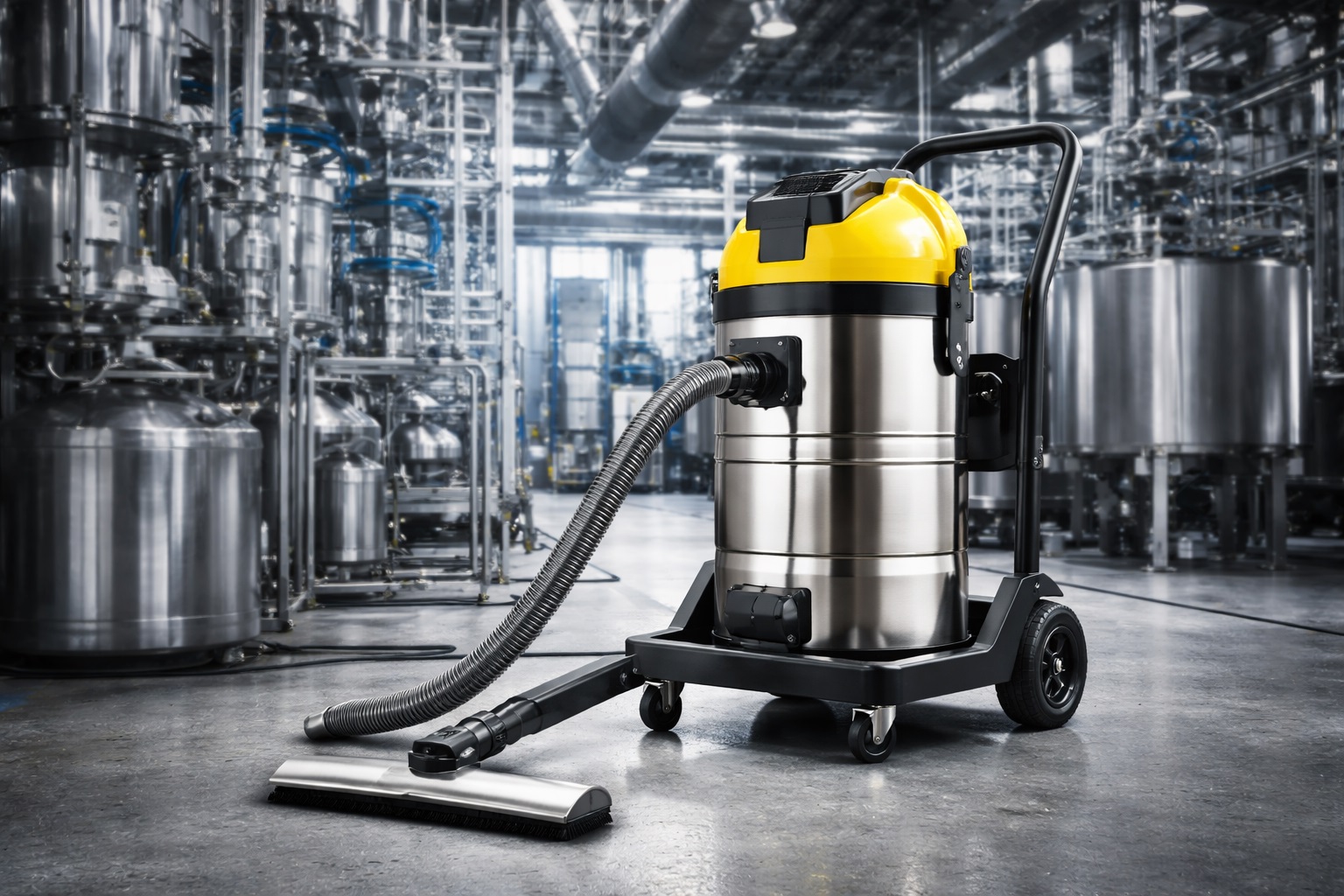
🚫 The 3 most expensive “cleaning mistakes” chemical plants keep repeating
Buying “industrial” on label, not on workflow → suction collapses, filters clog, operators improvise.
Using one wet/dry unit for everything → powders turn to paste, downtime spikes, exposure risk rises.
Ignoring contamination control → cross-batch residue, rework, rejected product, and audit pain.
Chemical plants don’t “clean” the way other industries clean. You’re managing hazardous powders, corrosive residues, solvent splashes, and compliance-driven waste handling—often inside tight production windows where downtime costs more than the equipment itself.
That’s why barrel vacuum cleaners (also called drum vacuums) have become a go-to format for chemical sites: they combine high-capacity recovery with contained transfer and rugged build options (stainless steel, anti-static kits, staged filtration) that traditional machines simply can’t match.
This guide is written for EU & Middle East B2B procurement buyers sourcing an Industrial Vacuum Cleaner solution for chemical facilities—people who need practical specs, buying criteria, and deployment playbooks that reduce risk, labor, and total cost of ownership.
I. 🧠 Why barrel vacuum cleaners win in chemical plants (and when they don’t)
A barrel vacuum is not “just a bigger tank.” In chemical operations, the format matters because it supports:
High-volume recovery (powder + debris + granules or liquid spills) without constant emptying
Safer handling through closed-lid designs, liners, and controlled disposal workflows
Better contamination control when paired with staged filtration (pre-filter + main filter + HEPA)
Process-adjacent cleaning where residues need to be collected, labeled, and moved as waste
Where barrel vacuum cleaners don’t belong:
Offices, admin zones, and light daily housekeeping: Upright Vacuum Cleaners are faster for carpets and corridors, and Household Vacuum Cleaners can be acceptable for non-process areas if your site policy allows. But they are not designed for chemical process residues.
Tiny maintenance tasks: a compact unit may be more ergonomic than a full drum system.
Procurement takeaway: In chemical plants, buy barrel vacuum cleaners for process zones, and keep Upright Vacuum Cleaners / Household Vacuum Cleaners strictly for clean, non-process spaces to avoid accidental cross-use.
II. ⚠️ The real chemical-industry hazards your vacuum must solve
Most vacuum failures in chemical sites are not “motor problems.” They’re spec mismatches that show up as clogging, leaks, and unsafe handling.
1) Fine powder hazards
Fine powders create:
Filter loading and suction drop
Airborne exposure risk during cleanup
Cross-contamination between batches/products
Your solution is not just “more power.” It’s airflow + filtration architecture + dust handling method—the core reason barrel vacuum cleaners dominate process cleaning.
2) Liquids + wet residues
Chemical plants deal with:
Water-based liquids, oils, solvents, neutralization residues
Sticky sludge that destroys standard filters and float systems
This is where Wet Dry Vacuum Cleaners in a barrel format shine—if the internals, sensors, and seals match your chemicals. A generic wet/dry unit can become a maintenance nightmare if you vacuum mixed residues without the correct separation steps.
3) Static electricity & ignition risk
Many facilities require anti-static / conductive accessories, grounding, and potentially certified explosion protection depending on zone classification and site rules.
Procurement takeaway: “Industrial Vacuum Cleaner” is too broad. Chemical sites need a risk-aligned barrel vacuum cleaners configuration—including accessories and disposal workflow.
III. 🧩 The 7-spec barrel vacuum checklist buyers should actually use
Ignore marketing labels. Use this checklist to build a purchase spec that survives real production conditions.
1) Performance spec: airflow vs. sealed suction
You want both, but they behave differently:
Airflow (CFM / m³/h) drives pickup of light powders and debris
Sealed suction (water lift / kPa) drives pickup of heavy granules, wet sludge, long hoses
If your use case involves long hose runs, overhead pickups, or dense powders, prioritize a High Suction Vacuum Cleaner design (strong static pressure). In real plants, a High Suction Vacuum Cleaner is often what turns a “slow cleanup” into a predictable SOP.
Field rule: If operators keep “pulsing” the hose to keep pickup going, suction is likely insufficient or filtration is wrong.
2) Filtration staging (this is where most buyers miss)
For chemicals, staged filtration is the difference between stable suction and constant downtime.
A practical stack:
Cyclonic / baffle or drop-out pre-separation (reduces main filter loading)
Primary cartridge or star filter sized for continuous duty
Optional HEPA final stage where exposure control matters
If your plant has sensitive adjacent spaces (labs, QA offices, packaging), HEPA support also aligns with Vacuum Cleaner for Allergies requirements—though in chemical sites the goal is typically exposure control and containment, not comfort. Still, spec sheets that claim “allergy friendly” without a real HEPA stage are a red flag. A true Vacuum Cleaner for Allergies claim should translate to sealed airflow + verified high-efficiency filtration.
3) Container and contact materials
Match the barrel to the chemistry:
Stainless steel (304/316) for corrosion resistance and easy wipe-down
Chemical-resistant seals (e.g., EPDM, Viton depending on solvents/acids)
Smooth internal surfaces for decontamination
4) Waste handling workflow
Ask: How is waste removed, labeled, and disposed?
Options that reduce mess:
Liners (bag-in/bag-out style)
Quick-release drum clamps
Dedicated waste drums for specific chemistries
5) Anti-static package
At minimum for powder-rich environments:
Conductive hose
Grounding chain or grounding point
Conductive casters/wheels
Verified continuity path from nozzle to drum
6) Mobility and ergonomics
Chemical plants punish equipment that’s hard to maneuver:
Stable wheelbase and steering casters
Hose length that matches reality (not a brochure demo)
Handle design that works with gloves and PPE
7) Maintainability and spares
Procurement should insist on:
Filter change time targets (e.g., under 5 minutes)
Standardized accessories across barrel vacuum cleaners fleets
Locally available consumables and gaskets
IV. 🧪 Wet + dry in one plant: how to avoid “one-vacuum-to-rule-them-all” mistakes
Many buyers try to standardize on a single Wet Dry Vacuum Cleaners platform. That’s fine only if you plan two modes and enforce them.
Mode A: Dry powder collection (high filtration discipline)
Run dry collection with dry filters only
Use pre-separation to prevent “filter cementing”
Avoid vacuuming wet residue in this mode—it turns powder into paste inside the filter housing
Mode B: Wet recovery (liquid-first configuration)
Use liquid-appropriate separators and floats/sensors
Remove or isolate dry filters during wet recovery if the design allows
Rinse/neutralize per EHS needs
Best-practice procurement: Specify either
two dedicated barrel vacuum cleaners (dry-only + wet-only), or
a Wet Dry Vacuum Cleaners system with safe, fast conversion kits and clear SOPs.
This decision often cuts cleanup downtime dramatically because operators stop fighting clogging and messy changeovers.
V. 🧯 Cross-contamination control: the missing link in most vacuum bids
In chemicals, the vacuum is part of your quality system, not just maintenance.
A practical 4-layer contamination strategy
Dedicated units by risk:
One vacuum per zone/product family when contamination cost is highColor-coded accessories:
Hoses/nozzles assigned to specific areasChangeover validation:
Quick swab/wipe protocol at nozzle + hose inletWaste traceability:
Drum labeling aligned with waste stream requirements
Procurement hack: Add a bid requirement: “Supplier must support a contamination-control kit (color accessories + recommended validation routine).”
This separates commodity sellers from process-capable partners fast.
Also: keep Upright Vacuum Cleaners and Household Vacuum Cleaners out of process areas—those categories are rarely designed for closed containment, chemical compatibility, or traceable waste handling.
VI. 💰 The TCO model: how to justify barrel vacuum cleaners beyond purchase price
If you’re presenting internally, stop arguing about unit price and show Total Cost of Ownership.
TCO = Labor + Downtime + Consumables + Risk
Labor: time to set up, move, empty, and change filters
Downtime: production pauses during cleanup (often the biggest hidden cost)
Consumables: filters, liners, gaskets, hoses
Risk: incident probability, exposure events, rework due to contamination
A simple ROI worksheet (copy/paste)
Current cleanup time per incident: ___ minutes
Incidents per week: ___
Loaded labor cost/hour: ___
Production downtime cost/hour: ___
Expected time reduction with correct system: ___%
Expected filter life extension with staged filtration: ___%
A better Industrial Vacuum Cleaner configuration—especially staged filtration plus the right High Suction Vacuum Cleaner performance—often pays for itself via lower downtime and fewer “failed cleanups.”
VII. 🛒 Procurement scoring: a buyer’s comparison matrix (screenshot-friendly)
Use the following 10-point scorecard (rate each 1–5). This is designed to be easy to share internally and with distributors.
✅ 10-point procurement scorecard
Application fit: powders / liquids / mixed residues clearly addressed
Performance clarity: airflow + sealed suction published and realistic
Filtration staging: pre-separation + primary + optional HEPA available
Containment & waste handling: liners, drum clamp, traceability workflow
Chemical compatibility: drum material + seal material specified
Anti-static readiness: conductive accessories + grounding path explained
Wet/dry discipline: conversion kit or dedicated units recommended
Ease of maintenance: filter change time, tool-less access, wash-down options
Spare parts & service: local availability, lead time, training
Operator usability: stability, maneuverability, PPE-friendly handling
Interpretation:
40–50: strong chemical-grade system
30–39: acceptable with SOP controls (watch filtration/compatibility)
<30: likely downtime + safety + performance issues
Red flag: If a seller positions a Household Vacuum Cleaners unit as a “budget industrial option,” or claims Upright Vacuum Cleaners can replace barrel vacuum cleaners in process zones, they’re not aligned with chemical-plant risk and waste workflows.
VIII. ❓ FAQ (buyer questions that show up in RFQs and audits)
1) How do I reduce filter clogging when vacuuming fine chemical powders?
Use staged filtration and pre-separation. A drop-out chamber or cyclone reduces what hits the primary filter. Pair that with a properly sized cartridge/star filter and consider a HEPA final stage where exposure control is critical. Most “clogging problems” are actually spec problems, not operator problems.
2) Can one unit handle both powders and liquids safely?
Yes, but only with strict mode discipline. Many Wet Dry Vacuum Cleaners fail in chemical sites because wet residue is vacuumed immediately after powders, creating paste that blocks filters and contaminates housings. The safest approach is two dedicated barrel vacuum cleaners (dry-only + wet-only) or a true conversion kit with SOP enforcement.
3) What performance matters more—airflow or suction?
Both matter, but powders and long hoses typically need stronger sealed suction. If you’re cleaning in tight spaces, long distances, or lifting dense materials, you’ll want a High Suction Vacuum Cleaner configuration. For light dust pickup over wide areas, airflow is often the limiter.
4) What does “allergy vacuum” mean in industrial procurement?
In consumer language, Vacuum Cleaner for Allergies usually means HEPA filtration and sealed leakage control. In chemical plants, the same principles apply—sealed airflow and high-efficiency filtration—but the driver is exposure control and contamination prevention, not comfort.
5) Are upright or household vacuums ever useful in chemical facilities?
Yes—in clean zones. Upright Vacuum Cleaners work well in offices, corridors, carpets, and showrooms. Household Vacuum Cleaners may be used in strictly non-process areas if approved by site policy. They should not be your process cleaning tool or your waste-handling system.
6) What makes an Industrial Vacuum Cleaner “chemical-grade”?
It’s not just horsepower. Chemical-grade means: compatible materials, safe containment and disposal workflow, filtration staging, anti-static readiness where required, maintainability, and supplier documentation support. Barrel vacuum cleaners are popular because they naturally support traceable, contained waste handling.
Conclusion: the chemical-plant “cleaning solution” is a system
High-efficiency cleaning in chemical environments isn’t achieved by buying the strongest motor. It’s achieved by pairing the right barrel vacuum cleaners platform with the right filtration staging, wet/dry workflow, anti-static strategy, and contamination controls—then turning it into an SOP your operators can execute consistently.
If you buy on specs alone, you’ll get a machine.
If you buy on workflow, you’ll get a repeatable cleaning outcome: safer, faster, and cheaper over time—exactly what an EU/MENA Industrial Vacuum Cleaner procurement decision should deliver.
Hashtags
IndustrialVacuumCleaner, BarrelVacuumCleaners, DrumVacuumSystem, WetDryVacuumCleaners, HighSuctionVacuumCleaner, VacuumCleanerForAllergies, UprightVacuumCleaners, HouseholdVacuumCleaners, ChemicalIndustryCleaning, ChemicalPlantCleaning, PowderSpillCleanup, FinePowderCollection, SolventSpillRecovery, LiquidRecoverySystem, SludgePickup, HEPAFiltrationSystem, HEPAFinalStage, DustExposureControl, ContainmentCleaning, AntiStaticVacuum, ConductiveVacuumHose, GroundingContinuity, ConductiveCasters, StainlessSteelVacuum, SS304Vacuum, SS316Vacuum, CorrosionResistantEquipment, ChemicalCompatibleSeals, EPDMSeals, VitonSeals, FilterStagingDesign, PreSeparatorCyclone, DropOutChamber, CartridgeFilterSystem, StarFilter, BagInBagOut, DrumLinerSystem, WasteDrumHandling, HazardousWasteLabeling, BatchChangeoverCleaning, CrossContaminationControl, ColorCodedAccessories, CleaningSOP, ProcurementChecklist, TCOModel, DowntimeReduction, PlantMaintenance, EHSCompliance, DistributorReady, MENAIndustrialSupply, EUIndustrialProcurement, Lanxstar



