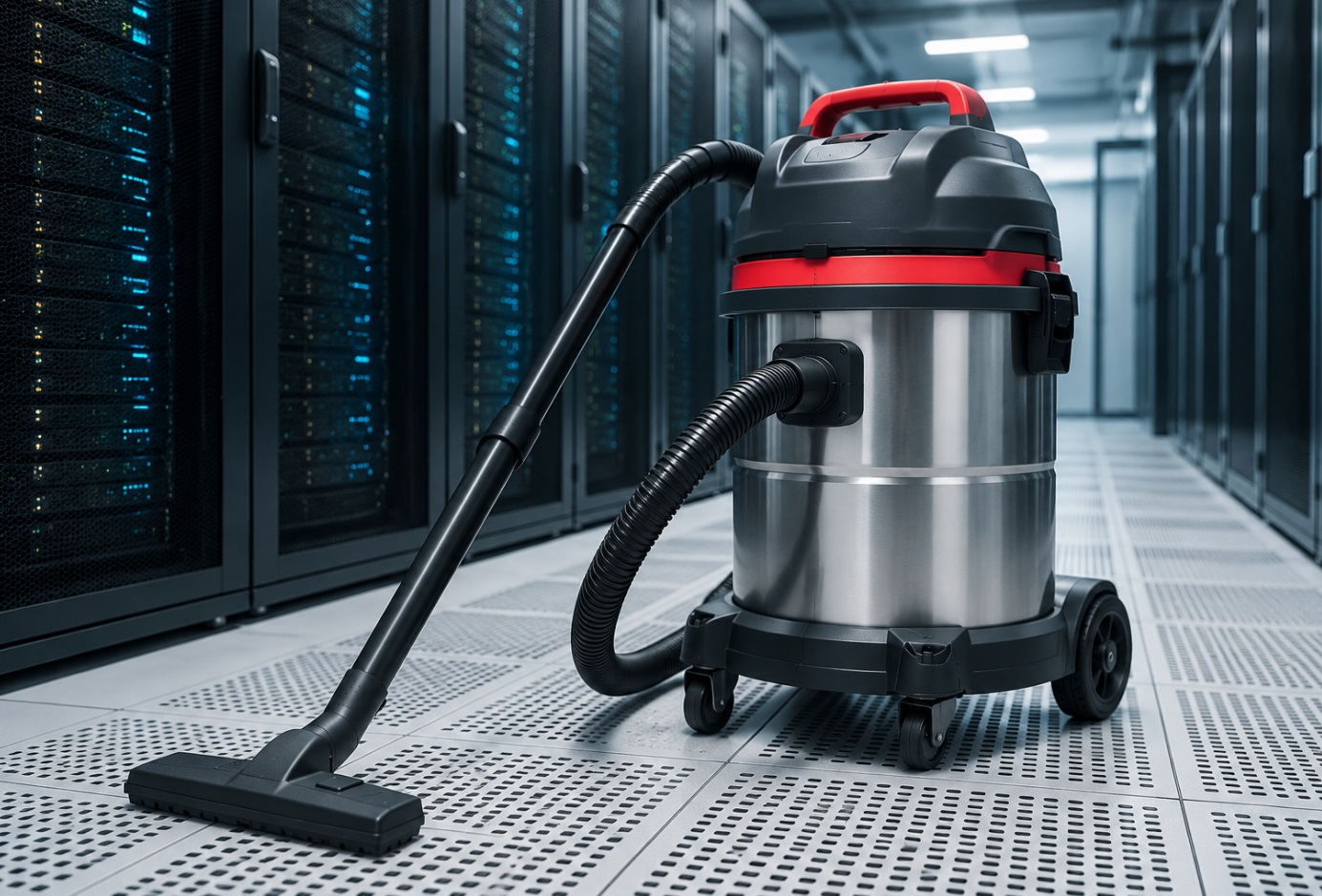
As AI workloads scale rapidly, AI data center maintenance has become one of the most critical operational disciplines in modern infrastructure. Unlike traditional server environments, AI clusters generate significantly higher heat density, airflow pressure demand, and continuous load stress.
In this environment, cleaning is no longer a support function—it is a performance stabilization system directly linked to uptime, GPU efficiency, and cooling reliability.
This guide explains how professional operators use data center cleaning equipment, industrial vacuum solutions, and engineered dust control methods to maintain stable AI infrastructure performance.
🧠 1. Why AI Data Centers Require a Different Cleaning Standard
AI data centers are fundamentally different from conventional IT facilities due to:
High-density GPU clusters
Continuous 24/7 compute workloads
Extreme heat output per rack
High airflow dependency for thermal stability
❌ Why traditional cleaning fails:
Cannot handle continuous dust generation from airflow systems
Misses micro-particle accumulation in GPU heat sinks
Does not align with cooling system pressure zones
👉 In AI environments, even minor dust buildup can reduce compute efficiency.
🌬️ 2. Cooling System Maintenance Is the Core of AI Data Center Stability
In AI infrastructure, cooling system maintenance is not optional—it is the primary performance control layer.
Key cooling stress factors:
GPU heat spikes under training workloads
High rack power density (10–50kW per rack)
Continuous airflow turbulence
Dust accumulation on heat exchangers
💡 Engineering insight:
Cooling efficiency directly determines GPU performance stability. If airflow is reduced, compute throttling begins immediately.
🧰 3. Data Center Cleaning Equipment: What AI Facilities Actually Use
Standard cleaning tools are insufficient for AI environments. Professional operators rely on specialized data center cleaning equipment designed for sensitive electronics and airflow systems.
✔ Core equipment includes:
HEPA H13/H14 anti-static vacuum systems
ESD-safe micro-cleaning tools
Low-turbulence airflow extraction systems
Precision brush + containment cleaning kits
High-efficiency particulate capture units
🧠 Key requirement:
All equipment must prevent particle re-dispersion during cleaning operations.
🖥️ 4. Server Facility Cleaning in High-Density AI Clusters
In AI clusters, server facility cleaning must be executed with zoned precision.
✔ Cleaning zones include:
GPU server racks
High-pressure intake airflow zones
Cable routing and floor channels
Cooling unit intakes and exhaust paths
❌ Common mistake:
Cleaning entire rooms uniformly instead of targeting high-dust accumulation zones.
✔ Professional approach:
Zone-based cleaning schedules
Airflow-aware maintenance planning
Rack-by-rack cleaning cycles
🌪️ 5. Industrial Vacuum Solution: Why Airflow Engineering Matters More Than Suction Power
A professional industrial vacuum solution is not defined by suction strength—it is defined by airflow control stability.
✔ Key engineering features:
Multi-stage HEPA filtration
Cyclone pre-separation for fine dust
Stable airflow under continuous load
Sealed containment architecture
💡 Critical insight:
In AI environments, suction instability leads to dust redistribution—which increases contamination risk.
🧱 6. Dust Control Methods for AI Data Centers
Effective dust control methods are based on prevention rather than removal.
✔ Engineering-based strategies:
1. Positive pressure airflow design
Prevents external dust from entering server halls.
2. HEPA filtration at air intake points
Captures micro-particles before they enter circulation.
3. Zoned airflow segmentation
Separates high-heat GPU zones from low-load areas.
4. Anti-static infrastructure materials
Reduces particle adhesion on equipment surfaces.
💡 Key insight:
Dust control is an airflow design problem, not a cleaning frequency problem.
📊 7. Impact of Poor Cleaning on AI Performance
Dust accumulation in AI environments leads to measurable performance degradation:
❌ Operational effects:
GPU thermal throttling under load
Reduced inference speed consistency
Increased cooling energy consumption
Higher fan failure rates
✔ Long-term consequences:
⚙️ 8. AI Data Center Maintenance as a Performance Optimization System
Modern AI data center maintenance is evolving from reactive cleaning into predictive infrastructure management.
✔ Advanced practices include:
Sensor-based dust monitoring
Predictive maintenance scheduling
Thermal mapping of server racks
AI-driven airflow optimization
🧠 Industry shift:
Maintenance is no longer about cleaning—it is about sustaining computational efficiency.
🏁 Conclusion: Cleanliness Is Compute Performance in AI Infrastructure
In AI environments, cleaning is directly tied to computational output. Without proper data center cleaning equipment, structured server facility cleaning, and engineered dust control methods, performance degradation becomes unavoidable.
Modern operators now treat AI data center maintenance as a core performance layer, equal in importance to compute hardware and networking systems.
In AI infrastructure, dust is not contamination—it is lost computation power.
📌 Hashtags
aidatacentermaintenance, datacentercleaning, serverfacilitycleaning, coolingmaintenance, coolingefficiency, industrialvacuumsolution, dustcontrolmethods, datacentercleaningequipment, gpucluster, aiinfrastructure, highdensitycomputing, serverroomcleaning, datacenteroperations, itfacilitycleaning, airflowengineering, thermalmanagement, datacenterinfrastructure, hepa filtration, esdsafe cleaning, precisioncleaning, industrialcleaning, datacentercooling, gpu cooling, ai workload, machinelearninginfra, deeplearningcluster, cloudinfrastructure, hyperscaledatacenter, edgecomputing, datacenterdesign, uptimeoptimization, missioncriticalsystems, hardwarereliability, fanperformance, heatdissipation, contaminationcontrol, airflowmanagement, predictive maintenance, ai monitoring, datacenterautomation, cleaningautomation, industrialmaintenance, infrastructurecleaning, buildingmaintenance, engineeringprocurement, b2binfrastructure, systemreliability, datacentersecurity, vacuumtechnology, Lanxstar