Hi, message us with any questions.
We're happy to help!





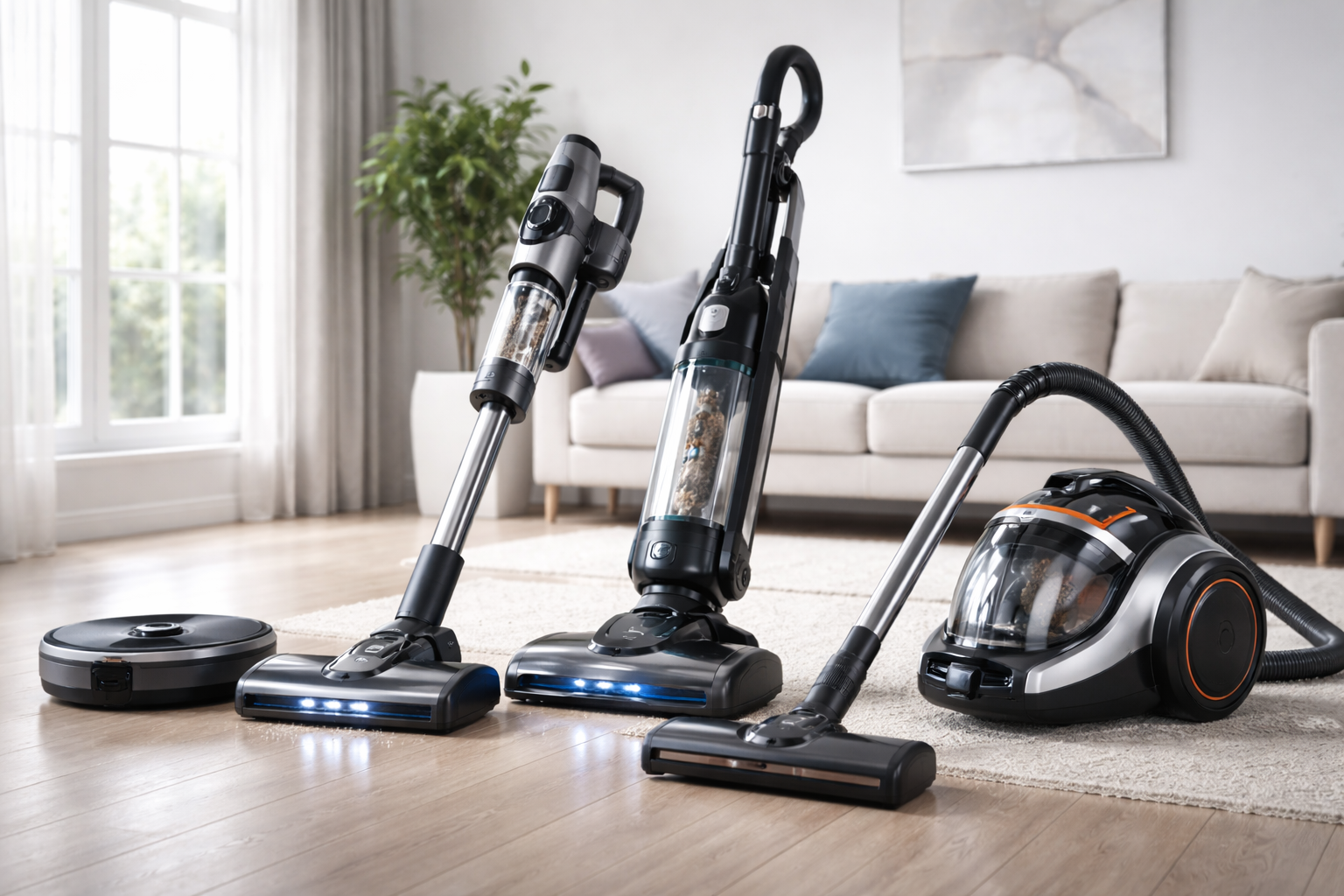
As the global cleaning industry continues to expand, success in 2026 will no longer be defined by sales volume alone. For buyers, distributors, and brands, the critical question is which types of vacuum cleaners generate the most reliable and sustainable return on investment (ROI).
Different vacuum cleaner categories now show clear differences in demand stability, pricing power, maintenance cost, and lifecycle value. Understanding these differences is essential for smart product and sourcing strategies.
1. Why ROI Has Become the Core Metric in 2026
The market is becoming more rational.
As competition intensifies, low-price volume strategies are increasingly risky. Inventory pressure, warranty costs, and price wars are eroding margins across many regions.
From a vacuums procurement perspective, ROI is now the key benchmark guiding product selection.
2. High Suction Vacuum Cleaners: The Stable ROI Foundation
High Suction Vacuum Cleaner models remain the backbone of the global market.
Across residential, commercial, and light industrial environments, strong suction is still the most basic and non-negotiable requirement. Demand for these products is broad and consistent.
Key characteristics:
Stable long-term demand
Mature technology with low failure rates
Suitable for large-scale distribution
ROI profile: Medium-to-high, stable returns
3. Energy-Efficient Vacuum Cleaners: ROI on a Strong Upward Curve
Energy-Saving Efficient Powerful Vacuum Cleaner products are gaining momentum rapidly.
Rising energy costs and stricter regulations are driving demand for energy-efficient designs, especially in Europe and North America. These products often qualify for institutional and B2B procurement.
Key advantages:
Lower operating cost for end users
Strong regulatory alignment
Higher lifecycle value
ROI profile: High, long-term returns
4. Wet and Dry Vacuum Cleaners: Multi-Scenario ROI Growth
Wet Dry Vacuum Cleaners are among the strongest ROI performers heading into 2026.
Their ability to handle dry debris and liquid spills makes them suitable for homes, garages, workshops, warehouses, and commercial spaces. A Large-Capacity Wet Dry Vacuum Cleaner further increases efficiency in professional environments.
ROI profile: High, multi-scenario returns
5. Cordless Vacuum Cleaners: High Turnover with Competitive Pressure
Cordless Vacuum Cleaner models and cordless handheld vacuums remain one of the fastest-growing segments.
They offer strong user experience and high replacement frequency, but competition is intense. Differentiation and branding are critical for maintaining margins.
ROI profile: Medium-to-high, brand-dependent
6. Handheld and Portable Vacuums: Small Size, Fast Cash Flow
Li-ion Cordless Handheld Vacuum Cleaner and Car Vacuum Cleaner products perform well in niche but expanding segments.
Advantages include:
Lower unit price
Ideal for bundle sales
Strong growth in automotive and travel use
ROI comes from volume and fast turnover.
ROI profile: Medium, cash-flow friendly
7. Quiet Vacuum Cleaners: Urbanization-Driven ROI
Demand for quiet vacuum cleaner and Quiet Vacuum for Night Use models is rising with global urbanization.
These products are especially attractive for apartments, hotels, offices, and healthcare facilities, where low noise enables premium positioning.
ROI profile: Medium-to-high, premium-driven
8. Multi-Functional Durable Vacuum Cleaners: Core B2B ROI Engine
Multi-Functional Durable Vacuum Cleaner products are the profit backbone of B2B and commercial channels.
Their long service life, stable performance, and low return rates make them ideal for long-term customer relationships within vacuum cleaner distribution networks.
ROI profile: Very high, long-term stability
9. Budget Vacuum Cleaners: Volume-Driven ROI
Search-driven demand such as:
best vacuum on a budget
best affordable vacuum
good budget vacuum cleaner
continues to generate large volumes.
However, ROI depends heavily on supply chain efficiency, cost control, and after-sales management.
ROI profile: Medium, scale-dependent
10. HEPA Filter Vacuum Cleaners: Health-Driven ROI Growth
HEPA Filter Vacuum Cleaner demand is expanding due to allergy awareness, pet ownership, and health-conscious consumers.
In Europe and North America, HEPA filtration is becoming a standard expectation rather than a premium feature.
ROI profile: Medium-to-high, trend-driven
11. Highest ROI Product Combinations for 2026
The strongest ROI opportunities are increasingly found in combinations, not single features:
Energy-efficient + high suction
Wet and dry + large capacity
Durable design + commercial applications
Cordless + portable niche segments
Multi-value products outperform single-purpose designs.
12. Manufacturer Capability and ROI Stability
ROI is influenced not only by product type, but also by manufacturing strength.
Manufacturers such as Lanxstar, with stable quality, complete product lines, and OEM/ODM flexibility, enable distributors to manage long-term ROI more effectively.
Supply stability supports financial predictability.
Conclusion
Looking ahead to 2026, the vacuum cleaner market will continue to grow—but the best opportunities will belong to those who understand ROI structure, not just demand volume.
Energy-efficient, wet and dry, durable, and health-oriented vacuum cleaners represent the most attractive investment categories. For global buyers, distributors, and brands, now is the time to realign product portfolios around sustainable returns.
To explore vacuum cleaner solutions optimized for long-term ROI, visit
www.lxvacuum.com
Target Readers at the End
Global vacuum cleaner procurement managers
International distributors and wholesalers
Brand owners and channel managers
Vacuum cleaner product planners and R&D engineers
OEM / ODM sourcing and supply chain teams
50 Related Keyword Groups
Lanxstar vacuum cleaner, 2026 vacuum cleaner forecast, cleaning appliance ROI, High Suction Vacuum Cleaner, Portable Quiet Vacuum Cleaner, Self-Cleaning Vacuum Cleaner, Multi-Functional Durable Vacuum Cleaner, Fast Lightweight Vacuum Cleaner, Energy-Saving Efficient Powerful Vacuum Cleaner, Large-Capacity Wet Dry Vacuum Cleaner, Wet Dry Vacuum Cleaners, Wet and Dry Vacuum Cleaner, Li-ion Cordless Handheld Vacuum Cleaner, cordless handheld vacuums, Cordless Vacuum Cleaner, Car Vacuum Cleaner, quiet vacuum cleaner, Quiet Vacuum for Night Use, Portable Vacuum for Travel, HEPA Filter Vacuum Cleaner, Apartment Vacuum Cleaner, Vacuum Cleaner for Pet Hair, Vacuum Cleaner for Hardwood Floors, best vacuum on a budget, best budget hoover, good budget vacuum, best affordable vacuum, best budget vacuum, best value for money hoover, best value hoover, best vacuum cleaners on a budget, best vacuums on a budget, good budget vacuum cleaner, vacuums procurement, vacuum cleaner distribution